Top 10 Songs of 1997 (Billboard Hot 100 Year-End Countdown)
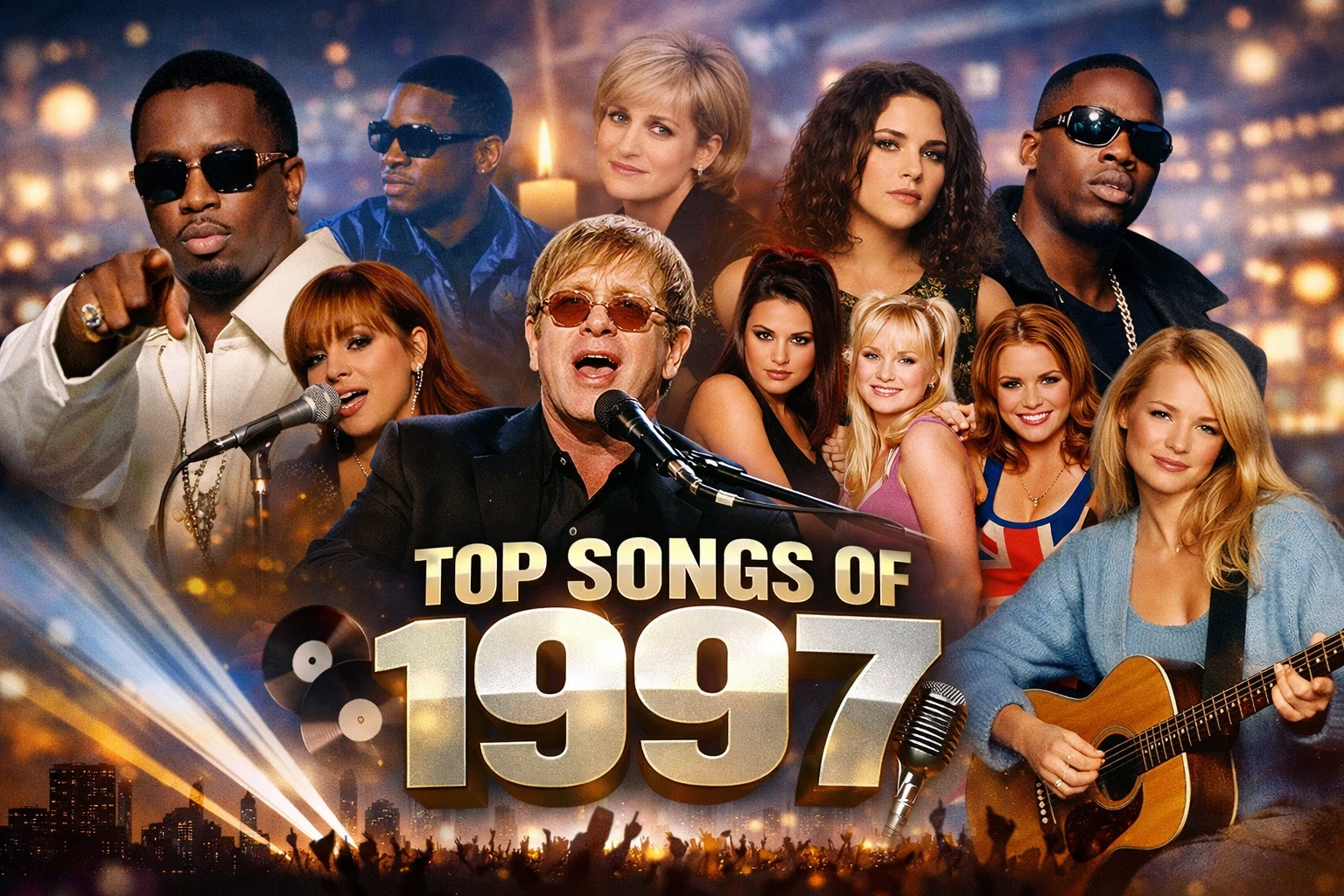
If 1997 had a smell, it was warm CD jewel cases, mall cologne clouds, movie-theater carpeting, and the inside of a car where somebody kept slapping the radio button because every station somehow sounded huge. This was a year of emotional whiplash. Grief ballads broke records. Puff Daddy took over the culture. The Spice Girls crash-landed in America with all the subtlety of a glitter grenade. Adult-pop heartbreak still had real commercial muscle. And radio somehow carried all of it without collapsing.
This countdown ranks the Top 10 Songs of 1997 using Billboard’s Hot 100 Year-End chart. These weren’t just songs people heard. These were the tracks that lived in shopping malls, school dances, family cars, bedroom stereos, weddings, cookouts, roller rinks, and every public place where late-90s pop was allowed to get all over the furniture.
Top 10 Songs of 1997 (Billboard Year-End Hot 100) — Quick List
- #10 “Wannabe” — Spice Girls
- #9 “How Do I Live” — LeAnn Rimes
- #8 “Return of the Mack” — Mark Morrison
- #7 “Don’t Let Go (Love)” — En Vogue
- #6 “I Believe I Can Fly” — R. Kelly
- #5 “Can’t Nobody Hold Me Down” — Puff Daddy featuring Mase
- #4 “Un-Break My Heart” — Toni Braxton
- #3 “I’ll Be Missing You” — Puff Daddy & Faith Evans featuring 112
- #2 “You Were Meant for Me” / “Foolish Games” — Jewel
- #1 “Candle in the Wind 1997” / “Something About the Way You Look Tonight” — Elton John
#10 — “Wannabe” — Spice Girls
Why it hit
“Wannabe” didn’t sound like American radio polish. It sounded like chaos with a hook. That’s exactly why it exploded. The song is fast, bratty, loud, and full of clashing personalities, but beneath all that attitude is an absurdly efficient pop machine. The chorus lands immediately, the verses feel like a group conversation happening at top speed, and the whole thing moves like it knows standing still would kill it.
Its real power was attitude. Plenty of catchy songs fade because they have no personality beyond the hook. “Wannabe” had too much personality to ever be background music. The voices collide, the energy keeps shifting, and the whole record feels like a dare. It was fun, bratty, and weirdly liberating. More importantly, it gave “girl power” a chorus people could actually yell.
Why it mattered in 1997
By the time “Wannabe” crossed fully into the U.S., the song felt like a pop event, not just a single. It shifted the energy of Top 40 in a hurry. 1997 had plenty of glossy male-driven swagger and adult heartbreak on the chart, but the Spice Girls came in with something brighter, funnier, and more communal. They made pop feel less controlled and a lot more physical.
Gen X Rewind
This is the sound of America realizing British pop had just shown up wearing platform sneakers and absolutely no indoor voice.
Legacy
“Wannabe” remains one of the defining pop introductions of the decade—part anthem, part marketing miracle, part sugar rush, and still impossible to hear passively.
#9 — “How Do I Live” — LeAnn Rimes
Why it hit
Some songs do not need a No. 1 peak to dominate a year. They just outlast everything around them. That is the story of “How Do I Live.” The record’s power was never about shock value or a huge moment of novelty. It was about persistence. The melody stuck, the emotion was broad enough for anyone to pour themselves into it, and radio kept finding space for it.
It also hit a very useful late-90s sweet spot: dramatic enough for pop audiences, polished enough for adult contemporary, and rooted enough in country-pop feeling to reach listeners outside the usual Top 40 lanes. The result was a song that seemed to just keep existing everywhere. Not loudly. Constantly.
Why it mattered in 1997
The song proved again that the late 90s still had enormous room for country-pop crossover, especially when the production was clean enough and the emotion universal enough to move beyond genre lines. It also helped define 1997 as a year where radio embraced long-haul emotional songs, not just instant-sugar hits.
Gen X Rewind
This is the song that made “long chart run” feel less like a statistic and more like a haunting. It was just always there.
Legacy
It remains one of the great Hot 100 endurance stories and one of the most durable romantic ballads of the late 1990s.
#8 — “Return of the Mack” — Mark Morrison
Why it hit
Some records survive because they are beautifully written. Others survive because they walk into the room like they own it. “Return of the Mack” is firmly in the second category. The beat has swagger built into it, the vocal sells wounded pride like a luxury product, and the hook lands with the kind of confidence that makes you believe every word even if the singer sounds a little too pleased with himself.
That self-mythologizing is part of the appeal. The song is not humble, introspective, or apologetic. It is a victory speech disguised as a comeback single. In 1997, that kind of stylish arrogance felt right at home. It sat comfortably next to Bad Boy-era flash and late-night R&B sheen, while still sounding just different enough to stand out.
Why it mattered in 1997
“Return of the Mack” was one of the year’s coolest records in the most immediate sense of the word. It helped reinforce how much the mainstream wanted confidence, groove, and image in the same package. It didn’t need a lot of emotional explanation. It had rhythm and attitude, which was often enough.
Gen X Rewind
This is shades-on, collar-up, walking-faster-than-necessary music. The confidence is ridiculous. The song earns it anyway.
Legacy
It remains one of the most recognizable one-hit wonders of the 90s and one of the best late-90s examples of style becoming its own kind of hook.
#7 — “Don’t Let Go (Love)” — En Vogue
Why it hit
En Vogue had always had a gift for making emotional tension sound expensive. “Don’t Let Go (Love)” is romantic, but not soft around the edges. The beat feels urgent, the arrangement stays tight, and the group’s harmonies never slip into passivity. The song is interested in longing, but it is equally interested in control. That is a big part of what makes it feel stronger than a standard late-90s love song.
It also works because each vocal line sounds like it belongs to women who know exactly what they want and are not especially interested in explaining themselves twice. That clarity gave En Vogue a different kind of authority from many of their peers. The song doesn’t chase the listener. It locks in and waits for the listener to catch up.
Why it mattered in 1997
As pop got brighter and more youth-driven, En Vogue showed there was still plenty of room for grown, sleek, beautifully arranged R&B with real edge. “Don’t Let Go (Love)” kept them relevant in a year that was already tilting toward a shinier version of the late 90s.
Gen X Rewind
This is one of those songs that instantly makes the room feel better dressed.
Legacy
It holds up as one of En Vogue’s strongest later-era hits—sharp, commanding, and still cooler than most of the chart around it.
#6 — “I Believe I Can Fly” — R. Kelly
Why it hit
“I Believe I Can Fly” was built for maximum uplift. It takes a simple lyrical idea, gives it a slow climb, and then keeps escalating until the whole thing feels less like a song than a public act of encouragement. The piano intro, the choir-like lift, the full-throated delivery—everything about it is aimed at transcendence. There is nothing half-measured here.
That total commitment is why it connected so widely. The song was useful in the broadest commercial sense. It worked at graduations, school assemblies, awards shows, sports montages, and late-night radio in equal measure. 1997 still had an enormous appetite for music that could function as emotional reinforcement, and this single delivered that with zero ambiguity.
Why it mattered in 1997
At the time, it represented a kind of inspirational mainstream peak: a song big enough to cross formats, serious enough to feel important, and simple enough that almost anyone could attach their own hopes to it. It fit perfectly into a year that still loved giant statements.
Gen X Rewind
This is maximum-volume inspiration. The kind of song that made even school events feel like they had Oscar ambitions.
Legacy
The song remains musically significant as one of the era’s biggest inspirational anthems, but its legacy is now inseparable from R. Kelly’s later convictions on federal sex-crimes and racketeering charges. Because of that, many listeners and outlets now discuss the song with a very different level of discomfort than they once did.
#5 — “Can’t Nobody Hold Me Down” — Puff Daddy featuring Mase
Why it hit
This was the sound of Sean “Puff Daddy” Combs turning executive power into on-mic dominance. “Can’t Nobody Hold Me Down” is glossy, aggressive, and self-celebrating in exactly the way late-90s Bad Boy records were designed to be. The sample-driven production feels expensive on purpose, and Mase’s laid-back delivery gives the whole track a cool, efficient counterbalance to Puffy’s louder presence.
The song hit because it felt like the beginning of a takeover. It was not a modest debut at center stage. It was a declaration that the glossy, luxury-heavy, highly commercial version of rap was about to become one of pop radio’s defining sounds. You can hear the ambition all over it. The record is less interested in subtlety than in momentum, status, and scale.
Why it mattered in 1997
It helped define the year’s most commercially powerful rap lane. By 1997, hip-hop was no longer just breaking through on the Hot 100. It was shaping the mainstream aesthetic itself—how records sounded, how videos looked, and how success was performed in public.
Gen X Rewind
This is shiny-suit, champagne-budget, “we are absolutely not trying to look humble” music.
Legacy
The track remains an important Bad Boy-era hit, but Sean Combs’ catalog is now also discussed alongside his 2025 conviction on prostitution-related charges and prison sentence, which he is appealing. That does not erase the song’s impact in 1997, but it undeniably changes how a lot of listeners talk about it now.
#4 — “Un-Break My Heart” — Toni Braxton
Why it hit
“Un-Break My Heart” is not interested in moderation. It goes straight for devastation and stays there. The lyric asks for the impossible. The melody is huge. The arrangement gives Toni Braxton room to sound utterly wrecked without ever losing control. That last part is what makes it work. The performance is enormous, but it never becomes messy. She sounds destroyed with perfect technique.
That combination of theatrical pain and precision is what turned the song into such a monster. Late-90s radio still had plenty of appetite for giant heartbreak, especially when it came wrapped in a voice this distinctive. Toni’s low, rich tone keeps the record grounded even while the production keeps reaching for the rafters.
Why it mattered in 1997
It was one of the last truly unstoppable mega-ballads before the late 90s leaned even harder into teen pop, brighter dance-pop, and more youth-centered chart energy. In that sense, it feels like the peak of a certain kind of adult heartbreak song.
Gen X Rewind
This is breakup music with full weather effects.
Legacy
It remains one of Toni Braxton’s signature records and one of the defining ballads of the entire decade.
#3 — “I’ll Be Missing You” — Puff Daddy & Faith Evans featuring 112
Why it hit
This song did not feel like an ordinary single. It felt public. “I’ll Be Missing You” took grief and translated it into a form the whole country could hear at once. Faith Evans gives the record its emotional center, 112 helps widen the frame, and Puffy turns personal loss into something ceremonial. The familiar sample only made it more immediate: people already understood the emotional entry point before the verses even arrived.
Its scale came from the fact that it was carrying more than one kind of weight. It was a memorial record, a mainstream rap moment, a radio event, and part of a much larger cultural response to loss in 1997. That is why it hit beyond genre. Even people outside hip-hop understood what the record was trying to hold.
Why it mattered in 1997
Alongside Elton John’s No. 1 song, it helped define 1997 as a year where public mourning became a major part of the chart story. That is unusual, and it gives the year a very particular emotional texture.
Gen X Rewind
This is one of those records that instantly pulls the whole year back into focus.
Legacy
It remains a defining memorial hit of the 1990s. At the same time, conversations about Sean Combs’ later work and catalog are now shaped by his 2025 conviction and sentence, which adds a layer of complexity to how many people revisit these songs today.
#2 — “You Were Meant for Me” / “Foolish Games” — Jewel
Why it hit
Jewel’s year-end presence in 1997 came from the opposite end of the spectrum from Puffy, Elton, or the Spice Girls. She won with intimacy. “You Were Meant for Me” sounds conversational, observant, and almost casually wounded. It does not posture. “Foolish Games” goes a little more openly romantic and bruised, but it still feels handwritten rather than engineered. Together, they made Jewel feel less like a pop star and more like the voice of private disappointment getting national distribution.
That emotional smallness—small in scale, not impact—is exactly why the songs lasted. They felt believable. Listeners could live inside them for months because the details felt human instead of theatrical. In a year full of very large commercial gestures, Jewel’s songs succeeded by sounding close enough to overhear.
Why it mattered in 1997
Her success proved that the singer-songwriter lane was not some fringe coffeehouse side story. It could compete directly with big-budget mainstream pop if the writing felt honest enough and the audience felt seen inside it.
Gen X Rewind
This is coffeehouse heartbreak, notebook-margin sadness, and staring-out-the-window-like-you-were-cast-in-an-indie-movie music.
Legacy
These songs remain some of the strongest examples of late-90s intimacy becoming fully mainstream without losing its handwritten feel.
#1 — “Candle in the Wind 1997” / “Something About the Way You Look Tonight” — Elton John
Why this was the #1 song of 1997
There are chart-toppers, and then there are records that clearly belong to a much bigger moment than the chart itself. “Candle in the Wind 1997” was the latter. It arrived in the wake of Princess Diana’s death and immediately became a public expression of grief on a scale pop singles almost never reach. That alone made it historically unusual.
But the record also worked musically because Elton John knew how to deliver grandeur without losing emotional clarity. The performance is controlled, solemn, and still large enough to match the size of the moment surrounding it. Paired with “Something About the Way You Look Tonight,” the release also carried the full weight of adult-pop prestige at a time when that lane still had enormous commercial force.
That is why it was not merely successful. It was overwhelming. It became part of how 1997 is remembered, not just what it sounded like. Plenty of year-end No. 1 songs define a season. This one defined a moment of public memory.
Gen X Rewind
This is the sound of a year pausing.
Legacy
It remains one of the biggest singles in chart history and one of the clearest examples of a pop release becoming something larger than pop.
1997 Rewind Verdict
1997 is one of the strangest Top 10s of the decade, and that is exactly what makes it memorable. You had public grief and private heartbreak, rap taking over the mainstream in a flashier and more emotionally expansive way, girl-group pop detonating in America, adult-contemporary ballads still carrying massive weight, and singer-songwriter records refusing to disappear.
It is not a tidy chart. It is a transitional one. A little glossier, a little sadder, a little louder, and a lot more late-90s than what came just a few years before. If 1997 sounded like anything, it sounded like the decade changing shape in real time.
Read next: 90s Hub • Top 10 Songs of 1996 • Top 10 Songs of 1995 • Top 10 Songs of 1994 • Top 10 Songs of 1993
FAQ: Top Songs of 1997 (Billboard Hot 100)
What was the #1 song of 1997 on the Billboard Hot 100 year-end chart?
The #1 year-end song of 1997 was “Candle in the Wind 1997” / “Something About the Way You Look Tonight” by Elton John.
What were the top songs of 1997?
Billboard’s year-end Top 10 for 1997 included Elton John, Jewel, Puff Daddy, Toni Braxton, R. Kelly, En Vogue, Mark Morrison, LeAnn Rimes, and the Spice Girls.
How long was “I’ll Be Missing You” #1 on the Hot 100?
It spent 11 weeks at #1 on the Billboard Hot 100.
Did “How Do I Live” hit #1 on the Hot 100?
No. It was one of the biggest songs of 1997, but it peaked at #2 on the Billboard Hot 100.
Why does 1997 feel so emotionally split between huge grief songs and glossy late-90s pop?
Because that is exactly what the year was. The chart reflected a culture moving through loss, reinvention, commercial rap expansion, and a more brightly packaged late-90s pop era all at once.
Get the Weekly Gen X Drop
New videos, rewinds, and savage nostalgia — first.
JOIN THE NEWSLETTER WATCH VIDEOS