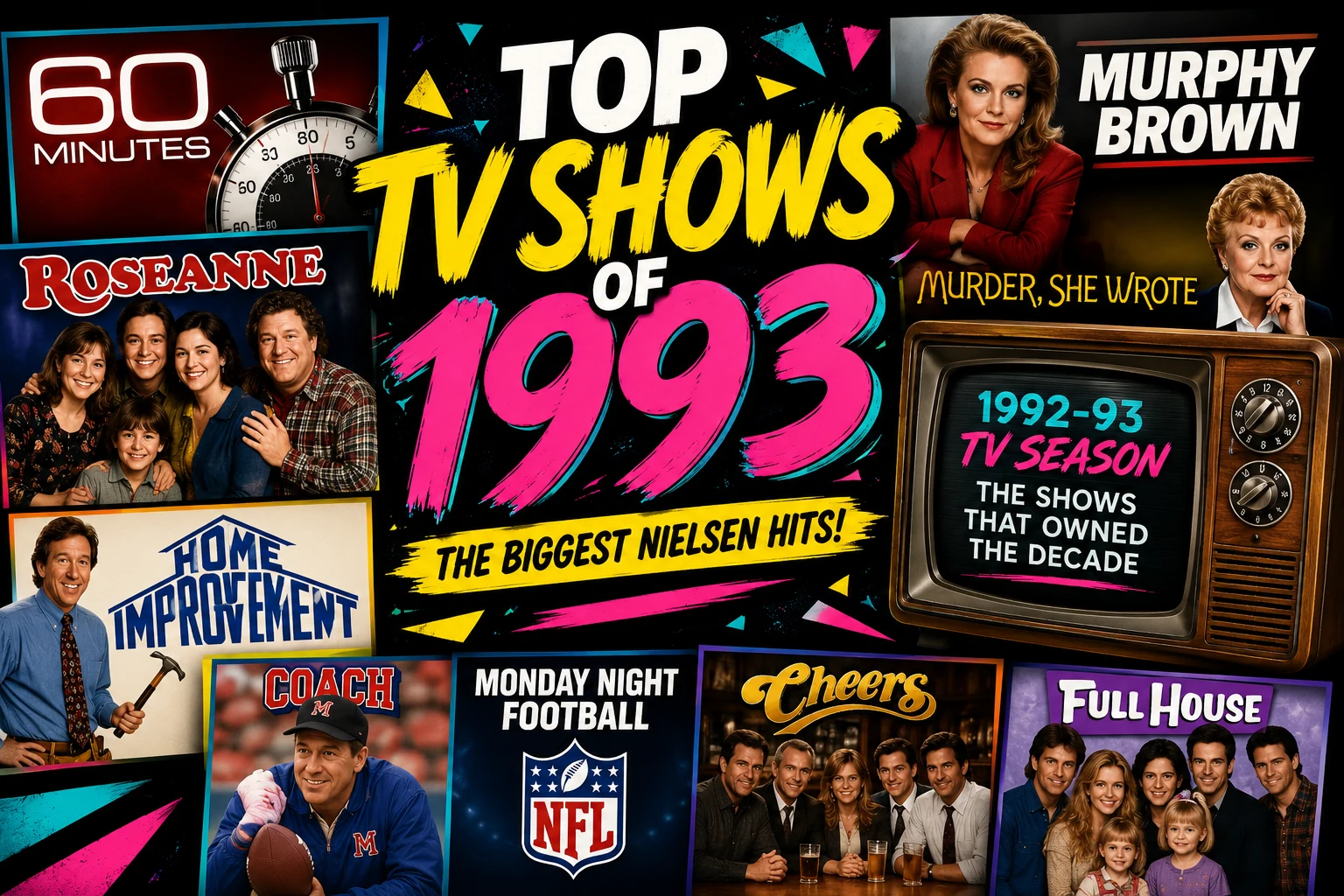
Top TV Shows of 1993: The Biggest Nielsen Hits Ranked
The top TV shows of 1993 were led by 60 Minutes, Roseanne, Home Improvement, Murphy Brown, Murder, She Wrote, Coach, Monday Night Football, CBS Sunday Movie, Cheers, and Full House. Based on the 1992–93 Nielsen television season, this ranking captures early-90s television settling into its own personality.
This is a year where the old network machine is still enormous, but the emotional center has shifted. Viewers are showing up for mass-audience journalism, working-class domestic frustration, broad family sitcom chaos, sharp newsroom comedy, mystery ritual, football spectacle, movie-event programming, and one final blast of elite barroom ensemble comedy.
In Smells Like Gen X terms, 1993 is not about TV deciding what the 90s are. It already knows. This is the year where the mix hardens into something unmistakable: less polished, more varied, more sarcastic, more adult, and much less interested in pretending every successful show has to live in the same emotional zip code.
1993 Means the 1992–93 Nielsen Season
This series assigns each television season to the year in which it ended. CBS Sunday Movie and Cheers tied at #8, so there is no separate #9 ranking and Full House appears at #10.
What Were the Top TV Shows of 1993?
The top TV shows of 1993, based on the 1992–93 Nielsen television season, were 60 Minutes, Roseanne, Home Improvement, Murphy Brown, Murder, She Wrote, Coach, Monday Night Football, CBS Sunday Movie, Cheers, and Full House. The #1 TV show of 1993 was 60 Minutes.
Quick List: Top TV Shows of 1993
The 1992–93 Nielsen season has a tie at #8 between CBS Sunday Movie and Cheers, so there is no separate #9 ranking.
1993 Nielsen Top 10 at a Glance
Here is the 1992–93 Nielsen season Top 10 in quick-scan form, with network and rating included for context.
| Rank | Show | Network | Nielsen Rating |
|---|---|---|---|
| #1 | 60 Minutes | CBS | 21.9 |
| #2 | Roseanne | ABC | 20.7 |
| #3 | Home Improvement | ABC | 19.4 |
| #4 | Murphy Brown | CBS | 17.9 |
| #5 | Murder, She Wrote | CBS | 17.7 |
| #6 | Coach | ABC | 17.5 |
| #7 | Monday Night Football | ABC | 16.7 |
| #8 tie | CBS Sunday Movie | CBS | 16.1 |
| #8 tie | Cheers | NBC | 16.1 |
| #10 | Full House | ABC | 15.8 |
How This 1993 TV Ranking Works
This list uses the Nielsen season ending in 1993, not a January–December calendar year. That means the rankings reflect the 1992–93 television season, which is the standard way network TV popularity was measured.
Note on the tie: CBS Sunday Movie and Cheers tied at #8 with a 16.1 Nielsen rating. Because of that tie, there is no separate #9 ranking, and Full House lands at #10.
Why 1993 Was Such a Big TV Year
1993 matters because the monoculture is still alive here — but it is no longer unified. 1993 feels like several different Americas all watching TV at the same time: parents with 60 Minutes, families with Full House, working-class reality with Roseanne, sports fans with Monday night football, and everyone else trying to figure out why television suddenly felt less polished and more real.
Jump to a Show
Countdown: The Top TV Shows of 1993
Several of these shows now have their own Smells Like Gen X features. When one does, you’ll find a Keep Watching link inside its entry so you can jump from the 1993 Nielsen snapshot into the deeper story.
#10 — Full House
Official Nielsen Rank: #10Full House at #10 is the season’s giant reminder that early-90s television still had a huge appetite for family comfort. Whatever else was changing in the culture, there remained an enormous audience for clean, warm, highly legible sitcoms built around reassurance, routine, and emotional simplicity.
Part of the power of Full House was that it knew exactly what it was selling and never got embarrassed about it. The show was not interested in irony, tonal abrasion, or realism in the Roseanne sense. It was selling affection, lesson-learning, and a version of family life where conflict could be real enough to matter but never so real that it threatened the basic promise of comfort.
In a season where viewers could also choose sarcasm, workplace stress, journalism, football, and mystery, Full House still stayed in the upper tier because it met a different emotional need. It was one of the clearest examples of how early-90s TV was not replacing one mode with another. It was stacking different modes together and letting the audience move among them.
#8 Tie — CBS Sunday Movie
Official Nielsen Rank: #8 TieThe CBS Sunday Movie tying at #8 is one of the best pieces of evidence that the early 90s still belonged partly to the old broadcast habit system. A movie slot in the top 10 sounds almost strange now, but in the 1992–93 season it made perfect sense. These network movie presentations still carried event value, still gathered large audiences, and still benefited from the idea that television could unify the country around something scheduled and finite.
Its place on the list also shows how broad “television success” still was in this era. The top ranks were not restricted to ongoing scripted series alone. Big recurring programming blocks could still land among the country’s biggest attractions. That matters because it reminds you that broadcast television was not yet fully reorganized around the kind of serialized prestige logic or niche identity that would grow stronger later.
In a season filled with strongly branded series, the CBS Sunday Movie slot represents a slightly older television instinct still paying off. It was a holdover from an earlier era, but not a dead one. That makes it valuable historically. It tells you 1993 was not just about what was new. It was also about what still worked.
#8 Tie — Cheers
Official Nielsen Rank: #8 TieBy 1993, Cheers was operating less like a hit show and more like infrastructure. Even tied at #8 rather than living at the very top of the rankings, it still represented one of the clearest standards for what network ensemble comedy could look like when every moving part was tuned correctly. The writing, the timing, the emotional continuity, the social setting — it all still worked at a remarkably high level.
What makes Cheers so important in the 1992–93 season is that it demonstrates the durability of craftsmanship even in a changing climate. The room around it had gotten louder, broader, more working-class in some corners, more event-driven in others, and more niche-feeling in still others. But Cheers did not need to chase any of that. It simply needed to remain excellent at being itself: adult, communal, character-first, funny without being flimsy, and emotionally textured without announcing itself as Important Television.
Its ranking also tells an interesting story about the early 90s. Elite mainstream comedy did not disappear when rougher, broader, or more overtly emotional hits rose around it. It simply had to share space.
#7 — Monday Night Football
Official Nielsen Rank: #7Monday Night Football at #7 is another reminder that live, communal, event-driven television still had enormous cultural leverage in 1993. This was not just sports on TV. It was one of the country’s shared weekly rituals, with all the scale and audience concentration that came with that. As the broader TV environment got more crowded, programming that could still make people show up all at once became even more valuable.
Its ranking is also important because it helps explain how broad the top tier really was. One list could include journalism, mystery, family sitcoms, adult workplace comedy, broad domestic comedy, and football without any of it feeling out of place. That range is one of the defining features of the era. It is what made the old broadcast system so culturally central.
#6 — Coach
Official Nielsen Rank: #6Coach at #6 is a great example of how the early 90s could still turn a likable, well-built, non-revolutionary sitcom into a major hit. Not every show in the top 10 had to arrive with a giant cultural thesis. Some simply had to be funny, accessible, and reliable enough to fit beautifully into a network ecosystem. Coach did that exceptionally well.
What makes its placement interesting is that it sits in the middle of a season otherwise remembered for bigger personalities and louder shifts. It is not as culturally transformative as Roseanne, not as institutionally weighty as 60 Minutes, and not as critically canonical as Cheers. But that is part of what makes it valuable. It reminds you how much of network TV success still came from consistency, structure, and a lead performance strong enough to anchor a familiar format.
In the broad emotional mix of 1993, Coach represents one of the more modest pleasures of the system: a dependable sitcom that could thrive not by reinventing anything, but by being good company.
#5 — Murder, She Wrote
Official Nielsen Rank: #5By the 1992–93 season, Murder, She Wrote was already a full institution, and finishing at #5 proves just how durable that institution remained. Jessica Fletcher still represented one of the most trustworthy, soothing, and quietly commanding presences in American television. That mattered because even as comedy got broader and sharper around it, viewers still wanted television that promised intelligence, order, and closure.
Part of the show’s strength was its refusal to seem desperate. It did not need to chase a trend. It did not need a tonal reboot. It knew exactly what it was and how to deliver that formula with consistency and grace. That kind of confidence made it an anchor in a TV culture that was otherwise getting noisier.
Its presence so high in the rankings also says something broader about the season. The audience for early-90s prime time was not a single age bracket looking for the same emotional tone every night. That is why a mystery led by an older woman could still outrank many flashier or trendier series.
#4 — Murphy Brown
Official Nielsen Rank: #4Murphy Brown at #4 is one of the strongest clues that 1993 television had firmly embraced adult workplace comedy as a mainstream mode rather than a specialty flavor. The series had wit, ego, newsroom pressure, political and media overtones, and a lead performance with enough force to dominate a scene without flattening everyone around her. That made it feel current in a way many more generic network sitcoms did not.
Its position this high in the ratings matters because it demonstrates that viewers wanted more than family-room setups. They were willing to follow a show built on professional friction, institutional setting, and sharper verbal rhythms. That is a significant part of what makes the early 90s feel different from the late 80s.
In the context of CBS’s strong season, Murphy Brown also helps explain why the network was so competitive. It was not winning with one single tone. It was winning with a mix of institutional seriousness, legacy comfort, and smart adult-skewing comedy.
#3 — Home Improvement
Official Nielsen Rank: #3Home Improvement reaching #3 by the 1992–93 season is one of the loudest indicators that the decade’s family-sitcom energy had changed. This was broad domestic comedy, yes, but not in the smoother, more aspirational late-80s style. It was louder, more overtly gendered, more physical, and more aggressively suburban-dad in a way that felt unmistakably 90s.
The show’s appeal came from its ability to feel familiar and fresh at the same time. It still offered the old broadcast promise of family accessibility, but it packaged that promise with a rougher, more performative masculinity and a bigger sense of noise. In other words, it was a new kind of comfort hit. Not softer comfort. Louder comfort.
Its high placement also shows that 1993 was no longer just about a few holdovers defending territory. Newer forms of mainstream sitcom success were now taking center stage. Home Improvement was not simply a hit. It was part of a reset in what the family-sitcom lane looked and sounded like.
#2 — Roseanne
Official Nielsen Rank: #2At #2, Roseanne was still one of the defining forces in American television, and by 1993 its importance had become bigger than its exact rank. The point was no longer that it had disrupted the old order. That had already happened. The point was that the world it helped normalize now felt built in. Working-class domestic life, sharper sarcasm, financial stress, and a more visibly worn-in home environment were all no longer shocking in prime time. They were part of the language.
That is what makes Roseanne so important in a pillar-style reading of 1993. It is not merely one of the biggest shows. It is one of the shows that made the rest of the season make more sense. The reason the broader top tier can support rougher tones, louder family friction, and less aspirational emotional packaging is because Roseanne proved that the audience would follow that shift.
At the same time, the show remained genuinely funny, which is easy to overlook when talking about its historical importance. It became a giant because it was funny, sharp, grounded, and alive in a way that a lot of older sitcom architecture was not.
#1 — 60 Minutes
Official Nielsen Rank: #160 Minutes finishing #1 in 1993 is the kind of fact that instantly tells you the broadcast monoculture was still real. In a season full of giant sitcoms and broad entertainment hits, the biggest show in America was still a news magazine. That is extraordinary by current standards, but in the early 90s it was still possible because television retained a larger civic and national function than it would later. The stopwatch still meant something. It still signaled seriousness, consequence, and national attention.
Its placement also helps explain CBS’s broader strength in the season. The network was able to combine legacy institutions, adult-skewing programming, and smart mainstream appeal into a top-tier lineup, and 60 Minutes sat at the symbolic center of that. It was not merely another successful show. It was a marker of authority.
In a season where comedy kept evolving and family formats kept mutating, 60 Minutes at #1 is also a reminder that the early 90s did not yet belong only to entertainment sprawl. Prime time could still be serious and gigantic at the same time.
Just Outside the Top 10: Northern Exposure
#11 — Northern Exposure
Just Outside the Top 10If you want one show in the 1993 rankings that proves mainstream audiences were willing to embrace something stranger, gentler, and more off-center than the usual network formula, it is Northern Exposure. It finished just outside the official top 10, but its presence says something crucial about the season: viewers were not only rewarding broad domestic comedy or legacy institutions. They were also rewarding mood, eccentricity, and a sense of place.
What made Northern Exposure so distinctive in the early-90s landscape was that it felt like television from a slightly different climate, emotionally and aesthetically. It was quirky without being smug, whimsical without becoming weightless, and cerebral without losing accessibility. That is a difficult balance to pull off on network TV, especially in an era still dominated by broad audience logic. But the show managed it by grounding all that eccentric atmosphere in character and emotional reality.
Its placement in the 1992–93 season is also a reminder that early-90s prime time had more range than nostalgia sometimes gives it credit for. A show like Northern Exposure could still become a real ratings force because the broadcast audience had not fully fragmented yet. There was still room for something offbeat to become part of the larger conversation.
Keep Rewinding 1993
If 1993 proved anything, it was that the culture had stopped pretending it needed one center. Prime time still had network gravity, but the rest of the year was just as loud and mixed-up. Radio bounced between soundtrack ballads, R&B slow burns, slick pop, and party records. The toy aisle was full of panic-buy crazes, media tie-ins, and bright plastic chaos. The movies were broad enough for dinosaurs, Robin Williams, legal thrillers, and blockbuster comfort all to feel like part of the same national conversation.
Here’s the rest of the 1993 cluster — the same-year pages that belong with this TV countdown if you want the full rewind instead of just the prime-time slice.
You May Also Remember
Whitney Houston, Tag Team, UB40, Janet Jackson, and the songs of 1993, Jurassic Park, Mrs. Doubtfire, The Fugitive, The Firm, and Sleepless in Seattle, Power Rangers, Beanie Babies, Talkboy, Barbie, Nerf, and Jurassic Park toys, the previous TV season, the next TV season, the 90s hub, and the bigger 90s nostalgia hub.
Basically: 60 Minutes still somehow beating everybody, Roseanne making TV feel more lived-in, Home Improvement turning suburbia into a power tool accident, Murphy Brown keeping the grown-ups sharp, and Cheers taking one final bow near the top of the ratings board.
Rewind Verdict
The top TV shows of 1993 reveal a system that is still broad, still powerful, and still capable of generating a genuine national conversation — but no longer through one dominant tone. 60 Minutes finishes first. Roseanne remains culturally central. Home Improvement proves the new family-sitcom mode has fully arrived. Murphy Brown keeps adult workplace comedy near the top. Murder, She Wrote and Cheers show the old institutions still matter.
That is what makes 1993 such a strong Gen X TV year. The monoculture is still alive, but it no longer sounds unified. It sounds like different emotional worlds competing for the same national attention — and winning it. There is comfort here, but multiple kinds of comfort. There is edge here, but multiple kinds of edge. The result is a top 10 that feels far more like the actual 90s than a simple holdover from the 80s.
If 1992 felt like the decade’s TV identity arriving, 1993 feels like that identity settling in and making itself at home.
FAQ: Top TV Shows of 1993
What were the top TV shows of 1993?
The top TV shows tied to the 1992–93 Nielsen season included 60 Minutes, Roseanne, Home Improvement, Murphy Brown, Murder, She Wrote, Coach, Monday Night Football, CBS Sunday Movie, Cheers, and Full House.
What was the #1 TV show of 1993?
The #1 TV show of the 1992–93 Nielsen season was 60 Minutes, with a Nielsen rating of 21.9.
What were the top 5 TV shows of 1993?
The top five TV shows of the 1992–93 Nielsen season were 60 Minutes, Roseanne, Home Improvement, Murphy Brown, and Murder, She Wrote.
What were the Nielsen ratings for 1993?
The 1992–93 Nielsen season ranked 60 Minutes at #1 with a 21.9 rating, followed by Roseanne at 20.7, Home Improvement at 19.4, Murphy Brown at 17.9, and Murder, She Wrote at 17.7.
Why does this 1993 post use the 1992–93 TV season?
Because this Smells Like Gen X series uses the Nielsen season ending in that year. So the 1993 post is based on the 1992–93 network television season rankings.
Why is there no #9 in the 1993 Nielsen ranking?
Because CBS Sunday Movie and Cheers tied at #8 with a 16.1 Nielsen rating. When a ranking has a tie, the next position skips ahead, so Full House appears at #10.
Was Northern Exposure a top 10 show in 1993?
No. Northern Exposure finished just outside the official top 10 at #11, but it is included here as a bonus because it helps capture the broader texture of the 1992–93 TV season.
What was the biggest family sitcom of 1993?
Among the major family sitcom hits, Home Improvement finished highest at #3, ahead of Full House at #10.
Was 1993 still dominated by sitcoms?
Mostly, but not entirely. The upper ranks also included 60 Minutes, Monday Night Football, and CBS Sunday Movie, which shows how broad mainstream television still was.
Which network dominated the top TV shows of 1993?
CBS had the #1 show with 60 Minutes and several top-10 entries including Murphy Brown, Murder, She Wrote, and CBS Sunday Movie. ABC was also very strong with Roseanne, Home Improvement, Coach, Monday Night Football, and Full House.
Why does 1993 TV matter for Gen X nostalgia?
1993 captures the early-90s TV identity settling in: working-class sitcoms, louder family comedy, adult workplace shows, live football, mystery comfort, newsmagazine authority, and a monoculture that was still powerful but no longer emotionally unified.
Was Cheers still one of the biggest shows in 1993?
Yes. Cheers tied for #8 in the 1992–93 Nielsen season, which makes its final season one of the biggest TV events of the year.
What were the top 10 TV shows of the 1992–93 season?
The Nielsen top 10 for the 1992–93 season included 60 Minutes, Roseanne, Home Improvement, Murphy Brown, Murder, She Wrote, Coach, Monday Night Football, CBS Sunday Movie, Cheers, and Full House.