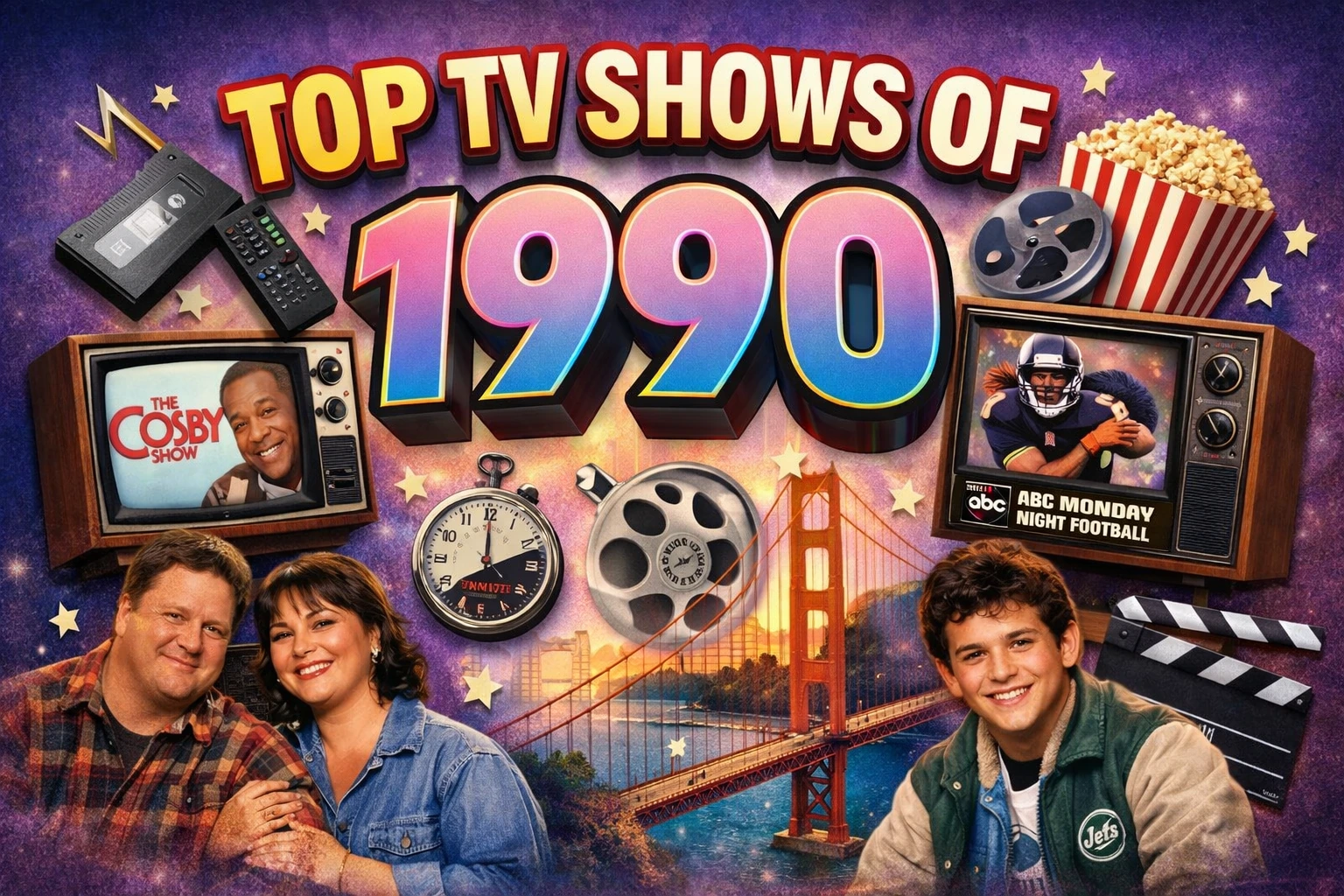
Smells Like Gen X • Top TV Shows of 1990
The Top TV Shows of 1990
The top TV shows of 1990 capture a medium that still belonged to the broadcast giants, but no longer in quite the same way it had even a year earlier. The big network machine was still running. NBC still had an absurd amount of comedy power. ABC still knew how to turn broad appeal into a weekly ritual. CBS could still muscle its way into the upper tier with institutional gravity alone. But the tone of what people wanted was shifting, and the 1989–90 Nielsen season makes that crystal clear.
This is the year where the center of the room got crowded. The old network polish did not disappear, but it started sharing the stage with something rougher, warmer, and more specifically lived-in. The Cosby Show was still enormous. Cheers was still an adult-comedy gold standard. The Golden Girls was still one of the smartest sitcoms on television. But Roseanne was no longer just a disruptive new hit. It had surged all the way into a tie for first place, which tells you exactly where the mood was going. Viewers still loved comfort. They just did not need it to look showroom perfect anymore.
The 1990 lineup is also a reminder that broadcast television used to be much broader than people remember. The top ranks included a news magazine, a sports franchise, a home-video clip show, a nostalgic coming-of-age comedy, and multiple sitcoms with wildly different emotional textures. This was still an era when one national TV culture could hold all of that at once. That is what makes the year so good to revisit. It is not just a countdown of big titles. It is a snapshot of American television learning how to carry two moods at once: polished dominance and more grounded, more human mess.
Gen X Note:
If 1989 was the year late-80s prime time started showing a few scuff marks, 1990 is the year those scuff marks became part of the appeal. TV still loved a glossy finish, but now viewers were rewarding sarcasm, realism, memory, sentiment, sports spectacle, and plain old national habit all at the same time.
Keep Rewinding 1990
The 1989–90 TV season was only one piece of the first full year of the 90s. This was also the year of Home Alone, Ghost, Pretty Woman, Total Recall, Game Boy momentum, Nintendo and TMNT still dominating the toy aisle, Mariah Carey breaking through, Wilson Phillips taking over radio, and pop culture officially stepping out of the 80s haze.
Keep the same-year rabbit hole going with the rest of the confirmed 1990 Smells Like Gen X cluster.
Every #1 Hit of 1990
The full Billboard Hot 100 #1 rewind from the first year of the 90s.
Top 5 Songs from August 7th, 1990
A summer chart snapshot with Sweet Sensation, Billy Idol, Johnny Gill, Snap!, and Mariah Carey.
Top 5 Songs on Sept. 2nd, 1990
A weekly chart rewind with Sweet Sensation, Poison, Bell Biv DeVoe, Wilson Phillips, and Jon Bon Jovi.
Top 10 Songs of 1990
The Billboard year-end hits that launched the 90s with ballads, pop, dance, rock, and crossover chaos.
Top 10 Movies of 1990
The box-office year of Home Alone, Ghost, Pretty Woman, Total Recall, and more.
Top 10 Toys of 1990
The toy aisle from the year TMNT, Nintendo, Barbie, Game Boy, and early-90s kid culture collided.
More Smells Like Gen X Videos
More music countdowns, nostalgia rewinds, chart flashbacks, commercials, and Gen X pop-culture videos.
Explore the 90s Hub
The main decade hub for 90s music, movies, TV, toys, videos, and pop-culture nostalgia.
Quick List: 1990’s Biggest TV Shows
The 1989–90 Nielsen season had a tie at #1, so there is no separate #2. That means the official 1990 top 10 runs from the tied #1 slot down through #10.
- #10 Monday Night Football
- #9 Empty Nest
- #8 The Wonder Years
- #7 60 Minutes
- #6 The Golden Girls
- #5 America’s Funniest Home Videos
- #4 A Different World
- #3 Cheers
- #1 (tie) Roseanne
- #1 (tie) The Cosby Show
Countdown: The Top TV Shows of 1990
#9 — Empty Nest
Official Nielsen Rank: #9
NetworkNBC
Debut Year1988
TV SnapshotAdult comfort sitcom
Empty Nest landing at #9 shows how valuable emotional familiarity still was in 1990. By this point, the show had settled into its own rhythm as a comfortable, adult-centered sitcom with enough warmth to feel relaxing and enough domestic friction to keep it moving. It is easy to think of it as simply adjacent to The Golden Girls, but that undersells what made it work. It was part of a broader late-80s and early-90s appetite for sitcoms built around adults, life-stage fatigue, and the quieter forms of family mess.
What made Empty Nest effective was tone. It did not try to be flashy, and it did not need an oversized premise. It operated on recognizable emotional territory: loneliness, parenthood, frustration, routine, and the small daily collisions of people who love each other but absolutely know how to get under each other’s skin. Broadcast TV was still exceptionally good at packaging that kind of emotional familiarity into something inviting, and this show is a strong example of the craft.
Its place in the top 10 also says something interesting about the year overall. As Roseanne pushed working-class bluntness further into the mainstream, and The Wonder Years gave viewers a more memory-driven emotional texture, Empty Nest held onto a more traditional comfort-sitcom role without feeling obsolete. It did not need to be disruptive. It just needed to be dependable, humane, and easy to live with for half an hour.
Why It Clicked
It gave viewers mature comfort television without making adulthood look joyless.
#8 — The Wonder Years
Official Nielsen Rank: #8
NetworkABC
Debut Year1988
TV SnapshotNostalgic coming-of-age dramedy
The Wonder Years at #8 is one of the most important entries in the whole 1990 lineup because it represents a very different kind of broadcast success. This was not a broad multi-camera family machine built on familiar sitcom rhythms. It was more wistful, more interior, and more emotionally observant. It brought nostalgia into prime time without making nostalgia feel empty. That alone made it stand out.
What viewers responded to was not just the period setting. It was the way the show used memory. The Wonder Years understood that looking backward could be funny, embarrassing, painful, romantic, and a little cruel all at once. It filtered adolescence through reflection, which gave the series a richer emotional texture than many of its peers. Instead of simply delivering jokes and plot, it delivered recollection. That made even smaller moments feel meaningful.
Its top-10 finish also tells you something big about the state of the audience in 1990. Viewers were clearly open to programming that felt more intimate and less mechanically big. In a lineup filled with giant broad-audience institutions, The Wonder Years proved that specificity and emotional intelligence could still travel. It was not competing by being louder. It was competing by being more precise about how life feels when you are inside it.
1990 Takeaway
This was memory-driven television that treated growing up like something worth examining instead of just something worth joking about.
#7 — 60 Minutes
Official Nielsen Rank: #7
NetworkCBS
Debut Year1968
TV SnapshotNews magazine powerhouse
60 Minutes being the seventh biggest show in America in 1990 is a reminder that television was still allowed to be serious and still be huge. In the current media climate, that can almost feel impossible to imagine, but the old broadcast ecosystem made space for journalism as a genuine mass-audience habit. The stopwatch did not signal a niche or prestige side lane. It signaled national importance.
The power of 60 Minutes came from institutional authority. People watched it because it felt consequential. It occupied a space between reporting and ritual. Viewers were not just tuning in for information; they were tuning in because the program still carried the weight of something that shaped the broader conversation. In a lineup full of comfort and entertainment, 60 Minutes represented the enduring idea that television could still claim seriousness without giving up reach.
Its place in this list matters because it broadens the story of 1990 beyond sitcom transition. The year was not only about comedy becoming more grounded or more textured. It was also about the continued strength of television formats that projected trust, authority, and scale. That kind of breadth is part of what made the broadcast era culturally central. One top-10 lineup could include football, family comedy, wistful coming-of-age storytelling, and hard-edged reporting without it seeming strange.
Why It Mattered
It proved that serious journalism was still one of the biggest forms of prime-time television in America.
#6 — The Golden Girls
Official Nielsen Rank: #6
NetworkNBC
Debut Year1985
TV SnapshotSharp ensemble sitcom
By 1990, The Golden Girls was no longer just a hit sitcom. It was a standard. The show remained one of the sharpest and most durable pieces of network comedy because it never relied on novelty. The central premise was strong, of course, but the reason it lasted was the writing. Dorothy, Rose, Blanche, and Sophia were not just funny archetypes. They were full comic engines with distinct rhythms, grievances, vulnerabilities, and weapons.
What makes the show’s continued top-tier success so impressive is how little it needed to posture. It did not look desperate to seem current. It did not chase youth energy. It did not dilute itself. It stayed exactly what it was: fast, character-based, emotionally literate, and funnier than many shows with much more conventional network premises. That confidence is a huge part of why it aged better than so many of its contemporaries.
In the 1990 rankings, its endurance also reinforces a larger truth about the era: audiences still rewarded sitcoms centered on adults and adult concerns. This was not a format built around cute-kid gimmickry or forced family uplift. It was built around wit, friendship, money worries, romantic disappointments, generational friction, and the daily reality of sharing space with people you adore and occasionally want to strangle. That made it feel fuller than standard comfort television, even while still delivering comfort.
Why It Clicked
It gave viewers elite ensemble comedy with actual emotional ballast underneath it.
#5 — America’s Funniest Home Videos
Official Nielsen Rank: #5
NetworkABC
Debut Year1989
TV SnapshotViewer-video breakout hit
The rise of America’s Funniest Home Videos to #5 is one of the most revealing TV stories of 1990 because it shows how quickly the medium could pivot toward participatory spectacle. The format was instantly legible: funny, chaotic, family-safe, repeatable, and built on the pleasure of watching regular people fail in ways everyone could laugh at. It became the season’s biggest breakout because it felt immediate in a way more polished programming often did not.
What made AFHV powerful was that it felt homemade inside a television system still dominated by network polish. The clips were messy. The humor was broad. The whole thing had a kind of democratic silliness to it. That gave it a different energy from the rest of the list. It did not ask viewers to invest in long arcs, ensemble chemistry, or a dramatic premise. It asked them to show up and enjoy the immediate ridiculous spectacle of human beings versus gravity, pets, furniture, and terrible judgment.
Its ranking hints at where television culture was headed. Even inside the old network era, viewers were already responding to formats that felt lighter, faster, and more openly assembled from ordinary life. Long before social video became the default texture of the internet, America’s Funniest Home Videos made viewer-submitted chaos into one of the biggest things on TV. That is historically significant because it turned regular people on camera into mainstream appointment viewing.
1990 Takeaway
It was the season’s breakout reminder that network TV could still reinvent mass appeal with one brilliantly simple format.
#4 — A Different World
Official Nielsen Rank: #4
NetworkNBC
Debut Year1987
TV SnapshotCampus sitcom with cultural momentum
A Different World at #4 shows how much cultural and creative momentum the series had accumulated by 1990. What began as a spinoff had become one of the most vital shows in the network landscape. The campus setting alone gave it more movement than the standard home-based sitcom format, but what really made it matter was the feeling that its world extended beyond the frame. It had social life, generational energy, romance, conflict, and a sense of becoming.
That feeling of forward motion made it incredibly watchable. Viewers were not just dropping into a static arrangement week after week. They were visiting a living social environment. That helped the show feel younger and more open than many of its sitcom peers, but it never lost the warmth necessary for broad appeal. That balance is what made it special. It had real identity without sacrificing accessibility.
Its ranking also matters historically because it widened the center of mainstream television. This was not a marginal show surviving on the edge of the schedule. It was one of the biggest programs in the country. A campus comedy with a strong Black ensemble and a vivid social identity had moved into the top tier of prime time. That is a major part of the 1990 TV story, and it deserves to be treated as such rather than just as a footnote to NBC’s larger comedy machine.
Why It Mattered
It brought cultural specificity, youth energy, and a stronger sense of social world-building into the very top of the ratings.
#3 — Cheers
Official Nielsen Rank: #3
NetworkNBC
Debut Year1982
TV SnapshotPrestige ensemble comedy
At #3, Cheers represents the peak form of broadcast ensemble comedy. By 1990, the show was no longer proving anything. It had already proved it. What it was doing instead was demonstrating how much range and longevity a beautifully built sitcom world could sustain. The bar setting remained one of the most effective environments in television history because it allowed personality, conflict, longing, sarcasm, and affection to circulate freely without ever feeling forced.
The genius of Cheers was always its precision. The show understood rhythm better than almost anything else on television. Characters did not simply exchange lines; they bounced, stalled, undercut, flirted, sulked, and collided in ways that felt lived-in. That level of performance and writing control is why the series stayed so high in the rankings even as the taste climate around it changed. It did not need reinvention. It needed to keep being excellent at the thing it already did better than almost anybody.
In the 1990 lineup, Cheers also functions as a kind of benchmark. While Roseanne was pushing mainstream comedy toward a rougher, more working-class realism, Cheers represented the older model at its most refined: adult, literate, warm, funny, and communal. It was still deeply alive because polished comedy had not stopped being powerful. The audience was just adding new appetites to the mix.
1990 Takeaway
This was still prestige-level mainstream comedy, broad enough for the mass audience and smart enough to feel genuinely crafted.
#1 (tie) — Roseanne
Official Nielsen Rank: #1 (tie)
NetworkABC
Debut Year1988
TV SnapshotWorking-class sitcom disruptor
The fact that Roseanne was tied for the top spot in 1990 is the loudest signal in the whole season. This was no longer simply a buzzy hit shaking up the old order. It had fully arrived as one of the defining shows in America. That matters because Roseanne did not win by imitating polished late-80s family TV. It won by dragging more strain, more money anxiety, more irritation, and more recognizable domestic fatigue into the center of prime time.
What the show understood better than many of its rivals was that realism could be funny without becoming grim. The Conners were stressed, but they were not joyless. Their house looked lived in, but the series never made that feel like defeat. The comedy came from voice, from accumulated tension, from the sharpness of people who do not have the luxury of pretending everything is fine. That gave the show a very different texture from more manicured sitcom worlds, and viewers responded to it in a massive way.
Its importance in the 1989–90 season is difficult to overstate. Roseanne told the industry that mainstream America would absolutely show up for a family sitcom that looked less idealized and sounded less polite. It widened the emotional register of network comedy. Suddenly, sarcasm, financial pressure, and blue-collar exhaustion were not side flavors. They were top-of-the-chart ingredients.
Why It Mattered
It proved that one of the biggest TV hits in the country could be rougher, angrier, more working-class, and more honest than the older sitcom model.
#1 (tie) — The Cosby Show
Official Nielsen Rank: #1 (tie)
NetworkNBC
Debut Year1984
TV SnapshotPrime-time ratings titan
Even with all that change, The Cosby Show still sat at the top in 1990. That is what makes the tie so fascinating. Roseanne was clearly pushing television toward its next tonal phase, but The Cosby Show still embodied the late-80s broadcast ideal strongly enough to remain co-#1. It was still the most powerful symbol of the smoother, more polished model that had dominated the second half of the decade.
Part of that enduring strength came from how the show packaged aspiration. The Huxtables were accomplished, warm, funny, and deeply stable in a way that still felt inviting to broad audiences. The series made competence and comfort look attractive without feeling cold. That is harder than it sounds. Plenty of television can feel polished; much less can feel polished and welcoming. The Cosby Show mastered that balance, which is why it remained such a dominant gravitational force.
Its continued placement at the top also explains why NBC still looked so powerful across the board. A show this big does more than win its own slot. It anchors an entire network identity. In 1990, that identity was still very much alive. Even as more grounded and more abrasive voices rose around it, The Cosby Show remained a symbol of the old center holding. That tension between old center and new disruptor is exactly what makes the season so rich to revisit.
1990 Takeaway
It remained the polished broadcast center of gravity even as television culture started leaning harder toward rougher realism.
Rewind Verdict
The top TV shows of 1990 are fascinating because they do not show a clean replacement of one television era by another. They show overlap. The Cosby Show and Roseanne tying for first is basically the whole story in one image. One show represents the polished, reassuring, late-80s network ideal at full strength. The other represents a sharper, more grounded, more visibly stressed version of family comedy that audiences were clearly hungry for. The old model had not collapsed. The new model had simply become too big to ignore.
Below them, the lineup gets even more revealing. Cheers and The Golden Girls prove that sophisticated, character-driven comedy was still a major force. A Different World shows that youth energy and cultural specificity were moving closer to the center. The Wonder Years demonstrates that memory and emotional nuance could still pull huge numbers. America’s Funniest Home Videos hints at the power of lighter, faster, more participatory formats. 60 Minutes and Monday Night Football remind you that prime time was still broad enough to make journalism and sports feel like national rituals.
That is why 1990 works so well as a Gen X TV year. It still has the comforts of the broadcast empire, but it is no longer pretending comfort is the only mood people want. There is more bite here. More sentiment, but also more abrasion. More polish, but also more mess. The top TV shows of 1990 feel like the last big moment before the decade fully started rearranging what mainstream television could sound like.
FAQ: Top TV Shows of 1990
Why does this 1990 post use the 1989–90 TV season?
Because this Smells Like Gen X series uses the Nielsen season ending in that year. So the 1990 post is based on the 1989–90 network television season rankings.
Why is there no separate #2 show on this list?
Because The Cosby Show and Roseanne were tied at #1 for the 1989–90 season. The next entry is therefore #3, which is Cheers.
What were the #1 TV shows of 1990?
For the 1989–90 Nielsen season, The Cosby Show and Roseanne shared the top spot.
What was the highest-ranked new show of the season?
America’s Funniest Home Videos was the season’s major breakout and the highest-ranked new hit in the 1989–90 lineup.
Was 1990 still mostly dominated by sitcoms?
Mostly, yes—but not entirely. The official top 10 also included 60 Minutes and Monday Night Football, which shows how broad mass-audience television still was at the time.
What makes the 1990 TV lineup important?
It captures a transitional moment: polished late-80s network dominance was still intact, but shows like Roseanne were already pushing mainstream television toward a rougher, more grounded, more early-90s emotional texture.