Top 10 Songs of 1998 (Billboard Hot 100 Year-End Countdown)
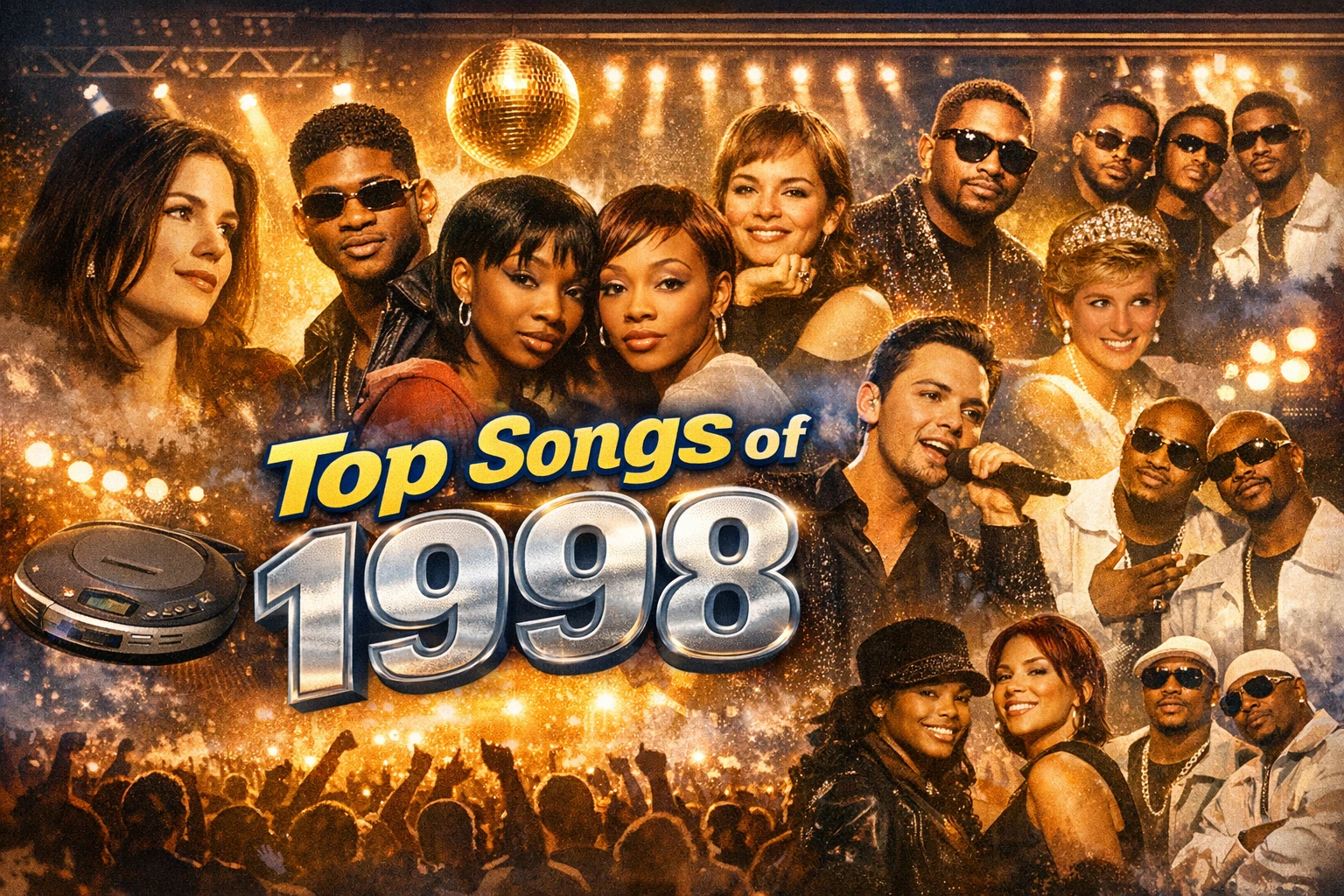
By 1998, pop radio felt less like a single lane and more like a six-lane pileup that somehow kept moving. One station gave you slow-burn R&B. The next gave you country crossover polished for the mall. Somewhere in the middle, adult-contemporary ballads were still refusing to die, singer-songwriter records were holding their ground, and the whole thing was inching toward the brighter, glossier Y2K era waiting right around the corner.
This was a year of songs with absurd staying power. Not just big debuts or flashy chart peaks, but records that settled into everyday life and refused to leave. They lived in car stereos, proms, school dances, waiting rooms, bedroom CD players, grocery store speakers, and late-night radio countdowns. If 1997 felt emotionally overloaded, 1998 felt more locked-in: smoother, shinier, and completely comfortable letting different genres crowd the same space.
This countdown ranks the Top 10 Songs of 1998 using Billboard’s Hot 100 Year-End chart. These weren’t just hits. These were the records that became part of the atmosphere.
Top 10 Songs of 1998 (Billboard Year-End Hot 100) — Quick List
- #10 “I Don’t Want to Wait” — Paula Cole
- #9 “Nice & Slow” — Usher
- #8 “Candle in the Wind 1997” / “Something About the Way You Look Tonight” — Elton John
- #7 “All My Life” — K-Ci & JoJo
- #6 “Together Again” — Janet
- #5 “How Do I Live” — LeAnn Rimes
- #4 “Truly Madly Deeply” — Savage Garden
- #3 “You’re Still the One” — Shania Twain
- #2 “The Boy Is Mine” — Brandy and Monica
- #1 “Too Close” — Next
#10 — “I Don’t Want to Wait” — Paula Cole
Why it hit
Paula Cole’s presence in the 1998 Top 10 is one of the best reminders that year-end charts are not just about how high a song climbs—they’re about how long it lives. “I Don’t Want to Wait” never even cracked the Hot 100 Top 10 on a weekly basis, and still finished the year at #10 because it simply would not go away. That tells you a lot about how deep the song got into people’s daily routines.
Musically, it never tries to overwhelm the room. It builds from reflection, not bombast. Cole sounds thoughtful rather than flashy, and the lyric carries the kind of adult anxiety that late-90s pop did not always make room for. It is a song about time, fear, regret, and choosing life before life chooses for you. That gives it more weight than the average radio staple.
Why it mattered in 1998
The song helped prove there was still strong mainstream appetite for introspective singer-songwriter material, especially when it was melodic enough to survive heavy radio rotation. It also became glued to pop culture because of Dawson’s Creek, which only deepened its identity as a late-90s emotional landmark.
Gen X Rewind
This is the sound of the late 90s discovering that even teen-TV theme songs could carry full existential dread.
Legacy
“I Don’t Want to Wait” remains one of the most enduring adult-pop crossovers of the decade and one of the stranger, more impressive year-end success stories on the Hot 100.
#9 — “Nice & Slow” — Usher
Why it hit
“Nice & Slow” is where teen stardom and grown-up R&B confidence started meeting in a much more serious way for Usher. The song’s genius is in how conversational it feels. That famous spoken intro does a lot of work: it instantly sets the mood, drops the pretense, and pulls the listener into something that feels private even though it became a giant public hit.
The production is all glide and patience. Nothing about it is frantic. It understands that seduction on the radio often works better when the beat looks unbothered. Usher’s vocal sits right in that sweet spot between sweetness and control, which helped the record cross over without losing its R&B identity. It felt polished, but it didn’t feel neutered.
Why it mattered in 1998
The song marked an important stage in Usher’s rise from promising young artist to genuine pop-R&B force. It also reflected how the late 90s were letting R&B steer the mainstream more openly, rather than just borrowing from it at a safe distance.
Gen X Rewind
This is pagers-on-the-belt, lights-low, “you probably should not have been singing this in middle school” music.
Legacy
It still stands as one of Usher’s formative signature hits—the moment where his chart power started looking less like potential and more like destiny.
#8 — “Candle in the Wind 1997” / “Something About the Way You Look Tonight” — Elton John
Why it hit
By 1998, this double-sided single had already become much larger than ordinary pop-radio success. It carried over from late 1997 because the scale of its commercial and emotional impact was so overwhelming that the chart year simply couldn’t contain it all. “Candle in the Wind 1997” was tied to public mourning on a historic scale, while “Something About the Way You Look Tonight” gave the release an additional adult-pop anchor with real staying power of its own.
That year-end carryover matters. It reminds you just how unusual the single’s run really was. Even after the peak emotional moment had passed, the record remained powerful enough to finish as one of 1998’s ten biggest songs. Very few releases operate at that level. This one did because it lived at the intersection of event, tribute, and pure chart mass.
Why it mattered in 1998
It served as a bridge between two chart years and gave 1998 an unusual emotional residue right at the top of the countdown. Most year-end lists feel like clean snapshots. This one carried visible aftershocks from a very public 1997.
Gen X Rewind
This is the sound of a pop single lingering in public memory long after most hits would have faded into ordinary rotation.
Legacy
It remains one of the biggest singles in Hot 100 history and one of the clearest examples of a release becoming part of collective memory, not just music culture.
#7 — “All My Life” — K-Ci & JoJo
Why it hit
“All My Life” is the kind of love ballad that sounds almost suspiciously sincere, which is exactly why it worked. The song strips away a lot of the harder edges associated with Jodeci and lets K-Ci & JoJo operate in full romantic mode. The melody is direct, the hook is immediate, and the vocal delivery is just raw enough to keep the whole thing from sounding too polished to trust.
There is also a key difference between a ballad that feels generic and one that feels ceremonial. “All My Life” landed on the ceremonial side. It sounded like a vow. That gave it uses beyond radio: weddings, dedications, proms, anniversary montages, every sentimental event the late 90s could manufacture. Once a song becomes socially useful like that, its staying power goes way up.
Why it mattered in 1998
It helped keep the classic R&B ballad alive in a year increasingly crowded with more playful or more aggressively contemporary sounds. It was also proof that pure romance still had commercial muscle if the vocal felt real enough.
Gen X Rewind
This is slow-dance, cake-cutting, and “someone absolutely dedicated this on the radio” music.
Legacy
It remains one of the most recognizable R&B love songs of the decade and arguably the definitive K-Ci & JoJo crossover hit.
#6 — “Together Again” — Janet
Why it hit
One of the reasons “Together Again” endures so well is that it hides its emotional depth inside motion. On the surface, it is bright, clubby, elegant, and effortlessly melodic. But underneath the sheen, the song is a tribute rooted in grief and remembrance. Janet Jackson turned loss into something that moved, which is not easy. Most memorial songs slow down. This one dances.
That’s what makes it smarter than it may seem at first glance. The track gives listeners joy and sadness at the same time without sounding conflicted. It sounds resolved. Janet doesn’t overplay the emotion. She lets the warmth of the song carry it, which makes the record feel more humane and less performative than a louder tribute might have.
Why it mattered in 1998
It showed how sophisticated mainstream pop-R&B could be when it trusted feeling over spectacle. It also helped define Janet’s late-90s identity as someone who could move between intimacy, sensuality, dance music, and emotional tribute without ever sounding lost.
Gen X Rewind
This is one of those songs that feels good immediately and gets sadder the older you get.
Legacy
“Together Again” remains one of Janet Jackson’s most beloved singles and one of the strongest examples of a dance-pop song carrying genuine emotional weight.
#5 — “How Do I Live” — LeAnn Rimes
Why it hit
“How Do I Live” is basically a case study in chart endurance. It did not become one of the biggest songs of the decade by briefly peaking and disappearing. It got there by hanging around so long it started to feel infrastructural. The song’s emotional premise is huge and simple enough to be universal, while the vocal gives it just enough country-rooted sincerity to separate it from the cleaner adult-pop ballads surrounding it.
It also benefited from being unusually flexible. Radio could place it almost anywhere. Pop audiences heard it as a sweeping love song. Country listeners heard the emotional directness they were used to. Adult-contemporary radio heard something safe but not bland. That kind of format mobility is why the song’s chart story became legendary.
Why it mattered in 1998
It proved, decisively, that country-pop crossover was no longer a novelty lane. By the end of the decade, it was part of the mainstream bloodstream, and LeAnn Rimes was one of the artists who helped normalize that.
Gen X Rewind
This is the radio equivalent of wallpaper you somehow got emotionally attached to.
Legacy
It remains one of the greatest long-run singles in Hot 100 history and one of the defining crossover ballads of the 1990s.
#4 — “Truly Madly Deeply” — Savage Garden
Why it hit
“Truly Madly Deeply” sounds like a love song that never met a small promise in its life. It offers not just affection but atmosphere, not just romance but full environment. That’s part of why it connected. It isn’t shy about wanting to be the definitive love song in the room. And for a while, it basically was.
The record also had insane chart legs because it lived comfortably across multiple formats. Top 40 could use it. Adult contemporary could build a small house inside it. Couples could project onto it. People driving alone at night could project onto it even harder. The lyric is oversized, but the performance sells it with enough conviction that it feels tender instead of ridiculous.
Why it mattered in 1998
It helped define the late-90s soft-rock / adult-pop crossover lane that sat right between singer-songwriter intimacy and full commercial romance. Savage Garden made earnestness sound marketable at scale.
Gen X Rewind
This is starry-sky, candlelight, “the promise level here is legally concerning” music.
Legacy
It remains one of the signature love songs of the era and one of the clearest examples of late-90s romantic excess done right.
#3 — “You’re Still the One” — Shania Twain
Why it hit
Shania Twain’s crossover magic was always partly about attitude, but “You’re Still the One” works because it dials that attitude into something steadier and more adult. The song is romantic without being syrupy, proud without being flashy, and polished in a way that helped it slide naturally into pop radio without scrubbing away its country identity.
It also told a different kind of romantic story than a lot of big late-90s hits. This isn’t infatuation or dramatic collapse. It’s about endurance. About staying. About surviving other people’s doubts and still standing there. That gave the song a maturity that made it resonate with more than just teenage listeners, which is a huge part of why it crossed so effectively.
Why it mattered in 1998
It was a major marker for how thoroughly country-pop had merged with the broader mainstream by the late 90s. Shania wasn’t “crossing over” in the old sense anymore—she was simply part of the center.
Gen X Rewind
This is one of those songs that made long-term love feel like something you could actually put on pop radio and people might buy.
Legacy
It remains one of Shania Twain’s biggest crossover triumphs and one of the classiest adult-romance hits of the decade.
#2 — “The Boy Is Mine” — Brandy and Monica
Why it hit
Because it understood that a great pop song can also be an argument. “The Boy Is Mine” turned a duet into a standoff and gave mainstream radio one of its juiciest narrative hooks of the decade. Brandy and Monica were already huge young stars, and the record used their contrast perfectly: one cooler and more measured, one hotter and more confrontational. That tension is the engine of the song.
What keeps it from being just tabloid bait is the craft. The production is smooth and restrained, which leaves space for the vocal interplay to do the real work. The track never rushes. It lets the rivalry sit there, simmering, while the melody keeps everything radio-friendly. That’s why it was both a cultural event and a 13-week chart monster.
Why it mattered in 1998
It turned R&B into pop drama on the biggest possible stage. It also proved that young Black female artists could dominate the center of the mainstream not as background influences, but as the actual main event.
Gen X Rewind
This is school-bus debate, lunch-table politics, and “everybody had an opinion even if nobody involved actually knew the guy” music.
Legacy
It remains one of the most important R&B crossover hits of the 90s and one of the definitive duet showdowns in pop history.
#1 — “Too Close” — Next
Why this was the #1 song of 1998
The funniest thing about 1998 is that after all the chart-history drama, crossover prestige, and long-running love songs, the year ended with “Too Close” at No. 1. And honestly, that makes perfect sense. This record is pure late-90s radio instinct. It is catchy, sly, rhythmic, funny if you actually listen to it, and just scandalous enough to feel like it’s getting away with something in broad daylight.
The track’s brilliance is that it works on multiple levels at once. If you’re too young to get the joke, it’s just an irresistible R&B single with a great groove. If you’re old enough to understand the double entendre, the song becomes even funnier because it never really stops pretending to be casual. That split-level design gave it massive reach.
Musically, it’s also exactly where 1998 was heading: more overtly sensual, more rhythm-first, more willing to let R&B set the pace for the entire mainstream. It doesn’t sound like a compromise between formats. It sounds like one format winning.
Gen X Rewind
This is one of those songs half the country sang along to before fully realizing what, exactly, they were singing along to.
Legacy
“Too Close” remains one of the most unmistakable late-90s R&B hits and a perfect #1 for a year when groove, polish, and just a little mischief ruled the radio.
1998 Rewind Verdict
1998 was one of those years where the Top 10 doesn’t tell one neat story—it tells three or four at once. R&B was still in command. Country crossover had become part of the center, not the edge. Adult-pop ballads were hanging on with serious commercial force. Singer-songwriters were still breaking through. And the whole thing was starting to tilt toward the brighter, shinier late-90s pop world that would explode even harder the next year.
That’s what makes the year so fun to revisit. It sounds transitional in the best way: not confused, just crowded. And crowded years usually give you better songs.
Read next: 90s Hub • Top 10 Songs of 1997 • Top 10 Songs of 1996 • Top 10 Songs of 1995 • Top 10 Songs of 1994
FAQ: Top Songs of 1998 (Billboard Hot 100)
What was the #1 song of 1998 on the Billboard Hot 100 year-end chart?
The #1 year-end song of 1998 was “Too Close” by Next.
What were the top songs of 1998?
Billboard’s year-end Top 10 for 1998 included Next, Brandy and Monica, Shania Twain, Savage Garden, LeAnn Rimes, Janet, K-Ci & JoJo, Elton John, Usher, and Paula Cole.
How long was “The Boy Is Mine” #1 on the Hot 100?
It spent 13 weeks at #1 on the Billboard Hot 100.
Did “I Don’t Want to Wait” hit the Billboard Hot 100 Top 10?
No. It peaked at #11 on the weekly Hot 100, but its long run made it the #10 year-end song of 1998.
Why does the 1998 chart feel so mixed?
Because it really was. The year brought together dominant R&B, country-pop crossover, adult-pop ballads, and singer-songwriter hits in a way that makes the chart feel broad, transitional, and very late-90s.
Get the Weekly Gen X Drop
New videos, rewinds, and savage nostalgia — first.
JOIN THE NEWSLETTER WATCH VIDEOS