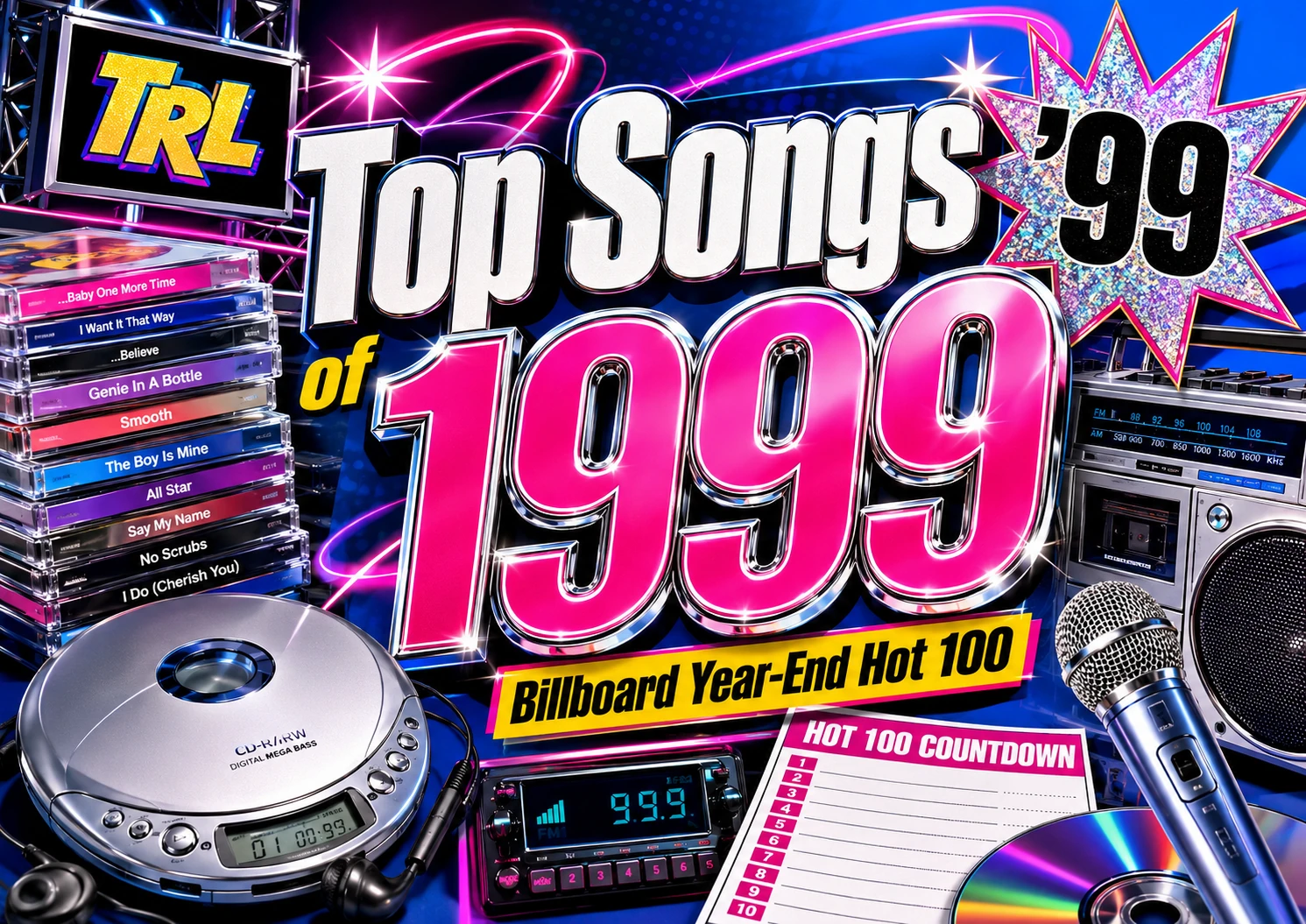
Top 10 Songs of 1999: Billboard’s Biggest Hits, Ranked
The top 10 songs of 1999 sound like the entire decade trying to leave through the same mall entrance. Teen pop had become an industrial operation. R&B still controlled the center of radio. Latin pop arrived with horns, leather pants, and no interest in waiting its turn. Dance-pop sounded metallic and futuristic, while breezy pop-rock and soft-focus romance kept pretending Y2K was not waiting outside.
This was the year Cher made reinvention sound like a machine from the future, TLC turned one insult into permanent vocabulary, and Britney Spears changed the temperature of pop music with a single opening piano hit.
Christina Aguilera arrived with a voice too large for ordinary newcomer status. Ricky Martin brought Latin pop into full American takeover mode. Monica, Whitney Houston, Faith Evans, Kelly Price, and Deborah Cox made sure R&B entered the new millennium with its emotional authority fully intact.
The ranking uses Billboard’s 1999 year-end Hot 100, so these are the biggest U.S. singles of the chart year based on cumulative performance—not a personal list of the best songs of 1999 and not a modern nostalgia vote.
“Believe” by Cher was Billboard’s number-one year-end song of 1999. “No Scrubs,” “Angel of Mine,” “Heartbreak Hotel,” and “…Baby One More Time” completed the top five.
Billboard Hot 100 Year-End Ranking
Billboard’s year-end order reflects performance across the full chart period. A weekly peak matters, but timing and staying power matter too. That is why songs such as “Heartbreak Hotel,” “Kiss Me,” and “Nobody’s Supposed to Be Here” finished inside the year-end top 10 without reaching number one.
1999 Was the Year the Future Arrived Early
The biggest songs of 1999 did not sound like a quiet ending. They sounded like every major late-90s trend had been given one final budget increase. Pop stars became full visual franchises. R&B remained musically and commercially central. Latin crossover broke wide open, and dance records began sounding less like ordinary instruments and more like somebody had installed software directly into the singer.
It was also the first full chart year after Billboard changed the Hot 100 to admit heavily played songs that were not sold as physical singles. That mattered because record labels had spent years keeping some enormous radio hits off the chart by withholding retail singles. By 1999, the Hot 100 more closely resembled what people were actually hearing in cars, malls, offices, clubs, and bedrooms.
The results were still wonderfully chaotic. Cher stood above a chart obsessed with youth. TLC turned standards into a singalong. Britney and Christina launched separate pop empires. Ricky Martin made the Latin-pop explosion look effortless, while Monica, Whitney Houston, Deborah Cox, and TLC kept R&B planted at the center of the culture.
Quick List: Top 10 Songs of 1999
- #1 “Believe” — Cher
- #2 “No Scrubs” — TLC
- #3 “Angel of Mine” — Monica
- #4 “Heartbreak Hotel” — Whitney Houston featuring Faith Evans and Kelly Price
- #5 “…Baby One More Time” — Britney Spears
- #6 “Kiss Me” — Sixpence None the Richer
- #7 “Genie in a Bottle” — Christina Aguilera
- #8 “Every Morning” — Sugar Ray
- #9 “Nobody’s Supposed to Be Here” — Deborah Cox
- #10 “Livin’ la Vida Loca” — Ricky Martin
1999 Billboard Year-End Top 10 at a Glance
This table shows Billboard’s complete 1999 year-end top 10, each song’s weekly Hot 100 peak, and the number of weeks it spent at number one.
| Year-End Rank | Song | Artist | Hot 100 Peak | Weeks at #1 |
|---|---|---|---|---|
| #1 | “Believe” | Cher | #1 | 4 |
| #2 | “No Scrubs” | TLC | #1 | 4 |
| #3 | “Angel of Mine” | Monica | #1 | 4 |
| #4 | “Heartbreak Hotel” | Whitney Houston featuring Faith Evans and Kelly Price | #2 | 0 |
| #5 | “…Baby One More Time” | Britney Spears | #1 | 2 |
| #6 | “Kiss Me” | Sixpence None the Richer | #2 | 0 |
| #7 | “Genie in a Bottle” | Christina Aguilera | #1 | 5 |
| #8 | “Every Morning” | Sugar Ray | #3 | 0 |
| #9 | “Nobody’s Supposed to Be Here” | Deborah Cox | #2 | 0 |
| #10 | “Livin’ la Vida Loca” | Ricky Martin | #1 | 5 |
Listen to the Top Songs of 1999
The companion playlist brings together the biggest songs of 1999 with the wider sound of the year: R&B, teen pop, Latin crossover, dance music, sunny pop-rock, adult heartbreak, alternative radio, movie songs, and the tracks that followed Gen X from car stereos to mall speakers and TRL afternoons.
Use the playlist while reading the countdown, then continue into the complete 90s Music archive for more Billboard year-end songs, hip-hop, R&B, slow jams, alternative music, grunge, pop hits, and Gen X radio memories.
Countdown: The Top 10 Songs of 1999
The countdown runs from Ricky Martin at #10 to Cher at #1, with chart peaks, weeks at number one, deeper 1999 music context, and lived-in Gen X memories for every song.
“Livin’ la Vida Loca”
Ricky Martin
Why It Hit
“Livin’ la Vida Loca” does not enter politely. It kicks open the door in leather pants, throws a spotlight across the room, and assumes everybody else will adjust. The percussion snaps, the horns shove the record forward, and the guitar hits with enough theatrical force to turn an ordinary car ride into an award-show entrance.
Ricky Martin sells every second like hesitation would be a breach of contract. The lyric is exaggerated, dangerous, glamorous, and ridiculous in exactly the right proportions. The woman in the song is not merely exciting. She is a complete emergency with excellent lighting.
The chorus also required no translation, explanation, or careful introduction. It arrived already designed for arenas, radio, television, clubs, weddings, and every public event willing to increase its pulse rate.
Why It Mattered in 1999
Five weeks at number one turned Ricky Martin’s English-language breakthrough into the opening blast of the year’s Latin-pop explosion. The record did not feel like a cautious crossover. It felt like the center of American pop had suddenly moved.
Its success helped clear a wider commercial path for Latin artists and Latin-influenced records throughout 1999. The same radio world soon made room for Jennifer Lopez, Enrique Iglesias, Marc Anthony, and a wave of music that refused to treat English-language pop as a closed club.
It also belongs squarely inside the late-90s pop and dance explosion, when the songs became louder, the videos became brighter, and performers were expected to arrive with enough visual energy to survive TRL.
Gen X Rewind
This is chrome-shirt, top-down-convertible, award-show takeover music.
Even people who had never followed Ricky Martin before knew the song almost immediately. One television performance, one massive chorus, and suddenly the entire country was living the same allegedly crazy life.
“Nobody’s Supposed to Be Here”
Deborah Cox
Why It Hit
“Nobody’s Supposed to Be Here” begins with the emotional confidence of somebody who has finally learned the lesson, closed the door, changed the locks, and promised never to make the same mistake again. Then love appears anyway and ruins a perfectly organized recovery plan.
That contradiction is the engine of the song. Deborah Cox does not sound eager to fall. She sounds irritated that her own heart has ignored several clearly posted warnings. The vocal grows from control into full surrender without losing the strength that makes the resistance believable.
The production gives the performance enough room to expand. It is polished and dramatic, but never so crowded that Cox disappears inside it. Every rise in the arrangement feels earned because the singer has spent the previous section trying to hold the emotion back.
Why It Mattered in 1999
The song peaked at number two, but its extraordinary endurance carried it to ninth for the year. It became one of those records that seemed permanently installed in radio rotation, moving between R&B, pop, adult contemporary, and dance remixes without losing its emotional center.
It remains an obvious entry among the essential R&B songs of the 1990s. The record delivered the decade’s preferred combination of vocal power, romantic damage, polished production, and enough resilience to make heartbreak sound like a job with benefits.
Gen X Rewind
This is “I was doing fine until the radio got involved” music.
The song belongs to late-night drives, call-in dedications, slow-dance floors, and the moment somebody decided emotional progress was overrated because the chorus had started again.
“Every Morning”
Sugar Ray
Why It Hit
Sugar Ray had figured out one of the most reliable late-90s radio tricks: make the music sound like excellent weather even when the relationship inside the lyric probably needs supervision.
“Every Morning” is all bright guitar, relaxed phrasing, and effortless singalong motion. Mark McGrath delivers the song with the confidence of somebody who has decided consequences are a problem for a less attractive afternoon.
Beneath the sunlit surface is a story about repetition, betrayal, return, and a romantic arrangement no sensible friend would endorse. That little edge gives the song enough personality to avoid becoming empty beach music.
Why It Mattered in 1999
A number-three peak and year-end #8 finish proved “Fly” had not been a one-time accident. Sugar Ray had found a version of pop-rock that could move through alternative radio, Top 40, adult formats, television, and summer playlists without sounding as if it had worked very hard.
The song also represents the lighter side of late-90s alternative crossover. By 1999, the guitars remained, but much of the angst had been replaced by polished hooks, celebrity charisma, and enough sunshine to sell sunglasses.
Gen X Rewind
This is beach-towel, mall-parking-lot, summer-break pop-rock.
It sounded like good weather even when your car had no air conditioning, your relationship was collapsing, and your CD player skipped every time somebody touched the dashboard.
“Genie in a Bottle”
Christina Aguilera
Why It Hit
Christina Aguilera entered a pop market already overflowing with carefully packaged newcomers, then immediately sounded as though she had brought more voice than the packaging could reasonably contain.
“Genie in a Bottle” does not bounce like ordinary bubblegum. It slides. The beat is controlled, the hook is suggestive without becoming blunt, and the production leaves enough open space for Christina’s vocal confidence to separate her from the crowd.
The song’s central metaphor performs several jobs at once. It sounds playful enough for teen pop while establishing boundaries and making desire conditional. The message is not simply attraction. It is attraction with an entrance exam.
Why It Mattered in 1999
Five weeks at number one made Christina’s arrival impossible to dismiss as an imitation of somebody else’s launch. The teen-pop boom clearly had room for more than one major female star, especially when the voices, personas, and records were distinct enough to create separate camps.
Alongside Britney Spears, Christina became one of the main engines of the late-90s teen-pop explosion. The rivalry would often be manufactured more aggressively than the music justified, but in 1999 the public was perfectly willing to buy both CDs and argue later.
Gen X Rewind
This is after-school TRL, glossy-lipstick, music-store listening-station pop.
You knew the chorus by the second spin. By the third, people were already debating who could sing, who could dance, who was copying whom, and why any of this had become a national policy discussion.
“Kiss Me”
Sixpence None the Richer
Why It Hit
“Kiss Me” sounds like a memory while it is still happening. The guitar is light, Leigh Nash’s vocal floats without disappearing, and the lyrics arrange moonlight, dancing, clothing, scenery, and romance with the care of somebody preparing a very expensive photograph.
Plenty of love songs try to sound timeless by removing every specific detail. “Kiss Me” takes the opposite route. Its details create the atmosphere, and the atmosphere does most of the emotional work.
The song never pushes. It glows. That softness made it useful across alternative-leaning radio, Top 40, adult formats, television, movie trailers, proms, and every romantic scene that needed to look more magical than the location budget allowed.
Why It Mattered in 1999
A number-two peak and year-end #6 finish made the song far larger than a pleasant alternative-pop crossover. Its appearances in teen-oriented movies and television helped attach it permanently to the soft-focus side of late-90s youth culture.
The record also provided a quiet contrast to the louder teen pop surrounding it. Britney, Christina, Ricky Martin, and Cher arrived with spectacle. Sixpence None the Richer succeeded with a guitar, an airy voice, and the suggestion that somebody nearby had hung string lights.
Gen X Rewind
This is prom-night, backyard-light, teen-movie makeover music.
It could make a gymnasium feel romantic, a suburban yard feel cinematic, and an ordinary walk through a mall parking lot feel as though Freddie Prinze Jr. might be waiting near the entrance.
“…Baby One More Time”
Britney Spears
Why It Hit
Some debut singles introduce an artist. “…Baby One More Time” introduced an entire new operating system for pop culture.
The opening piano hit is practically a starting pistol. Britney’s vocal enters with a strange mixture of confidence, loneliness, youth, and melodrama, while the production keeps tightening the hook until the chorus feels less like a section of the song and more like a permanent memory.
The record is engineered with ruthless precision, but it never sounds emotionally empty. Britney sells the longing directly enough to make the stakes feel real, even when the phrase at the center of the song left half the audience wondering what the songwriter had actually meant.
Why It Mattered in 1999
Two weeks at number one were only the numerical beginning. The video, styling, choreography, school setting, and public image became inseparable from the record. The song was not merely heard. It was watched, copied, discussed, criticized, parodied, defended, and replayed until resistance became theoretical.
Britney became the defining face of the late-90s teen-pop takeover. The arrival changed radio, MTV, magazines, fashion, celebrity coverage, and the standards by which every young pop performer would be judged for the next several years.
Gen X Rewind
This is after-school MTV, mall-record-store, Y2K hallway music.
One minute the decade still belonged to alternative bands, R&B groups, and adult ballads. Then the locker doors opened, Britney stepped into the hallway, and everybody understood the dress code had changed.
“Heartbreak Hotel”
Whitney Houston featuring Faith Evans and Kelly Price
Why It Hit
“Heartbreak Hotel” is not Whitney Houston standing alone in the center of an enormous ballad and lifting the entire arrangement toward the ceiling. This record is darker, closer, and more interested in the exhausted anger that arrives after the dramatic crying has already happened.
Faith Evans and Kelly Price turn the song into a shared indictment. Three major voices occupy the same emotional space, but they do not compete for the largest note. They build a collective case against somebody who has clearly exceeded the permitted amount of nonsense.
The production is smooth, shadowy, and firmly rooted in late-90s R&B. Whitney sounds contemporary without chasing younger artists, because the authority in her voice allows the music to move around her rather than replace her.
Why It Mattered in 1999
Its number-two peak and year-end #4 finish marked a major chapter in Whitney’s late-90s return to the center of R&B radio. She was no longer being presented only as the voice behind monumental adult ballads. She sounded fully connected to the current decade.
The record remains a major stop among the essential R&B songs of the 1990s, combining three distinct singers, grown-up frustration, restrained production, and enough vocal authority to make emotional damage sound professionally managed.
Gen X Rewind
This is expensive heartbreak music with full emotional staffing.
The lighting is dramatic, the evidence has been collected, the witnesses are prepared, and nobody is interested in hearing one more excuse before the chorus.
“Angel of Mine”
Monica
Why It Hit
After the competitive drama surrounding “The Boy Is Mine,” Monica returned with a song that seemed determined to lower the room’s blood pressure.
“Angel of Mine” is romantic without being flimsy. The melody is warm, the production is polished but patient, and Monica’s voice gives the song enough gravity to keep its tenderness from floating away.
She sounds young, but never uncertain. The performance carries the calm confidence of somebody recognizing that a relationship has changed her life and deciding that the truth does not require additional theatrics.
Why It Mattered in 1999
Four weeks at number one and a year-end #3 finish proved Monica’s success was not dependent on a duet, a rivalry, or the surrounding publicity. She could carry one of the year’s biggest records entirely through vocal presence and emotional clarity.
The song also reflects the remarkable space R&B held inside mainstream pop. A straightforward, sincere love song by a young Black woman could sit near the absolute top of the national chart without being treated as a specialist-format success.
Gen X Rewind
This is first-love idealism with better emotional competence than most real relationships could manage.
It belongs to radio dedications, slow dances, handwritten notes, and the period before text messages allowed people to damage romance with immediate access to one another.
“No Scrubs”
TLC
Why It Hit
“No Scrubs” achieves something most records never manage: it is musically smooth, lyrically ruthless, instantly funny, endlessly quotable, and useful enough to function as a screening process.
The production stays clean and controlled, allowing every rejection to land without interference. TLC does not sound furious. They sound finished. That difference is the entire power of the record.
A scrub is not presented as a dangerous villain or epic heartbreak. He is simply unqualified. The song treats his confidence as a clerical mistake and moves on before he can request an appeal.
Why It Mattered in 1999
Four weeks at number one and a year-end #2 finish turned the song into one of TLC’s largest hits. More impressively, it pushed its central word into everyday language so quickly that “scrub” almost stopped feeling like a lyric.
Its place among the 50 essential 90s R&B songs is secure because it combined message, humor, image, futuristic production, and a chorus that remained fun even after radio had played it enough times to qualify as workplace equipment.
The video reinforced TLC’s position at the edge of the next millennium. Silver sets, futuristic clothing, sharp movement, and Left Eye’s presence made the whole thing look like pop culture had been rebuilt inside a very expensive computer.
Gen X Rewind
This is the song where the chorus became common vocabulary before anyone had time to object.
School hallways, workplaces, radio shows, and living rooms suddenly contained detailed public discussions about who had no car, who lived at home, who was leaning from which side of whose ride, and why none of it would be accepted.
“Believe”
Cher
Why It Hit
“Believe” sounded like the future arriving through a speaker that had not been properly installed yet. The beat was enormous, the chorus was immediate, and Cher’s processed vocal turned a breakup song into something metallic, emotional, and completely unlike the adult-pop comeback records anybody expected from her.
The vocal effect attracted attention, but the song underneath it is what made the record last. “Believe” begins in pain, then refuses to remain there. The chorus turns survival into movement and gives the dance floor permission to function as emotional rehabilitation.
Cher also delivers the central question with the authority of somebody who has survived several versions of the music industry and has no interest in being defeated by one more disappointing man.
Why It Mattered in 1999
Four weeks at number one and the year-end crown made “Believe” one of the greatest comeback singles in pop history. In a year obsessed with teenage newcomers, the biggest record belonged to an artist who had already been famous through multiple generations of formats, fashions, and pop machinery.
The heavily processed vocal became one of the most copied production ideas of the years that followed. What initially sounded startling soon became part of the ordinary language of pop, dance music, hip-hop, and electronic production.
The song also belongs at the center of the late-90s pop and dance story. It connected adult resilience, club energy, futuristic production, and an enormous singalong without pretending youth was the only route to relevance.
Gen X Rewind
This is millennium-prep music: club lights, emotional wreckage, metallic vocals, and the sensation that the next decade had already started downloading.
There was something deeply satisfying about Cher standing above a chart packed with young stars. The industry spent 1999 selling the future, and the year’s biggest song came from somebody who had already survived several of them.
It was a perfect ending. The decade did not fade out. It turned on the effects, raised the volume, and left through the dance floor.
Keep Rewinding 1999
Continue through the final year of the decade with television, movies, toys, videos, and the larger 90s music archive. Together, these pages connect Billboard’s biggest songs of 1999 to the rest of the culture surrounding them.
1999 Rewind Verdict
1999 did not quietly end the decade. It summarized it, digitized it, overproduced it, and sent it onto television wearing better lighting.
R&B remained central enough to place TLC, Monica, Whitney Houston, Faith Evans, Kelly Price, and Deborah Cox inside the top 10. Teen pop became a full cultural machine through Britney Spears and Christina Aguilera. Ricky Martin helped open the Latin-pop floodgates, while Sugar Ray and Sixpence None the Richer kept radio’s softer guitar lane alive.
Above all of them stood Cher. “Believe” made heartbreak danceable, made digital vocal processing unavoidable, and proved reinvention did not belong only to whichever teenagers had just arrived at MTV.
For Gen X, these songs are TRL afternoons, CD singles, mall speakers, school dances, grocery stores, car rides, teen-movie trailers, bedroom stereos, dial-up internet, and the sound of the 90s taking one last glossy bow before Y2K kicked the door in.
FAQ: Top Songs of 1999
What was the #1 song of 1999?
“Believe” by Cher was Billboard’s number-one Hot 100 year-end song of 1999.
What were the top five songs of 1999?
The top five were “Believe” by Cher, “No Scrubs” by TLC, “Angel of Mine” by Monica, “Heartbreak Hotel” by Whitney Houston featuring Faith Evans and Kelly Price, and “…Baby One More Time” by Britney Spears.
What were Billboard’s top 10 songs of 1999?
The top 10 were “Believe,” “No Scrubs,” “Angel of Mine,” “Heartbreak Hotel,” “…Baby One More Time,” “Kiss Me,” “Genie in a Bottle,” “Every Morning,” “Nobody’s Supposed to Be Here,” and “Livin’ la Vida Loca.”
Why does this countdown use Billboard’s year-end Hot 100?
The year-end chart measures cumulative U.S. chart performance across Billboard’s chart period rather than personal opinion or present-day nostalgia.
How long was “Believe” at #1?
Cher’s “Believe” spent four weeks at number one on the Billboard Hot 100.
How long was “No Scrubs” at #1?
TLC’s “No Scrubs” spent four weeks at number one on the Billboard Hot 100.
How long was “Genie in a Bottle” at #1?
Christina Aguilera’s “Genie in a Bottle” spent five weeks at number one.
How long was “Livin’ la Vida Loca” at #1?
Ricky Martin’s “Livin’ la Vida Loca” spent five weeks at number one.
Did “Heartbreak Hotel” reach #1?
No. Whitney Houston’s “Heartbreak Hotel” peaked at number two, but its staying power carried it to fourth on Billboard’s 1999 year-end chart.
Did “Kiss Me” reach #1?
No. “Kiss Me” by Sixpence None the Richer peaked at number two and finished sixth on Billboard’s year-end chart.
Which songs in the 1999 top 10 reached #1?
“Believe,” “No Scrubs,” “Angel of Mine,” “…Baby One More Time,” “Genie in a Bottle,” and “Livin’ la Vida Loca” reached number one.
Why was “Believe” such an important song?
It became an enormous comeback for Cher, helped bring hard-tuned vocal processing into mainstream pop, and combined breakup emotion with a dance record built for the approaching millennium.
Why does 1999 sound so different from earlier 90s music?
Teen pop, futuristic dance production, Latin crossover, polished R&B, larger music videos, and the approaching Y2K era all changed the sound and presentation of mainstream music.
Is there a playlist for the top songs of 1999?
Yes. The companion Smells Like Gen X Spotify playlist is embedded on this page.
Where can I find more 1999 nostalgia?
The same-year links connect to the top television shows, movies, toys, videos, and the wider 90s Music archive.