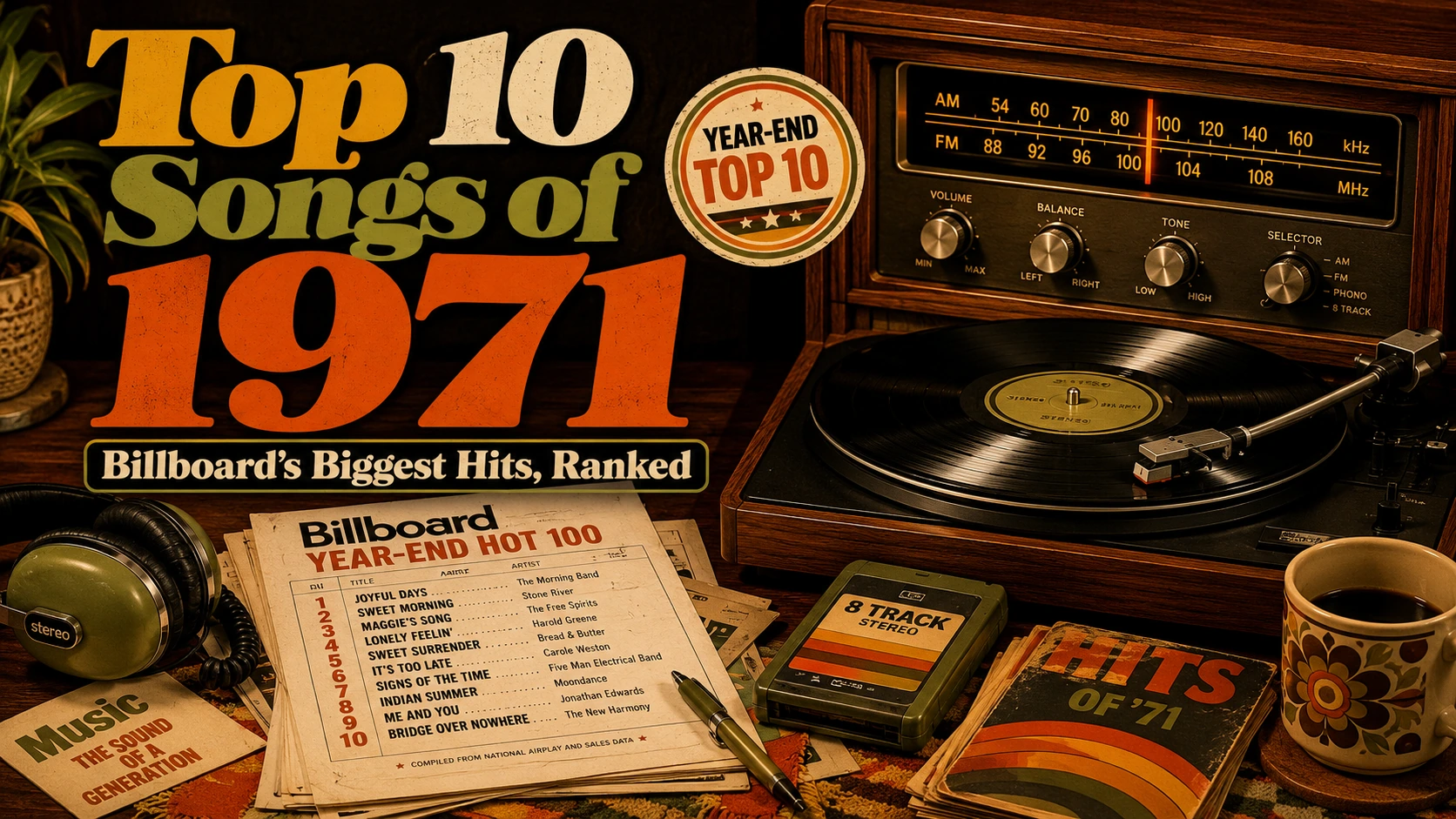
Top 10 Songs of 1971: Billboard’s Biggest Hits, Ranked
The top 10 songs of 1971 sound like a country changing stations without deciding what it wanted to hear next. Confessional singer-songwriters moved into the center, teen idols still ruled entire bedrooms, Motown delivered one of its most elegant heartbreak records, and giant pop-rock choruses continued flattening everything in their path.
Carole King made adult emotional honesty sound like mainstream pop. Rod Stewart turned a rough voice and complicated memory into a number-one breakthrough. John Denver built a permanent American singalong without ever reaching the weekly top spot.
At the same time, the Temptations made fantasy collapse in slow motion, the Bee Gees asked an unanswerable heartbreak question, and the Osmond family occupied two positions in the year-end top seven. Then Three Dog Night put a bullfrog at the beginning of the biggest song of the year and somehow made the entire country sing along.
This countdown follows Billboard’s 1971 year-end Hot 100. It ranks the biggest U.S. singles of the chart year by cumulative performance, not personal preference or later critical reputation.
“Joy to the World” by Three Dog Night was Billboard’s number-one year-end song of 1971. “Maggie May / Reason to Believe,” “It’s Too Late / I Feel the Earth Move,” “One Bad Apple” and “How Can You Mend a Broken Heart” completed the year’s top five.
Billboard Hot 100 Year-End Ranking
The weekly Hot 100 combined record sales and radio-airplay reporting. Billboard’s year-end order rewards performance across the chart period, which is why a durable number-two hit such as “Take Me Home, Country Roads” could outrank shorter-lived number-one singles.
1971 Put Personal Songs Beside Giant Pop Machinery
The biggest songs of 1971 reveal a radio culture with very few walls. Carole King’s conversational breakup realism could sit beside the Osmonds’ polished family pop, while Rod Stewart’s rough folk-rock storytelling shared the dial with Dawn’s apartment-building novelty romance.
That variety was not accidental. The single remained a shared national object, and AM radio still had the power to make completely different genres sound like parts of the same afternoon. Soul, country crossover, bubblegum, folk-rock, adult ballads and pop-rock anthems all competed for the same listeners.
The year also marked a shift toward records that sounded more personal. Even the largest productions often centered on private emotion: imagined love, failed relationships, homesickness, regret and the desire to get back somewhere that felt more stable than the present.
Quick List: Top 10 Songs of 1971
- #1 “Joy to the World” — Three Dog Night
- #2 “Maggie May / Reason to Believe” — Rod Stewart
- #3 “It’s Too Late / I Feel the Earth Move” — Carole King
- #4 “One Bad Apple” — The Osmonds
- #5 “How Can You Mend a Broken Heart” — Bee Gees
- #6 “Indian Reservation” — Raiders
- #7 “Go Away Little Girl” — Donny Osmond
- #8 “Take Me Home, Country Roads” — John Denver
- #9 “Just My Imagination (Running Away with Me)” — The Temptations
- #10 “Knock Three Times” — Dawn
1971 Billboard Year-End Top 10 at a Glance
This table shows Billboard’s complete 1971 year-end top 10, each record’s weekly Hot 100 peak and the number of weeks it spent at number one.
| Year-End Rank | Song | Artist | Hot 100 Peak | Weeks at #1 |
|---|---|---|---|---|
| #1 | “Joy to the World” | Three Dog Night | #1 | 6 |
| #2 | “Maggie May / Reason to Believe” | Rod Stewart | #1 | 5 |
| #3 | “It’s Too Late / I Feel the Earth Move” | Carole King | #1 | 5 |
| #4 | “One Bad Apple” | The Osmonds | #1 | 5 |
| #5 | “How Can You Mend a Broken Heart” | Bee Gees | #1 | 4 |
| #6 | “Indian Reservation” | Raiders | #1 | 1 |
| #7 | “Go Away Little Girl” | Donny Osmond | #1 | 3 |
| #8 | “Take Me Home, Country Roads” | John Denver | #2 | 0 |
| #9 | “Just My Imagination (Running Away with Me)” | The Temptations | #1 | 2 |
| #10 | “Knock Three Times” | Dawn | #1 | 3 |
Put 1971 Back on the Dial
Radio in 1971 could move from the Temptations’ quiet fantasy to Three Dog Night’s full-room singalong, then slide into John Denver, Donny Osmond or Rod Stewart without issuing a warning. Nobody needed the station to remain inside one carefully branded mood.
Continue through the complete 70s Music archive for year-by-year countdowns and the soul, funk, disco, classic rock, soft rock and AM-radio records that followed Gen X through kitchens, cars, department stores and wood-paneled living rooms.
Countdown: The Top 10 Songs of 1971
The countdown runs from Dawn at #10 to Three Dog Night at #1, with chart peaks, number-one runs, production details, deeper 1971 context and the memories these records carried into Gen X childhood.
“Knock Three Times”
Dawn
Why It Hit
“Knock Three Times” understood something fundamental about pop radio: listeners love a song that gives them something to do. The central knock-and-pipe signal is not merely a lyric. It is a built-in audience-participation device, a tiny piece of choreography that turns the chorus into a game before the record has even finished its first spin.
The production keeps everything bright and moving. Acoustic guitar, handclap-style accents, strings and a buoyant rhythm section create the feeling of a neighborhood musical taking place in the space between two apartments. Tony Orlando’s lead vocal sells the premise without smirking at it. That commitment is why the record lands as sincere pop rather than a disposable novelty.
As one of the biggest songs of 1971, it also benefited from being instantly understandable. No decoding was required. The story, the signal and the hook all arrived in the same package, making the single easy for Top 40 stations to repeat and even easier for listeners to remember.
Inside the Record
The song’s apartment-building setup gives it an almost cinematic quality. A man sees a woman below him, cannot work up the nerve to approach her directly and invents a coded response system: three knocks on the ceiling for yes, two strikes on the pipe for no. It is romantic, awkward and just exaggerated enough to feel like prime early-70s pop storytelling.
Musically, the arrangement keeps adding little bursts of color without getting in the way of the chorus. The verses move quickly, the pre-chorus tightens the anticipation, and the payoff arrives with a rhythmic pattern that practically announces itself through the speakers. That economy is a major reason the record survived heavy rotation.
The result sits comfortably between bubblegum pop, adult contemporary and the light country-pop crossover that was becoming increasingly common. That broad fit mattered in 1971, when a hit could travel through AM radio, variety television and family record collections without needing to belong to one narrow genre.
Why It Mattered in 1971
Three weeks at number one and a year-end #10 finish made “Knock Three Times” far more than a cute seasonal hit. It was evidence that playful, tightly constructed pop still had enormous commercial power during a year increasingly associated with confessional albums and serious singer-songwriters.
That contrast helps explain the richness of the 1971 Billboard hits. Carole King, Rod Stewart and the Temptations could bring introspection and ache, while Dawn could arrive with a ceiling-knock chorus and own the same radio dial. Mainstream pop was broad enough to hold all of it.
Gen X Rewind
For Gen X kids, this is the sort of record that seemed to be permanently stored inside kitchen radios and wood-grain console stereos. Even when nobody knew the title, somebody knew the knocking part.
It also carries the feel of early-70s variety television: bright sets, coordinated smiles and adults enjoying a song without first needing to explain why it was culturally important. Sometimes the hook was the whole point, and that was plenty.
“Just My Imagination (Running Away with Me)”
The Temptations
Why It Hit
“Just My Imagination (Running Away with Me)” is devastating because it remains so calm. The narrator imagines a complete life with a woman he barely knows, and the Temptations present that fantasy with such elegance that the listener can briefly believe it too. Only then does the title line pull the floor away.
Eddie Kendricks’ falsetto is the center of the record. He sounds hopeful, fragile and already aware that the life he is describing exists only in his head. The group harmonies never overwhelm him; they float around the lead like the dream itself, beautiful enough to make the eventual realization hurt more.
The single became one of the top soul songs of 1971 because it joined emotional sophistication to extraordinary radio polish. It was romantic enough for broad pop audiences, unmistakably rooted in Motown, and restrained enough to reward repeated listening rather than exhausting the feeling in one dramatic burst.
Inside the Record
The arrangement marked a graceful return to romantic balladry after the Temptations’ run of psychedelic-soul records. Strings, a gentle rhythm section and carefully layered vocals create space around the melody. Nothing rushes, because the entire song depends on the listener slowly discovering how much of the relationship has been imagined.
That structure is what makes the lyric more than simple unrequited love. The narrator has designed a home, children and a future before admitting that the woman does not even know him. The record understands how private fantasy can become emotionally real long before reality has agreed to participate.
The song also carries historical weight within the group. It is closely associated with the end of Eddie Kendricks’ classic Temptations era, which gives the performance another layer of farewell even when listeners are not consciously thinking about personnel changes.
Why It Mattered in 1971
Two weeks at number one and a year-end #9 finish showed that subtle soul could compete with the loudest pop hooks on American radio. The song did not need a gimmick or a large vocal explosion. Its power came from detail, patience and the ache of a fantasy quietly collapsing.
It also helped define the emotional breadth of the biggest songs of 1971. The year’s chart was not only about communal singalongs and teen-idol excitement. It made room for one of Motown’s most inward-looking and psychologically precise hits.
Gen X Rewind
This is living-room music after the conversation has stopped. Somebody is folding laundry, washing dishes or staring out a window, and the record is saying the thing nobody in the room plans to say aloud.
Many Gen X listeners encountered the Temptations as part of an inherited family soundtrack. “Just My Imagination” was one of the records that revealed the adults’ old music was carrying much more emotional information than children first realized.
“Take Me Home, Country Roads”
John Denver
Why It Hit
“Take Me Home, Country Roads” feels familiar almost before the first chorus ends. The melody rises in a way that invites another voice to join it, while the lyric turns landscape into emotional shorthand. West Virginia is not only a destination in the song; it becomes the name for belonging, distance and the place a person imagines when the present world feels temporary.
John Denver’s performance is warm without becoming overly polished. His vocal carries enough plainspoken sincerity to make the homesickness believable, and the acoustic arrangement leaves the song open for listeners to place their own road, town or childhood scenery inside it.
That universality explains why a record that peaked at number two still finished as one of the top songs of 1971. It worked as country crossover, folk-pop, singer-songwriter radio and communal singalong all at once. Few records could move through that many spaces without sounding calculated.
Inside the Record
The song was written by Denver with Bill Danoff and Taffy Nivert, and its greatest strength is the balance between specific images and broad emotion. Blue Ridge Mountains and the Shenandoah River give the lyric a location, while the repeated desire to go home gives every listener an entry point.
The arrangement is carefully modest. Acoustic guitar establishes motion, harmony vocals widen the chorus, and the rhythm never pushes so hard that the song loses its reflective quality. It sounds like a road trip without becoming a novelty travel song.
Its singability is also unusually durable. The melody does not demand a trained voice, and the chorus is built around long, open phrases that sound better when a roomful of people joins in. That quality helped the record outgrow its original chart run and become something closer to a folk standard.
Why It Mattered in 1971
The single’s year-end #8 placement demonstrated how completely country-influenced singer-songwriter music had entered mainstream pop. It did not need to reach number one to become one of the year’s defining records because it stayed useful across radio formats and listening situations.
It also pointed toward the softer, rural and acoustic side of 1970s pop. While rock grew heavier and soul became more expansive, records like this made intimacy, landscape and uncomplicated melody central parts of the decade’s commercial sound.
Gen X Rewind
This is back-seat station-wagon music: highway lines sliding past, vinyl seats sticking to bare legs and the adults in front singing louder when the chorus arrives.
For Gen X, “Country Roads” became one of those songs that existed everywhere—school assemblies, family gatherings, campfires, television and old radio stations. It felt inherited rather than discovered, which may be the clearest sign that a hit has become permanent.
“Go Away Little Girl”
Donny Osmond
Why It Hit
“Go Away Little Girl” arrived with a melody that had already proven its strength, but Donny Osmond’s version changed the emotional temperature. In his hands, the song became clean-cut teen drama—earnest, conflicted and safe enough for young listeners while still sounding polished enough for adult-controlled radio.
Osmond’s youthful voice is the key. The lyric describes someone trying to resist temptation, yet the performance carries more innocence than danger. That mismatch made the record especially effective for the teen-idol market: it offered romantic tension without asking the audience to enter a world that felt too adult.
The single became one of the biggest pop songs of 1971 because the melody was immediate and the star image was perfectly aligned with the moment. Radio, television appearances, fan magazines and family-friendly entertainment all reinforced one another.
Inside the Record
Written by Gerry Goffin and Carole King, the song already carried the sturdy construction of the Brill Building tradition. The verses build tension in compact phrases, while the title gives the chorus a simple emotional contradiction: leave because I do not want you to leave too late.
The 1971 production avoids rough edges. Strings, backing vocals and a controlled rhythm section keep the record smooth and bright, allowing Osmond’s vocal to remain the obvious focus. This was not music designed to challenge the listener; it was designed to create immediate attachment.
That does not make the craftsmanship accidental. Teen pop succeeds when the fantasy, voice and arrangement all point in the same direction. “Go Away Little Girl” did exactly that, turning an older songwriting standard into a record that belonged completely to the early-70s youth market.
Why It Mattered in 1971
Three weeks at number one and a year-end #7 finish proved that teen-idol pop remained a major commercial force even as album-oriented rock and singer-songwriter confessionals gained cultural prestige. Billboard’s year-end chart measures what people actually played and bought, and Donny Osmond was impossible to ignore.
The song also illustrates the generational layering of 1971 radio. A composition associated with an earlier pop era could return through a new young star and become contemporary again, connecting parents’ songwriting vocabulary with their children’s fan culture.
Gen X Rewind
This is Tiger Beat arriving through the radio speaker: carefully combed hair, television smiles and emotional crisis delivered in a form that could pass inspection in the family living room.
Gen X children often met teen-idol culture through older siblings, babysitters and magazine stacks. Even listeners who never owned a Donny Osmond record knew the voice, the face and the machinery surrounding songs like this.
“Indian Reservation”
Raiders
Why It Hit
“Indian Reservation” sounded darker and more deliberate than much of the pop surrounding it. The descending melody, martial rhythm and heavy vocal delivery immediately signaled that this was not another lightweight romance record. Even before listeners absorbed the lyric, the arrangement created a sense of displacement and loss.
Released under the shortened Raiders name, the record used the familiar pop-rock force associated with Paul Revere & the Raiders but redirected it toward a more solemn narrative. The chorus is broad enough for radio, yet the minor-key mood keeps the song from feeling triumphant.
That distinct identity helped it become one of the top Billboard songs of 1971. In a year filled with warm acoustic records and bright teen pop, “Indian Reservation” occupied its own shadowed corner of the dial.
Inside the Record
The full title frames the song as a lament connected to Cherokee displacement and cultural loss. Like many historical pop songs of its era, it compresses a complicated and painful history into a few dramatic verses. The record can open a door to that history, but it should not be mistaken for a complete or authoritative account of Indigenous experience.
Musically, the track depends on repetition. The rhythm moves with a processional quality, the vocal remains direct, and the chorus returns like a public declaration. That simplicity made the record memorable while preserving its serious tone.
The production also shows how mainstream pop could use atmosphere as a hook. There is no cheerful release and no conventional romantic payoff. The tension itself becomes the reason to keep listening, which was unusual enough to make the song stand apart.
Why It Mattered in 1971
Although it spent only one week at number one, sustained performance carried the single to sixth on Billboard’s year-end list. That is a reminder that annual rankings reward the full life of a hit, not only the length of its stay at the summit.
Its success also demonstrated that 1971 Top 40 still had room for records with political or historical weight, even when that weight was filtered through the simplified language of commercial pop. The song’s seriousness was part of its appeal, not an obstacle to it.
Gen X Rewind
For children, this was one of those records that made the room feel suddenly more serious. The title, rhythm and vocal suggested adult history was passing through the speaker, even when the details remained unclear.
That sense of mystery gave the song lasting power in oldies rotation. It did not blend into the background. It arrived with a mood, demanded attention and left questions behind.
“How Can You Mend a Broken Heart”
Bee Gees
Why It Hit
“How Can You Mend a Broken Heart” begins with a question it never expects to answer. That is the source of its power. The Bee Gees do not offer easy recovery or a tidy lesson; they remain inside the uncertainty, allowing the melody and harmonies to express what the lyric cannot solve.
Barry and Robin Gibb’s voices create a blend that sounds intimate and enormous at the same time. The lead carries exhaustion, while the harmonies widen the grief until it feels communal. The arrangement moves slowly, but every chord change adds pressure rather than letting the song drift.
As one of the biggest love songs of 1971, it succeeded because the emotion was universal and the production never oversold it. The record aches instead of begging. That restraint made it suitable for repeated radio play and personal replay after the chart run ended.
Inside the Record
The song belongs to the Bee Gees’ pre-disco period, when their reputation rested largely on melancholy songwriting, unusual chord movement and close vocal harmony. Listeners who know only the group’s late-70s falsetto image can hear a different kind of mastery here: softer, lower and deeply rooted in traditional pop ballad craft.
The arrangement leaves generous space around the vocal. Piano, strings and rhythm section enter carefully, creating the feeling of a private reflection gradually becoming too large to contain. The tempo never rushes toward relief because the song understands heartbreak rarely follows a useful schedule.
Its lyric also moves beyond a single romantic situation. Questions about rain, sunlight and beginnings turn private loss into something elemental. That broad language helped listeners apply the song to whatever absence they were carrying.
Why It Mattered in 1971
Four weeks at number one gave the Bee Gees their first U.S. Hot 100 chart-topper and established the group as a major American singles act years before the disco era transformed their public image.
The year-end #5 finish also reinforced the importance of adult emotional ballads within the 1971 music hits. The same chart that rewarded novelty hooks and teen stars made room for a slow, unresolved question about how people survive loss.
Gen X Rewind
This is the record that changes the room without anyone touching the lights. Adults keep doing what they were doing, but the conversation becomes thinner and somebody suddenly pays more attention to the stereo.
For Gen X listeners, the Bee Gees often arrived backward—from disco superstardom to the older family records. Discovering this song revealed that the group had already mastered heartbreak long before Saturday-night white suits entered the picture.
“One Bad Apple”
The Osmonds
Why It Hit
“One Bad Apple” moves with the confidence of a record that knows the chorus will work. The rhythm is bright, the group vocals are tightly arranged and the central phrase turns a familiar saying into an immediate romantic promise. By the time the title arrives, the listener already understands the entire argument.
The Jackson 5 influence is difficult to miss, especially in the youthful lead, syncopated groove and call-and-response energy. But imitation alone does not produce five weeks at number one. The Osmonds delivered the song with precision, personality and enough family-group chemistry to make the performance feel convincing on its own terms.
This was one of the biggest teen-pop songs of 1971 because it combined bubblegum accessibility with soul-influenced movement. Children could latch onto the hook, teenagers had the group image, and adult radio listeners received a professionally built pop single.
Inside the Record
The arrangement is a study in forward motion. Bass, drums and guitar establish the groove immediately, while the backing vocals answer the lead and keep the chorus in constant circulation. There is very little dead space because every element is pushing toward the next hook.
The lyric offers reassurance rather than heartbreak. One bad relationship should not poison the possibility of another, and the song packages that advice in a proverb simple enough to remember after one listen. Pop often succeeds by making emotional recovery sound easier than it is, and this record does so with complete confidence.
The Osmonds’ family image also mattered. They could appear on television, in magazines and on family stereos without creating the anxiety attached to rougher rock acts. The record’s brightness was part of a larger entertainment package built for maximum mainstream acceptance.
Why It Mattered in 1971
Five weeks at number one made “One Bad Apple” one of the longest-running chart-toppers of the year. Its year-end #4 placement confirms that teen and family pop were not side stories in 1971; they were central commercial forces.
The record also captures how quickly successful sounds traveled. Motown’s rhythmic and vocal language had reshaped American pop so thoroughly that a Utah family group could absorb those ideas, redirect them toward its own audience and create a massive hit.
Gen X Rewind
This is Saturday-morning television energy in record form: bright clothes, coordinated movement, family entertainment and a chorus that follows you into the rest of the day.
For Gen X kids, the Osmonds were part band, part television presence and part older-sibling fan culture. “One Bad Apple” is the moment all of those pieces locked together around an undeniable groove.
“It’s Too Late / I Feel the Earth Move”
Carole King
Why It Hit
Carole King’s double-sided single offered two different kinds of emotional force. “It’s Too Late” faced the end of a relationship with adult clarity, while “I Feel the Earth Move” delivered physical excitement through piano, rhythm and one of the most memorable openings of the year. Together they made the record almost impossible for radio to wear out.
“It’s Too Late” is especially striking because nobody is cast as a villain. The relationship has changed, both people know it, and the sadness comes from recognizing that affection cannot always repair what has ended. King’s conversational vocal makes the realization sound lived rather than performed.
That emotional honesty helped the single become one of the most important songs of 1971 as well as one of the biggest. The music was intimate enough to feel personal and melodic enough to dominate mainstream radio.
Inside the Record
The two sides reveal the range of Tapestry. “I Feel the Earth Move” is driven by piano and rhythmic urgency, with King sounding energized by desire. “It’s Too Late” uses a cooler groove, jazz-colored instrumentation and measured phrasing to describe what happens after the heat has gone.
King had already written major hits for other artists, but these performances made the songwriter herself the center of the story. Her voice was not polished in the traditional pop-diva sense, and that was part of the appeal. She sounded like the person who had actually lived through the words.
The double-sided success also suited radio perfectly. Stations could choose the urgency or the resignation, while listeners received two distinct reasons to buy the same single. Few records represented the breadth of early-70s adult pop so efficiently.
Why It Mattered in 1971
Five weeks at number one and a year-end #3 finish confirmed that the singer-songwriter movement had moved from the album pages into the commercial center of American pop. Personal writing was no longer an alternative to hitmaking; it had become one of its strongest forms.
The record also helped redefine what a major female pop star could sound like. King did not need elaborate theatrical presentation. Piano, precise writing and emotional credibility were enough to reshape the year.
Gen X Rewind
This is the sound of an album adults played from beginning to end. The cover seemed to be in every record collection, and the songs became part of the house long before children understood why they mattered.
For Gen X listeners, “It’s Too Late” often arrived as background music and became more accurate with age. The older you got, the less it sounded like a sad song and the more it sounded like someone telling the truth.
“Maggie May / Reason to Believe”
Rod Stewart
Why It Hit
“Maggie May” sounded rougher, looser and more lived-in than most polished pop singles of 1971. Rod Stewart’s rasp makes every line feel like a confession delivered after too little sleep, while the acoustic arrangement moves with the uncertain momentum of someone trying to decide whether regret and affection can occupy the same memory.
The narrative is unusually specific for a giant radio hit. Stewart is not singing an abstract love song; he is looking back at an older woman, lost time, damaged confidence and a relationship that still carries attraction after the excuses have run out. That specificity made the record feel private even when millions were hearing it.
As one of the biggest rock songs of 1971, it connected album-oriented looseness to Top 40 immediacy. The vocal was distinctive, the story was memorable and the mandolin-colored arrangement gave the single a sound no other record on the chart could easily imitate.
Inside the Record
“Reason to Believe” was initially treated as the more obvious side, but radio listeners and programmers gravitated toward “Maggie May.” That reversal is part of the song’s mythology: the supposed secondary track became the defining hit because people responded to its personality rather than the original marketing plan.
The arrangement feels conversational. Acoustic guitars, bass and drums leave room for Stewart’s phrasing, while the mandolin passage provides a bright instrumental signature against the complicated lyric. The record sounds carefully played without sounding carefully contained.
Stewart’s vocal performance is central to the sense of authenticity. He cracks, drags and pushes phrases in ways that a smoother singer might have corrected. Those imperfections make the narrator sound as though he is discovering the truth while telling it.
Why It Mattered in 1971
Five weeks at number one and a year-end #2 finish turned Rod Stewart into a major solo star. The record demonstrated that a singer could bring folk-rock instrumentation, adult subject matter and a visibly imperfect voice into the center of American pop.
It also captured the early-70s shift toward personality-driven records. The song did not sound manufactured for everyone, which is precisely why so many people believed it belonged to them.
Gen X Rewind
This is late-night FM spilling into the AM-radio world: older, rougher and slightly disreputable compared with the clean-cut pop elsewhere on the dial.
For Gen X kids, Rod Stewart’s voice always sounded as though it had already survived several lives. “Maggie May” was the record that made that weathered sound feel inseparable from the story.
“Joy to the World”
Three Dog Night
Why It Hit
“Joy to the World” begins with a line so strange and confident that the listener has no choice but to follow it. Jeremiah the bullfrog is not explained because explanation would slow the record down. Three Dog Night simply launches into the story, lets the absurdity become familiar and turns the chorus into a celebration large enough for everyone within earshot.
The group’s vocal arrangement is built for communal response. A strong lead carries the verses, the harmonies widen the refrain, and the repeated declaration of joy becomes less like a lyric than a room-wide instruction. The song invites shouting rather than careful interpretation.
That accessibility made it the number one song of 1971 on Billboard’s year-end Hot 100. It was odd enough to be memorable, simple enough to sing immediately and forceful enough to sound good through car speakers, party systems and small kitchen radios.
Inside the Record
Written by Hoyt Axton, the song reflects Three Dog Night’s gift for finding strong material and turning it into a vocal event. The band did not need every hit to come from inside the group; its identity came from interpretation, arrangement and the ability to make a songwriter’s idea sound inevitable on radio.
The performance balances rock energy with pop discipline. Piano and rhythm section keep the verses moving, backing voices build the sense of scale, and the chorus arrives often enough to feel unavoidable without losing its impact.
Its unusual lyric also worked because the record never treated the weirdness as a joke that needed a punchline. Jeremiah, wine, fish and deep-blue sea images simply belong to the song’s slightly surreal universe. The confidence of that presentation turns nonsense into personality.
Why It Mattered in 1971
Six weeks at number one and the top year-end position made “Joy to the World” the clearest commercial giant of the year. It crossed age groups and formats because its central emotion required no cultural homework. The record wanted the room to feel better, louder and more connected for three minutes.
It also completed the story told by the top 10 songs of 1971. The year contained heartbreak, fantasy, displacement, teen devotion and adult resignation, but Billboard’s biggest record was ultimately a giant communal singalong built around joy.
Gen X Rewind
This is the song that makes adults act like children and children assume they already know the words. Somebody shouts the chorus early, somebody else invents a line, and none of that damages the experience.
For Gen X, it became part of the permanent oldies-radio commons: cookouts, school events, road trips, television soundtracks and any room where a DJ needed people to sing together without handing out instructions.
Keep the 1971 Rewind Going
The songs were only one part of the year. Keep the same 1971 cluster together with television, movies and toys, or continue directly into the next Billboard countdown.
1971 Rewind Verdict
The top songs of 1971 did not share one genre, production style or emotional temperature. They shared replay value. Every record on the list gave radio something unmistakable: a knock code, a falsetto dream, a road home, a teen idol, a solemn march, a heartbreak question, a family-band groove, a piano confession, a rough memory or one extremely sociable bullfrog.
That range is why the year remains so rewarding. Billboard’s top 10 captures mainstream pop before format walls became too rigid, when a listener could hear country, soul, bubblegum, folk-rock and singer-songwriter pop during the same drive and simply accept that all of it belonged.
FAQ: Top Songs of 1971
What was the number one song of 1971?
“Joy to the World” by Three Dog Night was Billboard’s number-one year-end song of 1971. It spent six weeks at number one on the weekly Hot 100.
What were Billboard’s top five songs of 1971?
The year-end top five were “Joy to the World,” “Maggie May / Reason to Believe,” “It’s Too Late / I Feel the Earth Move,” “One Bad Apple” and “How Can You Mend a Broken Heart.”
Did “Take Me Home, Country Roads” reach number one?
No. John Denver’s “Take Me Home, Country Roads” peaked at number two, but its sustained chart performance carried it to number eight on Billboard’s 1971 year-end Hot 100.
Why are two songs listed together for Carole King and Rod Stewart?
Billboard credited both sides of those hit singles together during their chart runs. Carole King was listed with “It’s Too Late / I Feel the Earth Move,” while Rod Stewart was listed with “Maggie May / Reason to Believe.”
What kind of music was popular in 1971?
Mainstream radio included singer-songwriter pop, folk-rock, Motown soul, country crossover, teen-idol pop, family-group bubblegum and large pop-rock singalongs. Billboard’s top 10 shows how broad the year remained.
Why was 1971 important for singer-songwriters?
Artists such as Carole King and Rod Stewart helped place personal writing, distinctive voices and album-oriented musicianship at the center of mainstream singles radio rather than outside it.
Where can I find more 70s music?
Continue through the Smells Like Gen X 70s Music archive for additional Billboard countdowns, genres, artists and deeper decade rewinds.