Top 10 Songs of 1993 (Billboard Hot 100 Year-End Countdown)
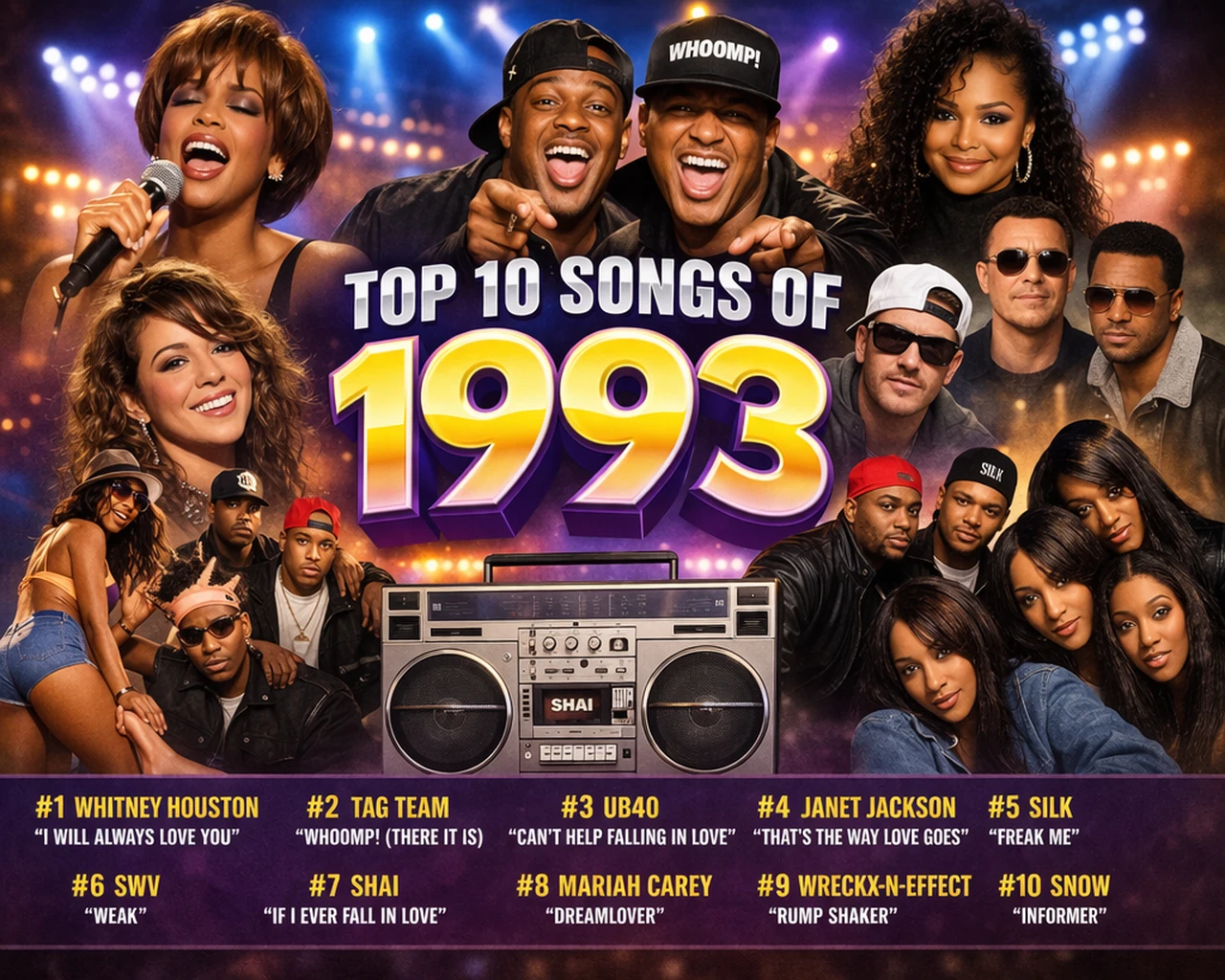
If 1993 had a smell, it’s warm VHS plastic, mall food court grease, CK One in the distance, and the inside of a car with the radio turned up too loud because somebody was absolutely determined to feel something. This was a year where pop didn’t bother choosing one identity. Soundtrack ballads got enormous. R&B got smoother and more dominant. Pop-rap got louder and dumber in the best possible way. And mainstream radio somehow made room for all of it.
This countdown ranks the Top 10 Songs of 1993 using Billboard’s Hot 100 Year-End chart. These weren’t just songs people heard. These were the records that took over school dances, shopping malls, roller rinks, living rooms, bedroom stereos, car dashboards, and every speaker in America that had even a little patience left.
Top 10 Songs of 1993 (Billboard Year-End Hot 100) — Quick List
- #10 “Informer” — Snow
- #9 “Rump Shaker” — Wreckx-n-Effect
- #8 “Dreamlover” — Mariah Carey
- #7 “If I Ever Fall in Love” — Shai
- #6 “Weak” — SWV
- #5 “Freak Me” — Silk
- #4 “That’s the Way Love Goes” — Janet Jackson
- #3 “Can’t Help Falling in Love” — UB40
- #2 “Whoomp! (There It Is)” — Tag Team
- #1 “I Will Always Love You” — Whitney Houston
#10 — “Informer” — Snow
Why it hit
Because 1993 had room for a hit that sounded like it had been dropped off from another planet. “Informer” is weird, catchy, slippery, and almost aggressively hard to decode on first listen. That should have limited it. Instead, it helped make the song unforgettable. The beat knocked, the cadence was addictive, and the whole thing had just enough novelty to make people lean in without writing it off as a gimmick.
That tension is what made it work. “Informer” was playful, but it also had enough rhythmic force to live on radio next to more polished R&B and pop records. In an era where crossover was getting broader, this song proved audiences would absolutely embrace something odd if the groove was strong enough. It felt different, and in 1993, different was starting to sell a lot better than safe.
Gen X Rewind
This is the song everybody quoted wrong, sang wrong, and still somehow got exactly right. Half the country had no idea what Snow was saying. The other half was lying.
Legacy
One of the strangest No. 1 hits of the early 90s and a permanent time capsule of mainstream radio’s brief willingness to get wonderfully weird.
#9 — “Rump Shaker” — Wreckx-n-Effect
Why it hit
Because subtlety got left in the parking lot. “Rump Shaker” is pure new jack swing-era attitude: hard beat, giant hook, club energy, and just enough chaos to make it feel rowdy instead of neat. The production hits immediately, and the song never tries to be tasteful in the way some crossover records did. It wants to be fun, loud, and impossible to ignore. Mission accomplished.
It also arrived during a moment when hip-hop and R&B were increasingly feeding pop culture’s appetite for bigger personalities and more physical grooves. “Rump Shaker” wasn’t trying to sell elegance. It was selling motion. That mattered. Songs like this turned dance-floor energy into a mainstream language radio could no longer sidestep.
Gen X Rewind
This is the sound of school dances, house parties, and at least one adult somewhere pretending not to notice what was blasting out of the speakers.
Legacy
A signature early-90s party record and one of the songs that kept new jack swing and hip-hop swagger right in the middle of the mainstream.
#8 — “Dreamlover” — Mariah Carey
Why it hit
Because Mariah Carey had already proven she could sing circles around the entire room, and “Dreamlover” let her do it inside a lighter, breezier, more playful pop setting. The sample gives it a lift, the melody glides, and Mariah sounds less like she’s trying to impress you than like she’s just operating on a higher vocal plane for fun. That ease is part of what makes the song so addictive.
It also captures a key early-90s shift: pop was getting more rhythmically nimble, more open to borrowing from older grooves, and more interested in blending sweetness with sharper production. “Dreamlover” feels bright and radio-friendly, but it’s not flimsy. It has structure, personality, and enough vocal sparkle to carry the whole thing straight into massive-hit territory.
Gen X Rewind
This is the kind of song that made every mall, convertible, and poolside scene in America feel 12% more glamorous than it really was.
Legacy
One of Mariah’s defining early hits, and one of the clearest examples of how she helped shape what polished, high-gloss 90s pop would sound like.
#7 — “If I Ever Fall in Love” — Shai
Why it hit
Because sometimes the most powerful thing a song can do is strip itself down and trust the voices. “If I Ever Fall in Love” feels intimate from the start, especially with that memorable a cappella opening, and that intimacy is exactly what made it stand out. There’s no giant production trick carrying the song. The record works because Shai sounded smooth, sincere, and locked in.
That sincerity played beautifully in 1993. The mainstream still had plenty of bombast, but there was also a huge appetite for R&B that felt romantic without being overstuffed. This song understood restraint. It didn’t need a giant gimmick. It just needed melody, harmony, and the confidence to let a soft performance hit hard.
Gen X Rewind
This is the kind of song that made middle-school and high-school feelings seem way more profound than they had any right to be. Everyone suddenly had a soundtrack for emotional situations they absolutely were not mature enough to handle.
Legacy
A classic slow jam and one of the era’s most beloved vocal-group hits—proof that smooth can hit just as hard as loud.
#6 — “Weak” — SWV
Why it hit
Because “Weak” understands exactly how to make vulnerability feel huge without turning it into melodrama. The melody is immediate, the production stays out of the way, and Coko’s vocal gives the whole song its emotional center. She doesn’t oversell the feeling. She just sounds consumed by it, which is why the song lands so hard.
In 1993, SWV sat in a sweet spot that mainstream radio loved: modern R&B with crossover power, polished enough for pop audiences but emotionally grounded enough to feel real. “Weak” has that rare quality of sounding both personal and universal. It feels intimate when you’re alone and massive when it comes through speakers in a public place. That’s a real hit-maker’s trick.
Gen X Rewind
This is late-night radio, bedroom stereo, and full dramatic collapse over somebody who probably was not worth all this. The song was. The person? Debatable.
Legacy
One of the defining R&B ballads of the decade and one of SWV’s signature songs—still smooth, still emotional, still lethal.
#5 — “Freak Me” — Silk
Why it hit
Because 1993 was fully committed to the slow jam as a commercial weapon, and “Freak Me” came armed. Silk took Keith Sweat-style R&B smoothness and turned it into something direct, atmospheric, and incredibly radio-efficient. The groove is unhurried, the vocals are glossy, and the record knows exactly what mood it’s trying to create. It never gets lost.
What made it such a powerful crossover hit is that it pushed just far enough. It felt grown, but still radio-friendly. Suggestive, but not alienating. By early-90s standards, that was the sweet spot. Songs like this could live on urban radio, cross over to pop, and become part of the broader culture without sanding themselves down into generic mush.
Gen X Rewind
This is the point where early-90s radio stopped pretending it was only for kids. The grown-up lane was open, and it had a lot of candles lit for some reason.
Legacy
A defining early-90s R&B hit and one of the clearest examples of how slow jams took over mainstream charts in this period.
#4 — “That’s the Way Love Goes” — Janet Jackson
Why it hit
Because Janet Jackson could make cool sound effortless. “That’s the Way Love Goes” is relaxed, hypnotic, and confident enough to let the groove do a lot of the work. Nothing about it feels desperate for attention. That’s part of the magic. The song doesn’t chase you down—it just slides into the room, takes over the air, and assumes you’ll catch up.
That restraint was a power move. While other big hits in 1993 went for maximum drama or maximum silliness, Janet delivered something smoother and sexier without losing any chart force. The record feels contemporary, but not trend-chasing. That’s one reason it aged so well. It wasn’t built around gimmicks. It was built around feel.
Gen X Rewind
This is the sound of realizing cool and loud are not the same thing. Janet barely has to raise her voice, and the whole room still belongs to her.
Legacy
One of Janet Jackson’s signature songs and one of the definitive groove-driven hits of the 90s—sleek, relaxed, and still impossibly good.
#3 — “Can’t Help Falling in Love” — UB40
Why it hit
Because 1993 was still extremely vulnerable to soundtrack-assisted romance, and UB40 turned an old standard into a perfect piece of mainstream softness. Their version smooths everything out into a slow, swaying, radio-ready glide. It’s warm, familiar, and almost impossible to dislike unless you were actively committed to being difficult.
The brilliance of the song’s success is how broad its appeal was. Older listeners recognized the melody. Younger listeners got a version that felt current enough to belong on the radio next to Mariah, Janet, and SWV. That kind of cross-generational reach is rare, and it’s a huge part of why the song became such a monster. It didn’t belong to one lane. It belonged everywhere.
Gen X Rewind
This is wedding-reception, slow-dance, movie-soundtrack, family-car, summer-night music. Basically: if there were speakers, this song had access to them.
Legacy
One of the biggest crossover covers of the decade and a perfect example of early-90s pop’s ability to make soft songs feel huge.
#2 — “Whoomp! (There It Is)” — Tag Team
Why it hit
Because some songs don’t become hits—they become public property. “Whoomp! (There It Is)” is pure crowd ignition: simple chant, huge beat, instant recognition, zero wasted movement. It is not trying to be elegant or subtle or important. It is trying to start a reaction, and it succeeds in under five seconds.
That directness made it unstoppable. The track crossed from clubs to radio to sports arenas to school dances because it didn’t require context. You heard it once, and you already understood how it worked. In 1993, that kind of communal, all-purpose party energy had enormous value. This song didn’t just ride the culture—it became one of the noises the culture made.
Gen X Rewind
This is one of the most aggressively inevitable songs of the 90s. The second it starts, everyone knows what comes next, even if they pretend they’re too cool for it. They are not.
Legacy
A permanent jock-jam, party-track, and pop-culture artifact. It may not have hit No. 1, but it absolutely won the public-space war.
#1 — “I Will Always Love You” — Whitney Houston
Why this was the #1 song of 1993
Because this was bigger than a hit. It was a cultural weather system. Whitney Houston took a beloved song and turned it into a full-scale event: that opening a cappella moment, that explosive key change into the body of the song, that vocal power that somehow manages to sound both technically unreal and emotionally direct. “I Will Always Love You” didn’t ask for your attention. It seized it.
Its dominance also says everything about the era. Early-90s radio still had room for songs that were unapologetically enormous—emotionally, vocally, commercially. The Bodyguard connection made it even bigger, but the movie alone doesn’t explain a run like this. The performance does. Whitney sounds like she’s singing from somewhere above the rest of the chart, and everybody else just has to deal with it.
And that’s why it ends 1993 at No. 1. Not because it was merely successful, but because it became unavoidable in a way only a handful of songs ever do. It moved past radio hit status into something larger: the song you heard everywhere, the song people attempted badly, the song that instantly turned any room into a moment whether it wanted one or not.
Gen X Rewind
This is hairbrush-microphone music, slow-dance music, heartbreak music, movie music, and “I am now having feelings beyond my clearance level” music. It was everywhere because it deserved to be.
Legacy
One of the most iconic performances in pop history and the undisputed giant of 1993. If the year had a voice, it sounded like Whitney Houston blowing the ceiling off.
1993 Rewind Verdict
1993 was a chart year with no interest in behaving. You had gigantic soundtrack emotion, smooth R&B slow jams, party-rap chants, crossover reggae-pop, and sleek Janet Jackson cool all living in the same Top 10.
That’s what makes it so rewatchable, re-listenable, and weirdly satisfying. It doesn’t feel neat. It feels real. Culture was shifting fast, and the radio reflected that. One minute you were getting Whitney-level emotional demolition. The next minute somebody was yelling “Whoomp!” at a football game.
Read next: 90s Hub • Top 10 Songs of 1992 • Top 10 Songs of 1991 • Top 10 Songs of 1990 • 80s Hub
FAQ: Top Songs of 1993 (Billboard Hot 100)
What was the #1 song of 1993 on the Billboard Hot 100 year-end chart?
The #1 year-end song of 1993 was “I Will Always Love You” by Whitney Houston.
What were the top songs of 1993?
Billboard’s year-end Top 10 for 1993 included Whitney Houston, Tag Team, UB40, Janet Jackson, Silk, SWV, Shai, Mariah Carey, Wreckx-n-Effect, and Snow.
How long was “I Will Always Love You” #1 on the Hot 100?
It spent 14 weeks at #1 on the Billboard Hot 100.
Did “Whoomp! (There It Is)” hit #1?
No — it was one of the biggest songs of 1993, but it peaked at #2 on the Billboard Hot 100.
Why does 1993 feel so split between giant ballads and party records?
Because it was a true transition-year chart. Mainstream radio was broad enough to let soundtrack anthems, smooth R&B, novelty-adjacent party rap, and cooler groove-based pop all hit at once.
Get the Weekly Gen X Drop
New videos, rewinds, and savage nostalgia — first.
JOIN THE NEWSLETTER WATCH VIDEOS