Top 10 Songs of 1992 (Billboard Hot 100 Year-End Countdown)
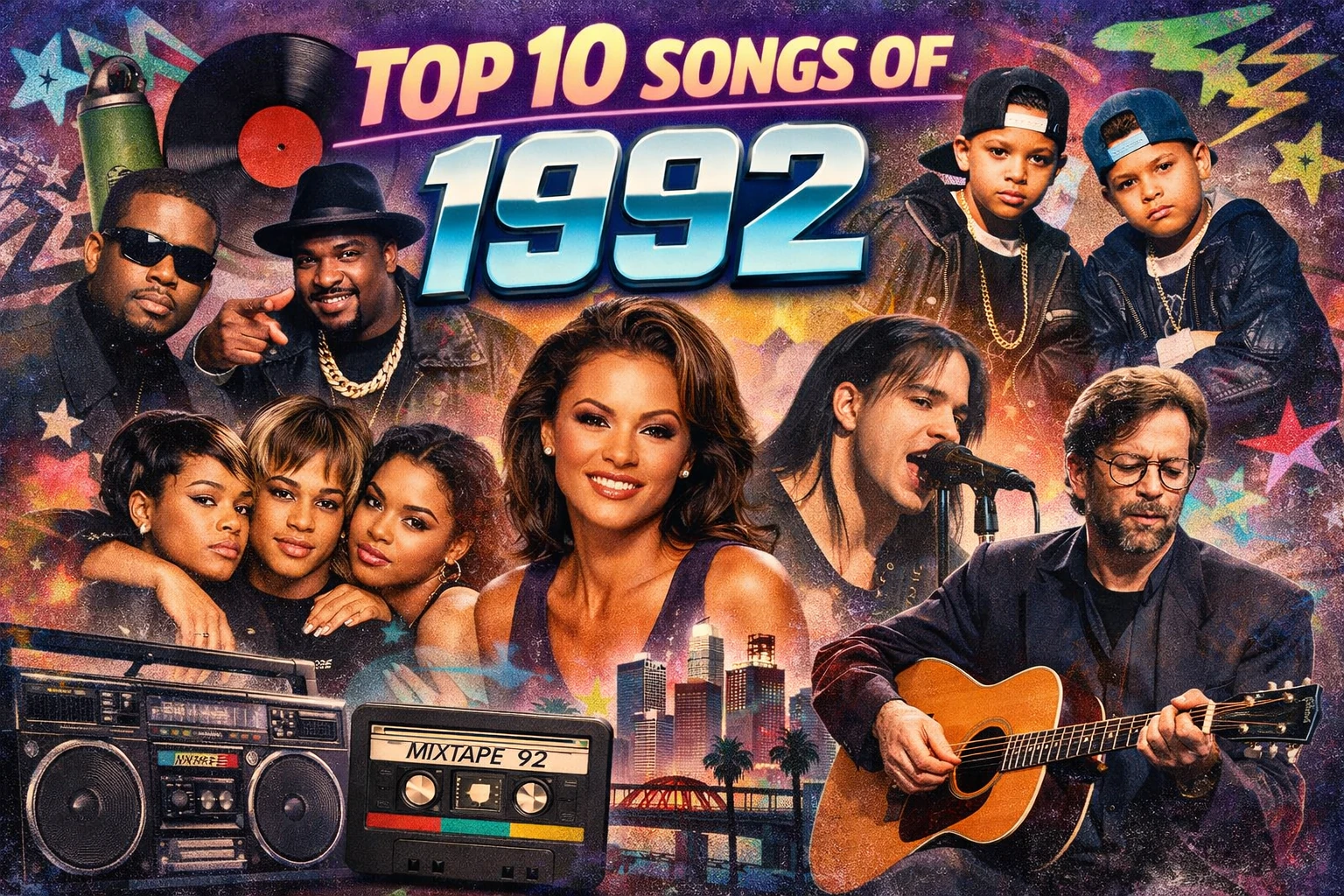
If 1992 had a smell, it’s warm plastic from a Discman, fresh mall pretzels, Aqua Net still hanging on for dear life, and the inside of a car with the radio permanently set to Top 40. This was not a neat, elegant music year. This was a collision. Slow jams got gigantic. Pop-rap went fully mainstream. New jack swing kept flexing. Alt-rock stopped lurking and started charting. And radio, for one glorious year, basically said: “Sure, all of that at once.”
This countdown ranks the Top 10 Songs of 1992 using Billboard’s Hot 100 Year-End chart. These weren’t just songs people liked. These were the records that took over school buses, roller rinks, food courts, bedrooms, living rooms, and every dashboard speaker in America.
Top 10 Songs of 1992 (Billboard Year-End Hot 100) — Quick List
- #10 “Just Another Day” — Jon Secada
- #9 “All 4 Love” — Color Me Badd
- #8 “Under the Bridge” — Red Hot Chili Peppers
- #7 “My Lovin’ (You’re Never Gonna Get It)” — En Vogue
- #6 “Tears in Heaven” — Eric Clapton
- #5 “Baby-Baby-Baby” — TLC
- #4 “Save the Best for Last” — Vanessa Williams
- #3 “Jump” — Kris Kross
- #2 “Baby Got Back” — Sir Mix-a-Lot
- #1 “End of the Road” — Boyz II Men
#10 — “Just Another Day” — Jon Secada
Why it hit
Because 1992 absolutely loved polished heartbreak with serious adult-radio crossover power. “Just Another Day” has that smooth, dramatic, ultra-clean early-90s production that made everything feel just a little more cinematic than real life actually was. Jon Secada’s voice does a lot of the heavy lifting here: emotional without getting sloppy, polished without sounding plastic, and just soulful enough to work across pop, adult contemporary, and Latin crossover lanes at the same time.
That balance is what made the song such a weapon on radio. It didn’t belong to just one audience. It could sit comfortably next to soft pop, R&B, and ballads without sounding out of place, which is a huge reason it stuck around. It’s also a perfect example of early-90s radio loving songs that sounded mature but still accessible—grown-up enough for wide appeal, catchy enough that kids heard it constantly anyway.
Gen X Rewind
This is car-window music. You didn’t need an actual broken heart for it to work. The song was willing to provide one for you on loan.
Legacy
One of the cleanest crossover hits of the year, and a reminder that 1992 still had real room for melodic, adult-leaning pop that could punch straight into the mainstream.
#9 — “All 4 Love” — Color Me Badd
Why it hit
Because Color Me Badd knew exactly how to sell soft-focus romance to the masses. “All 4 Love” is all polish, all harmony, all clean early-90s charm. It’s sweet in a way that somehow managed to feel massive at the time: not ironic, not self-conscious, just fully committed to being a radio-friendly love song with perfect hair and good lighting.
It also hit at a moment when mainstream pop was still happy to reward songs that felt sincerely romantic without needing an edge. That’s something people forget about the early 90s. Yes, harder sounds were coming. Yes, the culture was shifting. But there was still a huge appetite for songs that could soundtrack prom, slow dance, or just float out of a store speaker while America collectively pretended nobody had problems.
Gen X Rewind
This is the kind of song that played in public so often it started to feel like municipal background music. Malls. Dentists. Family cars. Everywhere.
Legacy
A pure artifact of glossy early-90s pop-R&B crossover—and one of the last big chart moments before that whole super-smooth male-group lane started feeling a little too safe for the rest of the decade.
#8 — “Under the Bridge” — Red Hot Chili Peppers
Why it hit
Because it made vulnerability sound like a mainstream event. “Under the Bridge” wasn’t the loudest song on the radio in 1992, but it may have been one of the most emotionally naked. The verses feel isolated and inward, then the song slowly opens up into something sweeping and bruised and weirdly beautiful. That kind of structure gave it a depth a lot of Top 40 songs simply didn’t have.
And that’s why it mattered so much. This wasn’t just an alt-rock song sneaking onto pop radio. It was a signal. The emotional tone was darker, lonelier, less polished, and less interested in pretending everything was fine. It still had melody, still had reach, still had that huge chorus—but it came from a different emotional climate. 1992 didn’t entirely belong to alternative rock yet, but “Under the Bridge” made it very clear that alternative rock was no longer waiting outside.
Gen X Rewind
This is the song that made mainstream radio feel a little more alone, a little more urban, a little more honest. Like the party had ended and somebody finally noticed the silence.
Legacy
One of the defining crossover rock hits of the early 90s, and one of the songs that helped reset what emotional honesty could sound like on Top 40 radio.
#7 — “My Lovin’ (You’re Never Gonna Get It)” — En Vogue
Why it hit
Because En Vogue could do something a lot of groups never manage: sound effortlessly cool while also sounding technically locked-in. “My Lovin’” is sharp, stylish, and built on attitude. The groove is lean, the vocal arrangement is lethal, and the message is basically a glamorized dismissal set to a beat. Which, naturally, rules.
The record also captures what made early-90s R&B feel so strong in the pop space. It was polished, yes, but not soft. Pretty, but not passive. En Vogue sounded like they were in total control of the room, and that kind of confidence translates. The song hits because it never seems to be asking for approval. It already knows it has the best outfit, the best vocals, and the best exit line.
Gen X Rewind
This is the soundtrack to finding out confidence could be musical. You hear it and immediately sit up straighter even if you’ve done absolutely nothing to deserve that energy.
Legacy
A cornerstone of early-90s R&B-pop crossover and one of En Vogue’s signature statements—slick, forceful, and still cooler than most things that came after it.
#6 — “Tears in Heaven” — Eric Clapton
Why it hit
Because some songs don’t feel like “hits” so much as public emotional events. “Tears in Heaven” is gentle, restrained, and devastating. It doesn’t perform grief with giant gestures. It just lets it sit there in the room, which makes it more powerful than a louder song probably would have been. The melody is simple, the arrangement is careful, and that lack of excess is exactly why it lands.
In a chart year full of swagger, dance beats, punchlines, and giant hooks, this song stood out by refusing to compete on those terms. It asked listeners to slow down and actually feel something. That’s not normally the easiest path to becoming one of the year’s biggest songs, but 1992 made room for it because the performance and the emotional weight were undeniable.
Gen X Rewind
This is the song that made the radio go quiet in a different way. Even as a kid, you could tell this one carried more than just melody.
Legacy
One of the most emotionally heavy mainstream hits of the decade, and proof that a deeply personal song could still reach massive pop audiences without being flattened into cliché.
#5 — “Baby-Baby-Baby” — TLC
Why it hit
Because TLC sounded like a whole new operating system for pop. “Baby-Baby-Baby” is playful, cool, rhythmically tight, and completely unbothered. It has new jack swing DNA, but it doesn’t feel boxed in by genre. It feels like personality first: the kind of record where the style, the vocals, the groove, and the attitude all arrive together as one unmistakable package.
And that package mattered. TLC didn’t sound like a cleaned-up version of something else—they sounded like a shift in where the culture was headed. The song is catchy, but not sugary. Smooth, but not sleepy. Confident, but not overbuilt. It’s the kind of track that made the early 90s feel younger, sharper, and more visually alive even if you were only hearing it on the radio.
Gen X Rewind
This is pure 90s cool before the decade fully knew what to do with itself. Bright colors, sideways attitude, hooks for days, and zero interest in asking permission.
Legacy
A defining TLC hit and one of the songs that helped shape what early-90s girl-group power would look and sound like for the rest of the decade.
#4 — “Save the Best for Last” — Vanessa Williams
Why it hit
Because 1992 still deeply believed in the prestige ballad. “Save the Best for Last” is elegant, adult, and structured to feel like the emotional resolution of a movie that may or may not exist. Vanessa Williams sells it with grace instead of force, which is part of why the song worked so well. It doesn’t beg for attention. It just rises into it.
The song also reflects how broad the mainstream still was. A year could make room for “Baby Got Back,” “Jump,” and this—an ultra-polished, romantic ballad with crossover appeal that felt classy enough for adult contemporary but catchy enough for pop radio. That kind of range is part of what makes 1992 such a fun chart year to revisit.
Gen X Rewind
This is the kind of song that made every ordinary moment feel like it should be happening under soft restaurant lighting with somebody reconsidering their life choices.
Legacy
One of the major ballads of the early 90s and Vanessa Williams’ signature pop moment—timeless, graceful, and still radio-perfect.
#3 — “Jump” — Kris Kross
Why it hit
Because this song is basically caffeine wearing clothes backward. “Jump” is all momentum: huge hook, instantly quotable chorus, bouncy beat, and enough attitude to make it feel bigger than a novelty but funnier than a serious rap record. It was one of those songs that could dominate kids, teens, and adults all at once because it was simple, loud, and impossible to ignore.
Its real genius is how physically immediate it is. You hear it and your body understands the assignment before your brain does. That kind of directness is pop gold. Kris Kross also arrived with a visual gimmick the culture couldn’t resist, which helped, but the song itself absolutely had the horsepower. Without the beat and chorus, the image would have faded fast. With them, it became unavoidable.
Gen X Rewind
This is playground, bus ride, bedroom, gym class, and living room music all at once. If you were alive in 1992, you did not escape this song. You survived it.
Legacy
One of the definitive youthquake hits of the decade, and a perfect example of how a record can be playful, massive, and permanently lodged in collective memory all at the same time.
#2 — “Baby Got Back” — Sir Mix-a-Lot
Why it hit
Because subtlety never had a chance. “Baby Got Back” is funny, oversized, wildly quotable, and built on a beat that made the song feel like an event before the first verse even got moving. It had the kind of hook that crossed out of rap and straight into mass culture—not just as a hit, but as a phrase, a joke, a reference point, a whole thing people knew whether they wanted to or not.
And that crossover mattered. In 1992, pop radio was still figuring out how fully it wanted to embrace rap records with strong personality and no interest in softening themselves for polite company. “Baby Got Back” basically kicked the door in laughing. It was playful, provocative, radio-ready, and culturally loud in a way that made it impossible to keep boxed up in one lane.
Gen X Rewind
This is one of those songs where the opening line alone can still hijack an entire room. The second it starts, the room is no longer in charge of itself.
Legacy
A pop-culture earthquake. It remains one of the most recognizable rap crossover hits ever, and one of the clearest signs that 1992 radio was willing to get weirder, bolder, and a lot more fun.
#1 — “End of the Road” — Boyz II Men
Why this was the #1 song of 1992
Because this is not just a hit song. It’s a total emotional occupation. “End of the Road” took the slow-jam format and inflated it to absolutely colossal size—huge harmonies, huge heartbreak, huge dramatic sweep. Boyz II Men didn’t just sing the song; they performed grief like it deserved premium lighting and a national audience. And apparently, America agreed.
What makes it more than just a big ballad is the vocal blend. The record doesn’t rely on one star turn. It works because the group sounds like a machine built for ache. Every phrase is polished, every harmony stacked just right, every emotional cue delivered with maximum clarity. It’s heartbreak engineered for mass consumption, but in the best possible way: immaculate, sincere, and way bigger than everyday life.
It also captures something crucial about 1992. For all the stylistic range on the chart—rap, R&B, alt-rock, crossover ballads—there was still enormous power in a song that simply felt gigantic. “End of the Road” didn’t win the year by being clever or trendy. It won by being unforgettable. Once it hit, it stayed. And stayed. And stayed.
Gen X Rewind
This is slow-dance music, breakup music, staring-out-the-window music, and “I am now feeling emotions above my pay grade” music. It didn’t just play on the radio. It lived there.
Legacy
One of the defining vocal-group hits of the 90s and the undeniable champion of 1992. If that year had an official heartbreak anthem, this was it by a landslide.
1992 Rewind Verdict
1992 was one of those rare years where the mainstream didn’t sound unified—and that’s exactly why it was so good. You had giant R&B ballads, pop-rap insanity, new jack swing confidence, smooth adult contemporary, and alt-rock vulnerability all elbowing for space on the same chart.
That makes this Top 10 feel less like a single genre story and more like a real snapshot of a culture in motion. The old formulas were still working. The new ones were already arriving. And radio, somehow, made room for all of it.
Read next: 90s Hub • Top 10 Songs of 1991 • Top 10 Songs of 1990 • Top 10 Songs of 1989 • 80s Hub
FAQ: Top Songs of 1992 (Billboard Hot 100)
What was the #1 song of 1992 on the Billboard Hot 100 year-end chart?
The #1 year-end song of 1992 was “End of the Road” by Boyz II Men.
What were the top songs of 1992?
Billboard’s year-end Top 10 for 1992 included Boyz II Men, Sir Mix-a-Lot, Kris Kross, Vanessa Williams, TLC, Eric Clapton, En Vogue, Red Hot Chili Peppers, Color Me Badd, and Jon Secada.
How long was “End of the Road” #1 on the Hot 100?
It spent 13 weeks at #1 on the Billboard Hot 100.
Did “Baby-Baby-Baby” by TLC hit #1?
No — it was one of the biggest songs of 1992, but it peaked at #2 on the Billboard Hot 100.
Why does the 1992 chart feel so all over the place?
Because it was a true crossover year. Mainstream radio still embraced ballads and polished pop, but rap, R&B, and alternative rock were all making bigger moves into the same chart space.
Get the Weekly Gen X Drop
New videos, rewinds, and savage nostalgia — first.
JOIN THE NEWSLETTER WATCH VIDEOS