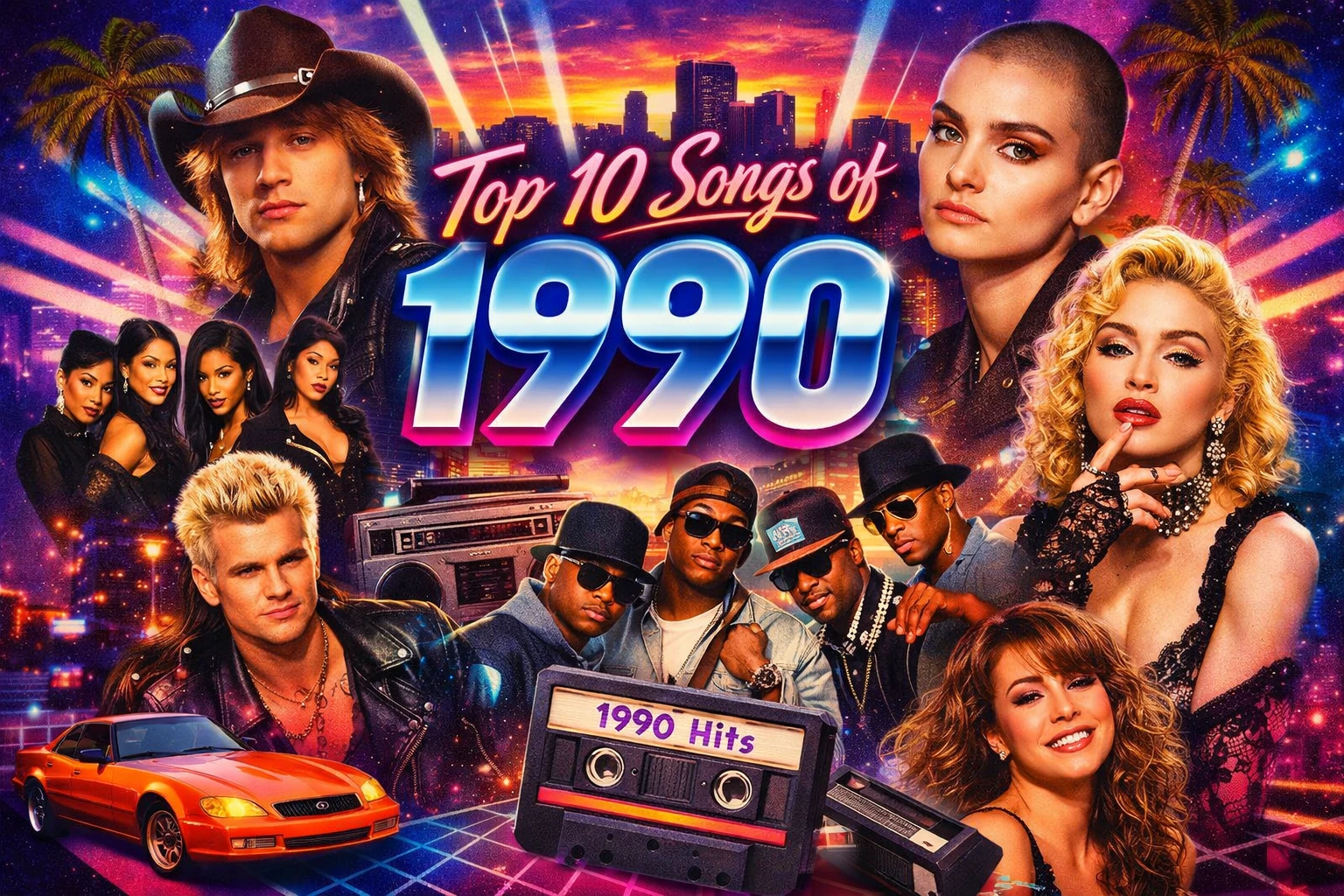
Top 10 Songs of 1990: Billboard’s Biggest Hits Ranked
1990 is the hinge year—the one where the 80s had not fully packed up, but the 90s had already walked in and started moving the furniture. The top 10 songs of 1990 sound exactly like that collision: soundtrack ballads, new jack swing, dance-pop precision, rock swagger, vocal fireworks, and the first clear signs of the diva decade.
This was the year Wilson Phillips turned California harmonies into the year’s biggest single, Roxette made movie heartbreak unavoidable, Sinéad O’Connor stripped pop sadness down to the nerve, Bell Biv DeVoe brought new jack swing attitude into the mainstream, and Mariah Carey arrived with a voice that changed the assignment.
This countdown uses Billboard’s Hot 100 year-end chart, so these were the biggest U.S. singles of the year based on chart performance—not critic picks and not a modern nostalgia ranking.
“Hold On” by Wilson Phillips was Billboard’s number-one year-end song of 1990. Roxette, Sinéad O’Connor, Bell Biv DeVoe, Madonna, and Mariah Carey completed the top six.
Billboard Hot 100 Year-End Ranking
The ranking reflects chart performance across 1990. A song’s year-end position is not determined only by its weekly peak; longevity and total chart performance matter too.
1990 Was the Radio Handoff Between Two Decades
Late-80s polish was still all over the dial, but new jack swing, bigger R&B vocals, house-pop glamour, and a harder early-90s rhythmic edge were already taking over.
The list moves from Jon Bon Jovi and Billy Idol to En Vogue, Bell Biv DeVoe, and Mariah Carey without ever sounding like one clean era. It sounds like the calendar changed before the culture did.
Quick List: Top 10 Songs of 1990
- #1 “Hold On” — Wilson Phillips
- #2 “It Must Have Been Love” — Roxette
- #3 “Nothing Compares 2 U” — Sinéad O’Connor
- #4 “Poison” — Bell Biv DeVoe
- #5 “Vogue” — Madonna
- #6 “Vision of Love” — Mariah Carey
- #7 “Another Day in Paradise” — Phil Collins
- #8 “Hold On” — En Vogue
- #9 “Cradle of Love” — Billy Idol
- #10 “Blaze of Glory” — Jon Bon Jovi
Watch and Listen to 1990
Want the video version of the 1990 chart rewind? Watch the Smells Like Gen X countdown of every Billboard Hot 100 #1 hit of 1990, featuring Phil Collins, Michael Bolton, Paula Abdul, Janet Jackson, Sinéad O’Connor, Madonna, Wilson Phillips, Roxette, Vanilla Ice, Whitney Houston, Stevie B, and more.
It is the moving-picture companion to this countdown—the year adult contemporary, dance-pop, new jack swing, rock, R&B, and the early sound of the 90s all collided on the Hot 100.
Countdown: The Top 10 Songs of 1990
The countdown runs from the final year-end slot to the song Billboard ranked as the biggest U.S. single of 1990. Each entry goes deeper into the sound, its place in the transition year, and why it still hits the Gen X memory bank.
“Blaze of Glory”
Jon Bon Jovi
Why It Hit
Because 1990 still had room for arena-rock drama, and Jon Bon Jovi knew exactly how to package it for maximum radio impact. “Blaze of Glory” is oversized in the most efficient way possible: big acoustic strum, big vocal, big chorus, and enough cinematic dust to make an ordinary drive feel like closing credits.
It sounds rugged without ever becoming messy, which made it an easy fit for rock stations, pop stations, and every car stereo caught between the end of the 80s and whatever the 90s were about to become. The song gave listeners all the drama of hard rock without asking mainstream radio to give up its polished surfaces.
How It Fit 1990
As the theme from Young Guns II, the record arrived with a built-in cinematic frame, but it did not need the film to survive. Radio turned it into a standalone anthem. By the time the chorus hit, you did not need cowboys, desert landscapes, or an outlaw plot. The song supplied all of that scenery by itself.
Its place in the 1990 top 10 also shows how slowly the old order disappeared. Grunge was not yet the national reset button. Arena rock still had a large audience, and a strong enough hook could cross into mainstream pop without apologizing for its size.
Gen X Rewind
This is peak “movie soundtrack hit becomes its own personality” territory. You did not need to care about Young Guns II to know the song. It was already doing laps on radio, giving every family-car ride an unnecessary sense of personal destiny.
It still works because it commits completely. There is no irony, no shrinking away from the chorus, and no attempt to make the drama seem cool by pretending not to care. The record rides straight into the sunset with both hands on the volume knob.
“Cradle of Love”
Billy Idol
Why It Hit
Billy Idol always understood the value of swagger, and “Cradle of Love” is swagger with precision engineering. The riff is clean and aggressive, the vocal is pure snarl-meets-pop, and the chorus is catchy enough to blast through both rock radio and mainstream Top 40 without losing its attitude.
The production gives every part room to announce itself. The guitars bite, the rhythm stays locked, and Idol performs the song like he already knows the camera has found him. That combination was still enormously valuable in 1990, when MTV presence and radio power could reinforce each other until a song felt unavoidable.
How It Fit 1990
The record sits directly on the fault line between late-80s pop-rock and early-90s transition. It has the polish and visual confidence of the previous decade, but the sound is leaner than the most inflated hair-metal productions.
Its video helped keep the song in the visual culture of the year, but the hook did the real work. Even without the images, “Cradle of Love” has the kind of opening that makes a station scan stop. It is immediate, physical, and completely uninterested in easing into the room.
Gen X Rewind
This is the sound of a song that made you feel cooler just by being in the room with it. You hear it and immediately picture leather jackets, chain-link fences, and the kind of confidence most of us absolutely did not have.
Today, the record is a useful reminder that 1990 was not yet ready to throw away rock-star theater. The pose still mattered. The sneer still mattered. And Billy Idol could still turn both into a pop event.
“Hold On”
En Vogue
Why It Hit
Because it sounded like the future tightening its jaw. “Hold On” fused classic soul instincts with new jack swing energy and vocal harmonies so sharp they felt custom-cut. En Vogue did not merely arrive with a hit; they arrived sounding finished, stylish, and completely certain they belonged at the center of the new decade.
The a cappella opening was a statement before the beat even arrived. It established the group as singers first, then let the production snap into place and prove they could handle modern radio just as easily. That old-school-meets-new-school structure made the record feel rooted and forward-looking at the same time.
How It Fit 1990
R&B was becoming more rhythmically assertive and more visually polished. “Hold On” fit that moment perfectly. It carried the elegance of a vocal group, the attack of contemporary production, and enough pop clarity to travel far beyond one format.
The song also established En Vogue as a group with a collective identity rather than one lead singer with background support. The harmonies, traded lines, and unified presentation were part of the appeal. They sounded like a complete unit.
Gen X Rewind
This is one of those songs that instantly makes a room feel more put together. Suddenly somebody has better lighting, better clothes, and an adult level of confidence you absolutely have not earned yet.
It has aged unusually well because the performance remains the center of the record. Production styles date. Great ensemble singing does not. Every time those voices lock together, the song resets itself.
“Another Day in Paradise”
Phil Collins
Why It Hit
Phil Collins had mastered the art of making serious themes sound radio-ready without stripping them of weight. “Another Day in Paradise” is adult contemporary at full power: moody synth textures, a deeply familiar Collins vocal, and a message serious enough to make the song feel like it mattered beyond its hook.
The arrangement is deliberately restrained. It does not chase a giant dramatic explosion because the tension comes from the contrast between the polished surface and the subject underneath it. Collins sounds weary rather than theatrical, which helped the song reach a huge mainstream audience.
How It Fit 1990
The record belongs to the adult-contemporary dominance that still shaped the beginning of the decade. Before alternative rock and hip-hop changed the emotional temperature of mainstream radio, songs like this could become national events through steady rotation across multiple formats.
Its year-end strength also demonstrates that 1990 listeners were not only chasing novelty or dance-floor momentum. There was still a large appetite for sober, carefully produced pop that asked the audience to pause.
Gen X Rewind
This is the sound of grown-up radio feeling genuinely heavy. It played in supermarkets, cars, kitchens, and waiting rooms, quietly making everything feel more serious than it did five minutes earlier.
Hearing it now brings back a form of mass-market seriousness that has mostly vanished from pop radio. The song did not need to be edgy to feel substantial. It only needed Collins’s voice and that shadowy keyboard atmosphere.
“Vision of Love”
Mariah Carey
Why It Hit
Because this was not just a debut single. It was an announcement. “Vision of Love” introduced Mariah Carey as a vocalist who was not interested in merely being good; she showed up sounding like the rulebook had been edited in real time.
The control, phrasing, melismatic runs, and lift into the upper register all made the record feel larger than an ordinary first single. What made it connect beyond pure technique was the emotional build. It does not rush to impress; it expands until the whole thing feels inevitable.
How It Fit 1990
The timing could not have been better. Pop and R&B were moving toward a new era of vocal spectacle, and “Vision of Love” supplied the blueprint at the start of the decade. The production leaves enough space for the voice to remain the event while still giving radio the polish it needed.
Mariah’s arrival also changed the competitive landscape. Suddenly, a new artist was being discussed alongside established powerhouse singers, and the conversation did not feel premature. By the final chorus, she no longer sounded like a promising newcomer. She sounded like the next standard.
Gen X Rewind
This is the song that made everyone stop mid-conversation and ask, “Wait… who is that?” Then somebody tried to sing it in the car and immediately learned humility.
The record still feels exciting because you can hear a career beginning at full strength. There is no tentative first step. “Vision of Love” walks through the front door carrying the entire 90s diva era behind it.
“Vogue”
Madonna
Why It Hit
Because Madonna understood that pop was not just sound. It was image, motion, attitude, and timing. “Vogue” is a masterclass in control: house-pop pulse, spoken glamour, stylized cool, and a hook so clean it feels architectural.
The production is both minimal and enormous. The beat leaves open space for the commands, piano figures, and atmosphere to register clearly. Every element feels placed for maximum visual impact, even when you are only hearing the record. The audio already contains the choreography.
How It Fit 1990
The song brought ballroom-inspired movement and language into a gigantic mainstream pop event. For millions of listeners, “Vogue” was the first contact with a style and culture that had existed outside the pop center long before the single arrived.
Madonna had already survived enough reinventions to be considered permanent, but “Vogue” proved she could still make the market pivot toward her. It fit clubs, MTV, radio, fashion, and celebrity culture all at once.
Gen X Rewind
This is the soundtrack to mirrors suddenly becoming more important than they used to be. Even with zero rhythm and less confidence, “Vogue” briefly made presentation itself feel like a superpower.
It remains one of those songs that transforms a room before the first verse is finished. The beat is not background. It is an instruction. Posture changes. Hands move. Somebody who should know better tries the poses anyway.
“Poison”
Bell Biv DeVoe
Why It Hit
Because “Poison” does not ask permission. That beat walks in first, takes over the room, and leaves no debate about who is in charge. Bell Biv DeVoe cracked something open: hip-hop attitude, R&B polish, new jack swing force, and just enough pop structure to make the song unavoidable.
The brilliance of “Poison” is that it feels fun and threatening at the same time. The groove is irresistible, but there is a bite to it. It was not soft crossover. It was crossover with teeth, rhythm, slang, and a production style that made older pop records sound instantly slower.
How It Fit 1990
The song helped define the point where new jack swing stopped feeling like a specialty sound and became part of mainstream American pop. It could dominate a school dance, a radio mix show, MTV, or a car stereo without changing its attitude.
Bell Biv DeVoe carried history with them, but the song did not lean on nostalgia. It created a separate identity: sharper, more streetwise, and rhythmically aggressive. That reinvention is part of why the hit felt so fresh.
Gen X Rewind
This is one of those tracks that can still hijack a room in about three seconds. You hear the opening and your brain immediately files a motion to stop whatever else it was doing.
It is also a perfect memory trigger for school gyms, roller rinks, house parties, talent shows, and any place where the bass had to travel through cheap speakers. Even distorted, it still hit.
“Nothing Compares 2 U”
Sinéad O’Connor
Why It Hit
Because it stripped everything down to the nerve. “Nothing Compares 2 U” does not overwhelm you with giant radio sugar or production tricks. It wins through emotional exposure. Sinéad O’Connor’s performance is so direct it borders on invasive.
The song had been written by Prince, but O’Connor’s interpretation made it feel completely personal. Her phrasing, restraint, and sudden surges of pain turned the composition into something stark and singular.
How It Fit 1990
The video’s close-up simplicity matched the record perfectly. In a medium built around spectacle, the face became the entire event. That image stopped MTV viewers, but it worked because the vocal already carried that much emotional force.
Its success is especially striking because it shared the chart with polished dance-pop, new jack swing, arena rock, and adult contemporary. Instead of meeting the year on its terms, it created a quiet space and made the culture enter.
Gen X Rewind
This is late-night, lights-low, staring-at-nothing music. The kind of song that made even kids understand adult sadness was operating on a completely different level.
It has never become casual nostalgia. Plenty of old hits turn into pleasant wallpaper. This one still changes the temperature. The opening notes arrive, conversation drops, and the song demands the same attention it did in 1990.
“It Must Have Been Love”
Roxette
Why It Hit
Because soundtrack ballads were major business in 1990, and this one was almost unfairly good. “It Must Have Been Love” has the widescreen emotional pull of a movie song, but it also works perfectly on its own: huge chorus, ache in the vocal, and production polished without sanding off the pain.
Marie Fredriksson’s performance carries the song from controlled sadness into full emotional release without losing precision. The verses hold back just enough to make the chorus feel like a door being thrown open.
How It Fit 1990
Its association with Pretty Woman gave the song an enormous cultural runway. The film and record reinforced each other until the single felt like part of the year’s emotional vocabulary. Yet the hit did not depend entirely on the movie.
The song also demonstrates how international pop could feel completely native to American radio. Roxette’s Swedish origin did not make the record sound imported or niche. It felt designed for every Top 40 station, mall, and soft-rock countdown in the country.
Gen X Rewind
This is the sound of a song turning an ordinary moment into a full internal montage. Suddenly the car window matters. The rain matters. Your nonexistent love life somehow matters.
It still lands because the record never treats heartbreak as small. The production gives the feeling room to become cinematic, while the vocal keeps it human enough to hurt. That balance is the whole trick.
“Hold On”
Wilson Phillips
Why It Hit
Because 1990 loved songs that felt reassuring without being boring, and “Hold On” nailed that balance. It is polished, uplifting, vocally rich, and built around a chorus engineered to survive endless radio repetition.
The trio’s blend is the real engine. The voices do not compete for attention; they lock together and make the chorus feel larger than any one singer. That group sound gave the record warmth, while the production kept it crisp enough for contemporary pop radio.
How It Fit 1990
What pushed it to the top of the year-end chart was consistency. This was not a novelty spike. It worked across formats and moods: in a car, at home, at work, in a mall, at a school dance—basically anywhere America had speakers.
There was also something perfectly timed about its optimism. The calendar had changed, but the culture had not yet settled into the harder, more skeptical personality associated with the later 90s. “Hold On” belonged to that brief opening where polished sincerity could dominate without irony as protection.
Gen X Rewind
This is one of those songs that was simply there. Everywhere. On every station, in every store, in every family car, somehow sounding motivational and slightly overqualified for the occasion.
Its omnipresence can make it easy to underestimate, but the craft is why it survived. The melody is immediate, the harmonies are unmistakable, and the chorus delivers exactly the emotional lift promised by the title.
Keep Rewinding 1990
The Billboard year-end chart was only one piece of 1990. Continue through the same year with the video countdown, television, movies, toys, and the larger 90s music archive.
1990 Rewind Verdict
1990 was not a clean break from the 80s. It was a collision. Big soundtrack ballads still ruled. Adult contemporary still had power. Madonna was still rewriting pop language in real time. New jack swing was kicking the decade forward. Mariah and En Vogue had arrived.
What makes this countdown so strong is how split-brained it is in the best possible way. “Hold On” and “It Must Have Been Love” feel like radio comfort food. “Nothing Compares 2 U” feels like emotional truth without armor. “Poison” sounds like the 90s kicking the door open. “Vision of Love” announces the vocal decade.
For Gen X, these songs are the sound of a decade changing shape in public: family car rides, cassette singles, mall speakers, MTV afternoons, school dances, roller-rink lights, and that moment when everything still looked a little 80s but already sounded like something else was coming.
FAQ: Top Songs of 1990
What was the #1 song of 1990 on Billboard’s year-end chart?
“Hold On” by Wilson Phillips finished as Billboard’s number-one Hot 100 year-end song of 1990.
What were the top songs of 1990?
The top 10 included Wilson Phillips, Roxette, Sinéad O’Connor, Bell Biv DeVoe, Madonna, Mariah Carey, Phil Collins, En Vogue, Billy Idol, and Jon Bon Jovi.
Why does this list use Billboard’s year-end Hot 100?
The year-end chart reflects the biggest U.S. singles based on chart performance across the year instead of personal opinion or a modern nostalgia ranking.
How long was “Hold On” by Wilson Phillips at #1?
“Hold On” spent one week at number one on the Billboard Hot 100 and finished as the year’s top-ranked single.
How long was “Nothing Compares 2 U” at #1?
Sinéad O’Connor’s “Nothing Compares 2 U” spent four weeks at number one.
Did “Poison” by Bell Biv DeVoe reach #1?
No. “Poison” peaked at number three, but its chart run helped it finish fourth on Billboard’s year-end ranking.
Which songs in the countdown reached #1?
“Hold On,” “It Must Have Been Love,” “Nothing Compares 2 U,” “Vogue,” “Vision of Love,” “Another Day in Paradise,” and “Blaze of Glory” all reached number one.
Why was “Vision of Love” important?
Mariah Carey’s debut helped establish the vocal style, pop-R&B crossover sound, and diva-era standards that shaped much of 1990s pop.
Why does the 1990 chart sound half-80s and half-90s?
It was a transition year, mixing late-80s polish and arena rock with new jack swing, house-pop, bigger R&B vocals, and the early sound of the 1990s.
Is there a 1990 playlist?
Yes. The companion Spotify playlist is embedded on this page, along with the Smells Like Gen X video covering every number-one hit of 1990.