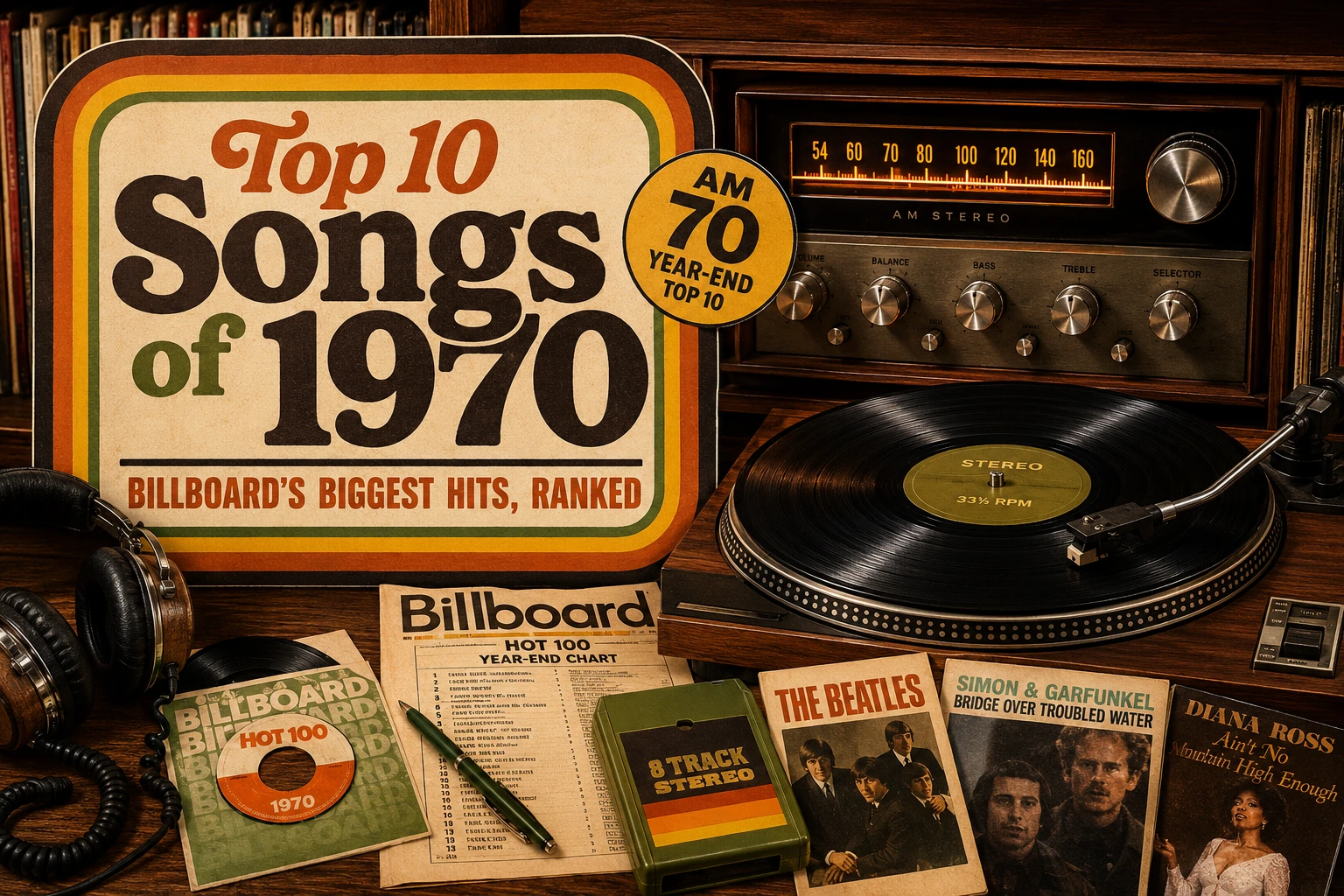
Top 10 Songs of 1970: Billboard’s Biggest Hits, Ranked
The top 10 songs of 1970 sound like two decades passing each other in a narrow hallway. The idealism, tension, harmonies and social unrest of the 1960s were still hanging in the air, but the softer pop, heavier rock, polished soul and singer-songwriter intimacy of the 1970s were already moving in with boxes.
This was the year Simon & Garfunkel built one of popular music’s largest emotional monuments, the Carpenters made softness feel unavoidable, and the Guess Who put a blunt, distorted guitar riff near the center of American radio.
Edwin Starr turned protest into a shouted chorus. Diana Ross stepped fully into her solo career with orchestral force. The Jackson 5 proved youthful pop could carry remarkable emotional weight, while the Beatles released one of their final great communal hymns as the group itself came apart.
This countdown follows Billboard’s 1970 year-end Hot 100. It is a ranking of the biggest U.S. singles of the chart year based on cumulative performance, not a personal list of the best songs released in 1970.
“Bridge Over Troubled Water” by Simon & Garfunkel was Billboard’s number-one year-end song of 1970. “(They Long to Be) Close to You,” “American Woman,” “Raindrops Keep Fallin’ on My Head,” and “War” completed the year’s top five.
Billboard Hot 100 Year-End Ranking
In 1970, the Hot 100 drew from record sales and radio-airplay reports. The year-end order rewards performance across the entire chart period, so a long, steady run could carry a song high on the annual list even when it never reached number one.
1970 Was the Sound of One Era Becoming Another
The year did not arrive with a clean break from the 1960s. Protest, war, political exhaustion and the aftermath of a turbulent decade remained impossible to ignore. That tension is sitting directly inside Edwin Starr’s “War,” but it can also be felt in the need for comfort running through “Bridge Over Troubled Water” and “Let It Be.”
At the same time, radio was opening toward several sounds that would define the decade ahead. The Carpenters brought immaculate soft pop into the center. Rare Earth joined rock muscle to Motown rhythm. Diana Ross transformed a familiar song into grand solo theater, and the Jackson 5 made young voices sound capable of carrying adult devotion.
That mixture is what makes the biggest songs of 1970 feel so alive. The list holds folk-pop, hard rock, protest soul, orchestral Motown, movie music, blue-eyed soul and polished romantic pop without acting as though any one of them needs to leave the room.
Quick List: Top 10 Songs of 1970
- #1 “Bridge Over Troubled Water” — Simon & Garfunkel
- #2 “(They Long to Be) Close to You” — the Carpenters
- #3 “American Woman” — the Guess Who
- #4 “Raindrops Keep Fallin’ on My Head” — B.J. Thomas
- #5 “War” — Edwin Starr
- #6 “Ain’t No Mountain High Enough” — Diana Ross
- #7 “I’ll Be There” — the Jackson 5
- #8 “Get Ready” — Rare Earth
- #9 “Let It Be” — the Beatles
- #10 “Band of Gold” — Freda Payne
1970 Billboard Year-End Top 10 at a Glance
This table shows Billboard’s complete 1970 year-end top 10, each song’s weekly Hot 100 peak and the number of weeks it spent at number one.
| Year-End Rank | Song | Artist | Hot 100 Peak | Weeks at #1 |
|---|---|---|---|---|
| #1 | “Bridge Over Troubled Water” | Simon & Garfunkel | #1 | 6 |
| #2 | “(They Long to Be) Close to You” | the Carpenters | #1 | 4 |
| #3 | “American Woman” | the Guess Who | #1 | 3 |
| #4 | “Raindrops Keep Fallin’ on My Head” | B.J. Thomas | #1 | 4 |
| #5 | “War” | Edwin Starr | #1 | 3 |
| #6 | “Ain’t No Mountain High Enough” | Diana Ross | #1 | 3 |
| #7 | “I’ll Be There” | the Jackson 5 | #1 | 5 |
| #8 | “Get Ready” | Rare Earth | #4 | 0 |
| #9 | “Let It Be” | the Beatles | #1 | 2 |
| #10 | “Band of Gold” | Freda Payne | #3 | 0 |
Put 1970 Back on the Dial
Radio in 1970 could move from Freda Payne to the Beatles, from the Guess Who to Diana Ross, and from a movie-theme singalong to one of the bluntest antiwar records ever sent into the American Top 40. Nobody appeared concerned that every song did not belong to the same carefully defined lane.
Continue through the complete 70s Music archive for songs by year, soul, funk, disco, classic rock, soft rock and the AM-radio soundtrack that followed Gen X through kitchens, station wagons, department stores and wood-paneled living rooms.
Countdown: The Top 10 Songs of 1970
The countdown runs from Freda Payne at #10 to Simon & Garfunkel at #1, with weekly chart peaks, number-one runs, deeper musical context and the memories these records carried into Gen X childhood.
“Band of Gold”
Freda Payne
Why It Hit
“Band of Gold” pulls off one of pop music’s oldest and most reliable tricks: it places emotional wreckage inside a record bright enough to dance to. The rhythm moves with confidence, the arrangement sparkles, and Freda Payne sings with enough control that the loneliness arrives a few seconds after the groove has already invited you inside.
The story is unusually bleak for such an energetic single. The marriage has failed almost as soon as it begins, and the title object is not a symbol of lasting love. It is the small, circular piece of evidence left behind after the promise has collapsed.
Payne never turns the performance into uncontrolled misery. She sounds bewildered, wounded and increasingly aware that the thing she expected to last may never have been solid in the first place. That restraint gives the record far more replay value than a larger theatrical performance might have carried.
Why It Mattered in 1970
The song peaked at number three but stayed powerful enough across the chart year to finish tenth overall. That is the signature of a record that worked well beyond one brief surge of attention.
It also showed how naturally sophisticated soul could move into mainstream pop without abandoning rhythm, adult emotion or dramatic storytelling. The production was polished enough for broad radio, but the hurt at its center remained sharp.
Inside the Record
Part of what makes “Band of Gold” one of the most memorable 1970 soul songs is the argument happening between the music and the lyric. The rhythm section keeps moving as though the night is still young, while Payne is already standing in the emotional wreckage. That tension gives the single its staying power. A sad ballad might have made the heartbreak obvious; this arrangement lets the hurt sneak up after the hook has taken hold.
The record also captures the sound of soul becoming broader early-70s pop without losing its bite. The backing vocals, strings and bright percussion make it radio-friendly, but Payne never allows the song to become decorative. Her voice stays focused on the unanswered question at the center: how could a promise that looked permanent disappear so quickly? That emotional clarity helped the single stand out among the many romantic Billboard hits of 1970.
Heard now, “Band of Gold” feels like a blueprint for decades of danceable heartbreak that followed. The surface offers movement, color and instant recognition; the story underneath is lonely enough to stop the room once the words register. That combination is why the song remains more than a period piece and why it still belongs in any serious list of the biggest songs of 1970.
Gen X Rewind
This is the kind of song many Gen X kids first heard without understanding what had gone wrong. The record sounded warm, lively and familiar. The adults understood that the story underneath it was anything but cheerful.
It belongs to kitchen radios, family parties, station wagons and living rooms where the music was doing more emotional work than anybody was willing to discuss.
“Let It Be”
the Beatles
Why It Hit
“Let It Be” arrived as the Beatles were breaking apart, but the song itself does not sound bitter or chaotic. It sounds like somebody searching for calm after every available argument has already been exhausted.
The piano establishes that mood immediately. The melody is direct, the gospel influence gives the chorus communal weight, and Paul McCartney’s vocal remains intimate even as the arrangement expands around him.
The title phrase works because it can mean several things at once. It can be reassurance, surrender, wisdom, exhaustion or the final conclusion reached when fixing the situation is no longer an available option.
Why It Mattered in 1970
Two weeks at number one and a year-end #9 finish made the song one of the final major chart statements released under the Beatles name. The group’s breakup gave the record an additional emotional shadow, whether listeners consciously connected the two or not.
It also fit the wider mood of the year. After years of cultural upheaval, political conflict and public tension, the idea of accepting what could not be controlled carried far beyond the circumstances of one band.
Inside the Record
The musical design of “Let It Be” is almost deceptively simple. The piano establishes a steady foundation, the verses leave room around McCartney’s voice, and the harmonies widen the song only when the message needs to feel communal. It is built like a private thought that gradually becomes something a room full of people can sing together. That balance helped make it one of the defining 1970 rock songs as well as one of the Beatles’ most durable standards.
The record never confuses restraint with weakness. The guitar, organ and rhythm section add force, but they do not overwhelm the central melody. Every part seems to understand that the words need space. On a radio dial crowded with hard rock, orchestral pop, Motown and singer-songwriter records, “Let It Be” succeeded by sounding both familiar and larger than the moment around it.
Its place among the top songs of 1970 also reflects how quickly it moved beyond ordinary single status. It became a farewell song, a hymn of acceptance, a piano standard and a piece of shared cultural language. Listeners did not need to know the details of the Beatles’ internal collapse to hear the exhaustion and consolation in the performance. The record carried its own ending inside it.
Gen X Rewind
This is the song that seemed to appear whenever the adults became quiet. It could enter through a kitchen radio and change the temperature of the whole room without anybody touching the dial.
Gen X inherited the Beatles as history, family record collection and cultural furniture all at once. “Let It Be” was one of the songs that made that history feel personal.
“Get Ready”
Rare Earth
Why It Hit
Rare Earth’s “Get Ready” takes a Motown song and stretches its rhythm until it feels large enough for a rock audience. The single edit keeps the essential drive, but you can still hear the jam-oriented spirit behind it—the sense that the band could keep riding the groove until somebody at the station finally pulled the plug.
The track is heavier than the polished pop surrounding it, but it never becomes clumsy. The bass line remains disciplined, the drums keep pushing forward, and the vocal carries enough grit to make the familiar melody feel newly physical.
That combination made the song useful across several kinds of radio. It could sit beside soul records without losing the groove and beside rock records without sounding too carefully dressed.
Why It Mattered in 1970
“Get Ready” peaked at number four, yet its sustained chart performance carried it to eighth for the year. It was not a brief curiosity. It was one of the records helping define the increasingly porous border between rock and soul.
Rare Earth’s success also demonstrated Motown’s reach beyond the label’s most familiar vocal groups. The songs and rhythmic language could be reshaped without losing the essential force that had made them work in the first place.
Inside the Record
“Get Ready” works because Rare Earth never treats the Motown foundation as something delicate that must be preserved behind glass. The band pulls the song toward heavier drums, thicker guitar and a looser performance style while keeping the melody and rhythmic invitation intact. The result is a true 1970 rock-and-soul crossover, not a rock band merely borrowing a soul song for novelty.
You can hear the record’s longer jam-oriented DNA even in the radio version. The players sound locked into a groove rather than confined by the clock, and that sense of forward motion gives the single unusual physical energy. It is polished enough for AM radio but muscular enough to suggest the album-rock culture growing beside it. That dual identity helped “Get Ready” become one of the most persistent Billboard songs of 1970.
The performance also explains why genre boundaries on early 70s radio could feel so much less rigid than they would later become. A listener could hear the Motown songwriting, a rock band’s attack and the communal energy of a live set in the same few minutes. “Get Ready” did not ask which audience it belonged to. It simply kept the beat moving until several audiences claimed it.
Gen X Rewind
This is dashboard-radio music—the kind that makes a road look longer, a car feel faster and an ordinary afternoon seem as though it may finally be going somewhere.
It belongs to worn speakers, denim jackets, basement stereos and record collections where genre labels mattered less than whether the track sounded good loud.
“I’ll Be There”
the Jackson 5
Why It Hit
The Jackson 5 had already exploded with bright, fast-moving singles, but “I’ll Be There” proved the group could slow down without losing any of its power. The song strips away much of the youthful celebration and asks Michael Jackson’s voice to carry a promise that sounds almost impossibly mature.
That contrast is the heart of the record. The lead singer is young, but the performance does not sound lightweight. Michael moves between tenderness and urgency with an instinctive control that would have been remarkable from a singer twice his age.
The arrangement supports him without crowding the promise. The harmonies widen the chorus, the rhythm remains gentle, and every return to the title feels more certain than the last.
Why It Mattered in 1970
Five weeks at number one made “I’ll Be There” one of the longest-running chart-toppers of the year. It was also the Jackson 5’s fourth consecutive number-one single, completing an extraordinary opening run.
More importantly, it expanded the group’s identity. They were not confined to energetic kid-pop. They could deliver a ballad that adults accepted, teenagers embraced and younger listeners carried with them long before they understood the full weight of the promise.
Inside the Record
“I’ll Be There” is carefully arranged to make the promise sound larger without making it sound unbelievable. The tempo is unhurried, the instrumental backing stays warm, and the family harmonies appear like reassurance surrounding the lead vocal. Michael Jackson sings with striking patience. He does not rush the emotional peaks, which allows the chorus to feel earned each time it returns.
That control separated the record from a typical youth-pop ballad. The Jackson 5 were young performers, but this was not presented as a novelty. The song asked adult radio listeners to take the devotion seriously, and they did. Among the biggest songs of 1970, few records bridged children, teenagers and parents so completely without flattening the emotion for any of them.
The single also revealed the range that would become central to Michael Jackson’s career. The bright attack of the group’s earlier hits gave way to phrasing, vulnerability and dramatic control. Long before the enormous solo records of the 1980s, “I’ll Be There” showed that he could hold attention with stillness. That is a major reason this 1970 Motown hit still feels like a performance rather than a childhood artifact.
Gen X Rewind
This is living-room-stereo music—the kind that could make a house feel warmer and more serious at the same time.
For many Gen X listeners, Michael Jackson seemed to exist in several eras at once. Records like this were already part of the family collection before his solo superstardom reshaped the next decade.
“Ain’t No Mountain High Enough”
Diana Ross
Why It Hit
Diana Ross did not simply repeat the familiar Marvin Gaye and Tammi Terrell version. Her recording turns the song into an extended piece of orchestral theater, beginning with spoken intimacy and gradually expanding until the promise feels large enough to cross an actual mountain.
That slow construction is essential. Ross does not rush to the chorus. She tells the story, lets the strings gather around her and allows every new layer to raise the emotional stakes.
By the time the full declaration arrives, the record no longer feels like an ordinary love song. It feels like a solo-career announcement delivered with a full orchestra and no concern for modest entrances.
Why It Mattered in 1970
Three weeks at number one gave Diana Ross her first solo Hot 100 chart-topper. That distinction mattered. She had already defined an era with the Supremes, but this record established that her commercial and artistic identity could continue outside the group.
The production also points toward the grander soul and pop-soul arrangements that would become increasingly common during the decade. Intimacy remained possible, but there was no rule saying intimacy had to stay small.
Inside the Record
The structure of Diana Ross’s “Ain’t No Mountain High Enough” is central to its power. Instead of beginning with the famous chorus and delivering a compact pop single, the recording opens like a private conversation. Ross speaks and sings her way through the promise while the arrangement gathers behind her. The listener is not handed the climax; the record builds a staircase toward it.
That approach made the song sound unlike most other 1970 pop hits. Strings, backing voices and rhythm move in waves, turning a familiar composition into a dramatic solo showcase. Ross remains poised throughout, which is exactly why the final expansion feels so enormous. She is not chasing the orchestra. The orchestra appears to rise in response to her certainty.
As one of the most important 1970 soul songs, the record also announced that Ross’s post-Supremes career would not depend on recreating the group’s sound. This was grander, more theatrical and built around her individual presence. The number-one success confirmed the transition, but the arrangement is what made the transition feel undeniable every time the song returned to the radio.
Gen X Rewind
This is a record that seemed to get larger every time the adults turned up the stereo. The spoken opening pulled the room inward; the final stretch pushed the walls back out.
It belongs to family gatherings, department-store speakers, car radios and every moment when ordinary affection required a full cinematic budget.
“War”
Edwin Starr
Why It Hit
“War” does not ease into its position. Edwin Starr begins at full force, asks the question and delivers the answer before anyone has time to find a comfortable neutral position.
The record’s directness is its greatest weapon. There is no delicate metaphor to decode and no soft language designed to protect the listener. The drums hit hard, the backing voices respond like a crowd, and Starr sings as though every line must make it through the radio before somebody changes the station.
Motown’s production discipline keeps the anger focused. The record is aggressive, but it is never musically chaotic. The groove carries the message directly into mainstream radio, making protest sound as immediate and memorable as any love song around it.
Why It Mattered in 1970
With the Vietnam War still defining American politics and family life, “War” was not commenting on a distant concern. It was addressing something listeners saw in nightly news reports, draft notices and empty chairs.
Three weeks at number one proved that a record could be politically blunt and commercially enormous at the same time. It finished fifth for the year because the chorus was not only a message. It was one of the strongest hooks on the radio.
Inside the Record
The arrangement of “War” is built like a confrontation. The drums strike with military force, the backing voices answer in sharp bursts, and every instrumental accent pushes Edwin Starr back toward the central question. There is almost no wasted space. The record understands that a protest song on Top 40 radio still needs the discipline of a great single, and it delivers the message through rhythm as much as words.
Starr’s vocal is crucial because he sounds less like a singer performing a position than a person who has reached the end of his patience. The famous response works as both slogan and hook, giving the song the instant memory of pop while keeping the urgency of public argument. That combination made “War” one of the most commercially successful and unmistakable protest songs of 1970.
Its place among the top five Billboard songs of 1970 says something important about the era. Radio listeners were willing to put a blunt antiwar statement at number one because the political crisis was not separate from daily life. It was present in television news, schools, workplaces and family conversations. “War” compressed that national pressure into a record nobody could mistake for background music.
Gen X Rewind
Many Gen X children first heard the song after its original political moment, but the force never depended on knowing every detail. The voice, drums and shouted response made the argument clear.
It sounded like the adults’ world breaking through the ordinary household soundtrack—anger, fear and public conflict arriving through the same speaker that had just played a love song.
“Raindrops Keep Fallin’ on My Head”
B.J. Thomas
Why It Hit
“Raindrops Keep Fallin’ on My Head” is cheerful without pretending that nothing is wrong. The singer is dealing with setbacks, but he refuses to let them decide the mood. That makes the record lighter than the year around it without making it empty.
The melody has the relaxed confidence associated with Burt Bacharach and Hal David at their most approachable. Nothing feels forced. The brass, rhythm and vocal all seem to arrive exactly where they are needed, then move aside before the song can become overdecorated.
B.J. Thomas sings with enough ease to make resilience sound ordinary. He is not delivering a grand motivational speech. He is simply refusing to let the weather win.
Why It Mattered in 1970
The song began its four-week run at number one with the first Billboard issue of 1970 and remained a major radio presence throughout the chart year. Its connection to Butch Cassidy and the Sundance Kid also reinforced the growing power of movie songs beyond the theater.
Finishing fourth for the year showed the commercial strength of a record that could play almost anywhere. It was suitable for pop stations, adult listeners, family cars and public spaces without sounding as though it had been designed by a committee to offend nobody.
Inside the Record
“Raindrops Keep Fallin’ on My Head” is a model of relaxed pop construction. The melody sounds casual, but the record is carefully shaped so that every instrumental turn supports the conversational vocal. B.J. Thomas never oversells the lyric. He sounds like someone talking himself back into a decent mood, which makes the optimism feel lived-in rather than pasted onto the song.
Its movie connection gave it an immediate visual identity, yet the single did not depend on the film to survive. On the radio, it became a compact statement of resilience that could sit comfortably beside rock, soul and adult pop. That broad usefulness helped it become one of the biggest pop songs of 1970 and one of the clearest examples of a soundtrack song taking on a life beyond the screen.
The record’s durability comes from its refusal to promise a perfect world. The rain is still falling; the problems have not disappeared. The singer simply decides that misery will not receive complete control of the day. That modest form of defiance fit 1970 better than a larger inspirational speech might have, and it still gives the song emotional weight beneath its easy surface.
Gen X Rewind
This is grocery-store, kitchen-radio and Sunday-afternoon music—the sort of song that became part of childhood atmosphere without asking for anyone’s full attention.
Years later, the melody can pull back the smell of vinyl car seats, a dashboard warmed by the sun and adults singing along while insisting they were not singing along.
“American Woman”
the Guess Who
Why It Hit
“American Woman” begins with the kind of guitar figure that does not ask whether the radio is ready. It arrives with suspicion, swagger and enough distortion to make the softer records around it seem suddenly overpolite.
Burton Cummings delivers the title phrase like an accusation and a warning. The song leaves room for interpretation, but the performance itself is not ambiguous. Something powerful is being rejected, and the singer wants plenty of distance between himself and whatever it represents.
The groove is heavy without becoming slow. The guitar keeps returning like a physical object, giving the track the kind of immediate identity that could survive both repeated radio play and the limitations of small car speakers.
Why It Mattered in 1970
The Hot 100 credited the number-one run to the double-sided single pairing “American Woman” with “No Sugar Tonight.” Together, the release held the top spot for three weeks.
Its year-end #3 finish also confirmed that Canadian rock could dominate the American singles market without softening its edges. The record brought tension, volume and a darker mood directly into the center of Top 40.
Inside the Record
The central riff of “American Woman” is more than an opening hook. It is the record’s entire posture—dark, repetitive, suspicious and impossible to ignore. The guitar leaves enough room for the rhythm section to push underneath it, while Burton Cummings’s vocal moves from warning to outright demand. The track sounds less like a polished invitation than a door being closed with considerable force.
That severity made it stand apart from many other 1970 Billboard hits. The record was heavy but still concise enough for Top 40, blues-rooted but clearly pointing toward the harder rock sound of the decade ahead. Small radio speakers could not reproduce every detail, but they did not need to. The riff, title and vocal attitude survived any amount of static.
Paired with “No Sugar Tonight,” the single offered two strong sides and became one of the defining rock songs of 1970. Its success also widened the American audience for the Guess Who and reinforced the growing international reach of North American rock. More than fifty years later, the record still sounds confrontational because nobody in the performance seems interested in smoothing the edges.
Gen X Rewind
This is dashboard-radio, denim-jacket and burned-vinyl-seat music. It made an ordinary road look wider and gave every stoplight the possibility of becoming a dramatic exit.
The riff remained powerful across generations because it never sounded neatly confined to 1970. It sounded like the next several years of rock arriving early.
“(They Long to Be) Close to You”
the Carpenters
Why It Hit
“(They Long to Be) Close to You” sounds effortless, but nearly everything about it is carefully controlled. The arrangement leaves open space around Karen Carpenter’s voice, the melody moves without strain and the harmonies arrive with the precision of sunlight passing through clean curtains.
Karen’s vocal is the center of the record. She never pushes for effect because she does not need to. The warmth, clarity and slight melancholy in her tone give the song more depth than its romantic surface initially suggests.
The lyric is openly idealized, but the performance keeps it from becoming weightless. There is tenderness in the record, yet there is also a quiet sense of distance—the feeling of admiring someone from a place that may never become entirely reachable.
Why It Mattered in 1970
Four weeks at number one transformed the Carpenters from a promising act into one of the defining pop groups of the decade. The song finished second for the year because it worked everywhere radio needed it to work.
It also helped establish the softer side of 70s pop as a major commercial force. The decade would become famous for hard rock, funk and disco, but immaculate melody and quiet vocals were equally capable of controlling the dial.
Inside the Record
The production of “(They Long to Be) Close to You” depends on precision that never calls attention to itself. The piano, brushed rhythm, orchestral colors and layered harmonies create an environment around Karen Carpenter rather than competing with her. Even the fuller moments preserve a sense of air. That spaciousness allows her low, intimate vocal tone to carry details that a more forceful singer might have erased.
The song is often remembered as pure sweetness, but Karen’s delivery adds a trace of longing that keeps the record from becoming weightless. She sounds close to the emotion and slightly removed from the person inspiring it. That quiet tension is part of why the single became one of the defining 1970 pop songs rather than merely a pleasant romantic hit.
Its enormous success helped establish the sound of polished soft pop that would remain central throughout the decade. Radio did not have to choose between emotional subtlety and a massive hook; the Carpenters offered both. As the second biggest song on Billboard’s 1970 year-end Hot 100, “Close to You” proved that restraint could be as commercially commanding as volume, distortion or spectacle.
Gen X Rewind
This is pure background-to-childhood music—the kind that played in kitchens, dentist offices, grocery stores, family cars and living rooms until it became part of the furniture.
That familiarity never erased the craft. Hearing Karen Carpenter’s voice years later can still make an ordinary room feel briefly softer than it has any right to be.
“Bridge Over Troubled Water”
Simon & Garfunkel
Why It Hit
“Bridge Over Troubled Water” begins with almost nothing: piano, space and Art Garfunkel’s voice offering comfort in a tone so controlled that the listener has no reason to doubt the promise.
The song’s scale reveals itself gradually. Each verse adds weight, the piano grows more forceful, the strings widen the frame and the final section rises until a private assurance has become something close to a public hymn.
That slow build is why the record never feels like empty grandeur. The enormous ending has been earned by the quiet beginning. The song first sits beside the listener, then lifts the entire room.
Why This Was the #1 Song of 1970
Six weeks at number one made it the longest-running individual Hot 100 chart-topper of the year. It finished first on Billboard’s annual ranking because the song was not merely admired. It became a source of comfort during a year when comfort was in unusually high demand.
The record also captured the transition taking place inside popular music. It came from the folk-rock world of the 1960s, but its orchestral scale, studio detail and emotional reach pointed toward the album-oriented ambition of the decade ahead.
There is a final layer to its impact: the duo behind it was nearing the end. The largest song of Simon & Garfunkel’s career arrived as their partnership was coming apart, lending the promise of support an unintended ache.
Inside the Record
The recording is a lesson in emotional architecture. The first verse offers little more than piano and Art Garfunkel’s voice, creating the sense that the promise is being made to one person in one difficult moment. The arrangement then adds weight in stages. Each expansion feels connected to the words, so the final scale never sounds like production added merely to impress the listener.
Garfunkel’s performance is equally disciplined. He begins with calm reassurance rather than immediate drama, saving the full force of his voice for the moment when the song can carry it. The result is both intimate and monumental—a rare balance that allowed “Bridge Over Troubled Water” to work as a radio single, an album centerpiece and a song people reached for during private grief.
Among all the top songs of 1970, none matched its combination of chart dominance, emotional reach and musical scale. It could be heard as friendship, spiritual comfort, romantic devotion or simple human solidarity. That openness gave millions of listeners a place inside the song and helped make it the clear number one song of 1970 on Billboard’s year-end ranking.
It also stands as one of the decade’s great transition records. The folk-derived songwriting is direct and humane, while the studio arrangement reaches toward the sweeping, album-sized ambition that would define much of 1970s music. “Bridge Over Troubled Water” closed one chapter of the 1960s without sounding trapped there. It entered the new decade already carrying the dimensions of a standard.
Gen X Rewind
This is the song that could make adults stop speaking in the middle of an ordinary room. It entered through the radio and briefly made everything around it feel larger, sadder and more important.
Gen X often encountered it as inherited music—from parents’ records, oldies radio, television specials and family stereos. It never sounded like a disposable artifact. It sounded like a standard the rest of popular music was still trying to reach.
The biggest song of 1970 was not loud, fashionable or designed around a gimmick. It was a promise that somebody would remain when the water rose, and millions of listeners accepted it.
Keep Rewinding 1970
The radio was only one part of the year. Continue through the movies, television, toys and larger 70s archives to put these songs back beside the culture that surrounded them.
1970 Rewind Verdict
The Billboard top 10 of 1970 does not sound like a decade that had settled on its identity. It sounds like the entire culture changing formats in real time.
“Bridge Over Troubled Water” and “Let It Be” offer comfort after years of public exhaustion. “War” turns anger into a chorus nobody could ignore. “American Woman” pushes hard rock through the dashboard, while “Close to You” proves softness can be every bit as commercially powerful.
Diana Ross and the Jackson 5 show Motown moving confidently into a new era. Rare Earth stretches the label’s rhythmic language toward rock, Freda Payne makes romantic devastation danceable, and B.J. Thomas gives the year a few minutes of weather-resistant optimism.
For Gen X, these songs are often inherited memories: parents’ records, kitchen radios, station wagons, department stores, family parties and the background soundtrack of childhood before we were old enough to understand why some of the adults suddenly looked sad.
FAQ: Top Songs of 1970
What was the #1 song of 1970?
“Bridge Over Troubled Water” by Simon & Garfunkel was Billboard’s number-one Hot 100 year-end song of 1970.
What were the top five songs of 1970?
The top five were “Bridge Over Troubled Water,” “(They Long to Be) Close to You,” “American Woman,” “Raindrops Keep Fallin’ on My Head” and “War.”
What were Billboard’s top 10 songs of 1970?
The top 10 were “Bridge Over Troubled Water,” “(They Long to Be) Close to You,” “American Woman,” “Raindrops Keep Fallin’ on My Head,” “War,” “Ain’t No Mountain High Enough,” “I’ll Be There,” “Get Ready,” “Let It Be” and “Band of Gold.”
How long was “Bridge Over Troubled Water” at #1?
Simon & Garfunkel spent six consecutive weeks at number one with “Bridge Over Troubled Water.”
Did every song in the 1970 year-end top 10 reach #1?
No. Rare Earth’s “Get Ready” peaked at number four, and Freda Payne’s “Band of Gold” peaked at number three. Their strong overall chart runs still carried them into the annual top 10.
How long was “I’ll Be There” at #1?
The Jackson 5 spent five weeks at number one with “I’ll Be There.”
Was “American Woman” a number-one song?
Yes. The Guess Who’s double-sided “American Woman” and “No Sugar Tonight” single spent three weeks at number one on the Billboard Hot 100.
What kind of music was popular in 1970?
Mainstream radio included folk-pop, hard rock, Motown, protest soul, soft pop, movie songs and rock-influenced soul. The variety in Billboard’s top 10 shows how broad American pop radio remained at the beginning of the decade.
Why does 1970 music still matter?
The year connected the political and musical aftermath of the 1960s with many of the sounds that would define the 1970s, including heavier rock, polished soft pop, orchestral soul and more intimate songwriting.
Where can I find more 70s music?
Continue through the Smells Like Gen X 70s Music archive for additional year-by-year countdowns, genres, artists and playlists.
Where can I continue the 1970 rewind?
Continue with the top television shows, movies and toys of 1970, or move forward to the top songs of 1971.