Top TV Shows of 1996: The Biggest Nielsen Hits of the 1995–96 Season

Top TV Shows of 1996: The Biggest Nielsen Hits of the 1995–96 Season
Smells Like Gen X • Top TV Shows of 1996

The Top TV Shows of 1996

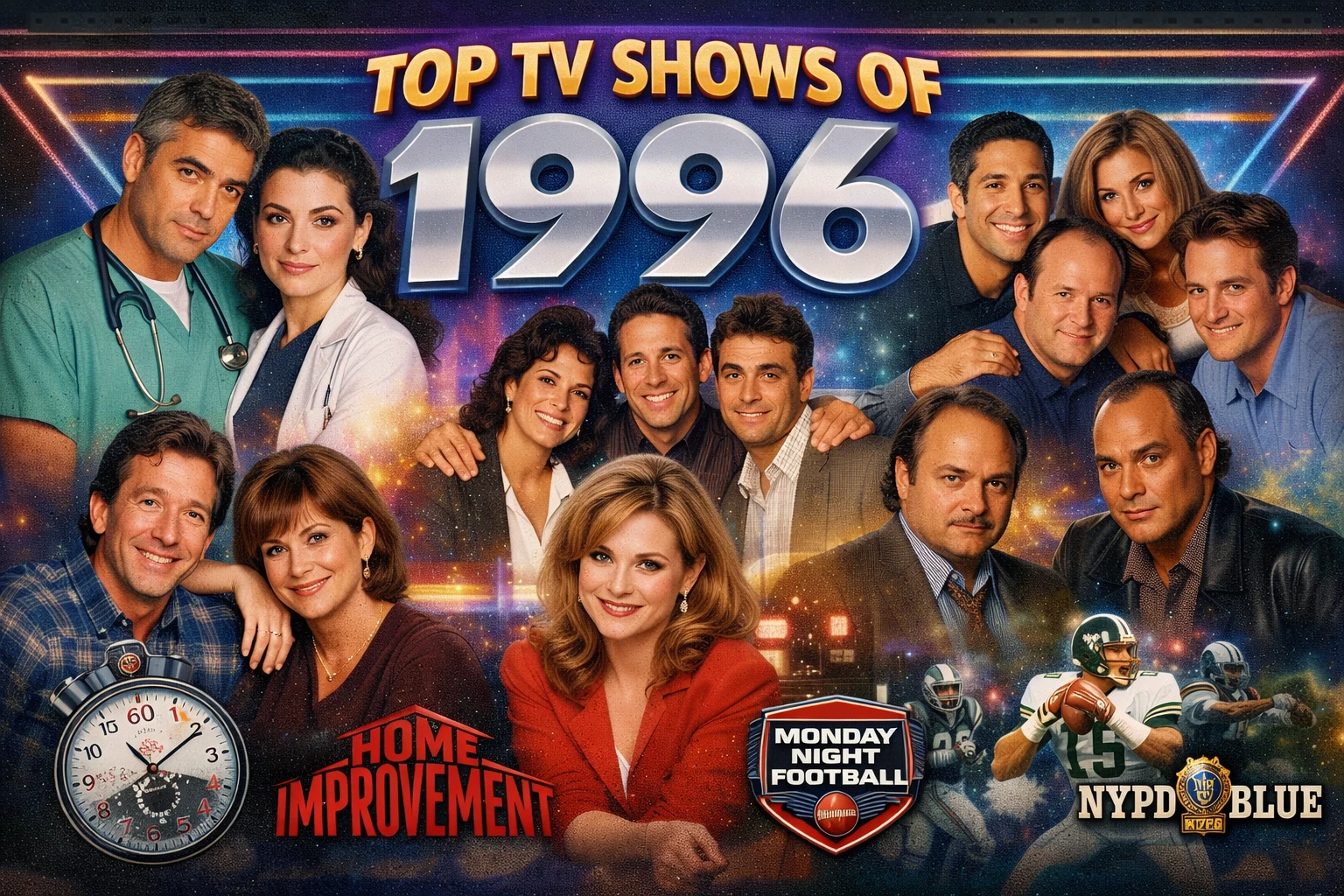
The top TV shows of 1996 feel like the moment mid-90s television fully hits commercial overdrive. By now, the old broadcast system is still strong enough to produce gigantic national hits, but the center of the conversation has shifted decisively toward faster, sharper, more personality-driven programming. The 1995–96 season is led by ER at #1, with Seinfeld right behind it, and that one-two punch tells you almost everything you need to know about where mainstream television was heading: more adrenaline, more confidence, more edge, and a lot less patience for blandness.

This is also a season where NBC’s Must See TV identity looks almost absurdly powerful. Four of the top eight shows came from NBC, including ER, Seinfeld, Friends, The Single Guy, and Boston Common, with Caroline in the City also sitting at #4. ABC still had real strength through Monday Night Football, Home Improvement, and NYPD Blue, while CBS held its serious-institution lane with 60 Minutes.

In Smells Like Gen X terms, 1996 is not the year TV gets cooler. It is the year TV is already cool and knows it. The broad family-sitcom lane is still alive, but it is no longer the only game in town. Now the top of the list includes emergency-room chaos, urban observational comedy, friend-group chemistry, slick single-life sitcoms, sports spectacle, and a much more accelerated sense of mainstream entertainment.

For Gen X, the top TV shows of 1996 were not just background noise. They were a snapshot of a culture moving faster without breaking apart yet. The biggest series of 1996 mixed sarcasm, urgency, sports ritual, city-life comedy, and broad family appeal into one shared television ecosystem. That is what makes this year so memorable: it captures a moment when network TV was still huge enough to feel universal, but already varied enough to sound like several different versions of America at once.

Gen X Note: 1996 feels like the decade in top gear. The monoculture is still alive, but now it comes with way more speed, style, and attitude.

Quick List: 1996’s Biggest TV Shows

  1. #10 NYPD Blue
  2. #9 60 Minutes
  3. #8 Boston Common
  4. #7 Home Improvement
  5. #6 The Single Guy
  6. #5 Monday Night Football
  7. #4 Caroline in the City
  8. #3 Friends
  9. #2 Seinfeld
  10. #1 ER

Countdown: The Top TV Shows of 1996

#10 — NYPD Blue

Official Nielsen Rank: #10
NetworkABC
Debut Year1993
TV SnapshotAdult urban drama

NYPD Blue rounding out the top 10 in 1996 is a strong reminder that network drama had fully entered a rougher, more adult phase by the middle of the decade. The show was no longer just the edgy exception or the buzzy controversy magnet. By the 1995–96 season, it had become a normalized part of mainstream success. That matters because it shows how much the audience had adapted to a different dramatic texture: less polished, more volatile, more urban, and more openly interested in moral mess.

What made NYPD Blue important in this particular season is that it held its place in a lineup dominated by velocity. ER was running on medical panic and momentum. Seinfeld was refining social irritation into elite comedy. Friends was building chemistry into mass appeal. Against all that, NYPD Blue still mattered because it brought adult dramatic grit into the upper tier. It helped make mainstream television feel less tidy.

For readers, NYPD Blue is one of the load-bearing shows in any best TV of the 90s conversation because it helped bridge older network procedural instincts with a newer, more character-frayed mode of storytelling. It did not just succeed in the era. It helped define how the era’s drama felt.

For Gen X viewers, NYPD Blue was one of the shows that made 1996 television feel less sanitized and more emotionally jagged. If you are looking back at the top TV shows of 1996, this series matters because it captured a version of network drama that felt restless, urban, adult, and distinctly mid-90s. It helped make the TV landscape feel more serious, more modern, and far less polished than the drama formulas that had ruled in earlier years.

Why It Mattered It kept gritty, adult, urban drama firmly inside the mainstream TV top tier.

#9 — 60 Minutes

Official Nielsen Rank: #9
NetworkCBS
Debut Year1968
TV SnapshotInstitutional journalism powerhouse

60 Minutes at #9 is one of the best reminders that even in a season dominated by quick-hit comedy and high-speed drama, broadcast television still retained a serious public center. By 1996, the program was no longer living at #1 the way it had in some earlier seasons, but staying in the top 10 at all is remarkable when you consider what it was competing against. This was a year of pure entertainment momentum, and 60 Minutes still held a seat at the main table.

Its ranking tells you something important about the shape of the medium. Mid-90s television was getting more restless, more segmented by tone, and more clearly organized around event or buzz, but millions of viewers were still showing up for the sober promise of reporting, interviews, and consequence. That is not trivial. It means the audience had not fully abandoned television’s older civic function even as the entertainment side of the dial got sharper and more seductive.

For readers, 60 Minutes is valuable because it keeps 1996 from collapsing into a single-note nostalgia story about neon sitcom dominance. The season was not just about coolness. It was also about institutional trust. That coexistence is part of what makes the broadcast era feel so expansive in hindsight.

Any honest look at the top TV shows of 1996 has to make room for the fact that Gen X audiences still lived in a television culture where hard journalism could sit beside sitcoms and sports at the top of the ratings. That is what makes 60 Minutes so important in a 1996 TV post. It reminds readers that the decade was not only about irony and entertainment heat. It was also about trust, authority, and the lingering power of television to feel nationally important.

Why It Still Mattered It proved serious journalism could still be a mass-audience habit even in one of the decade’s fastest entertainment seasons.

#8 — Boston Common

Official Nielsen Rank: #8
NetworkNBC
Debut Year1996
TV SnapshotMust See TV breakout

Boston Common at #8 is one of the most revealing rankings in the entire 1996 lineup because it captures how much scheduling power and network momentum still mattered in the Must See TV era. Today it is not one of the first shows people name when they think about 90s television, but that is exactly why its ranking is so interesting. It was a genuine Nielsen hit in a season packed with giant titles, which means it tells us something important about how broadcast success still worked.

Part of that story is proximity. NBC in 1995–96 was an absolute machine, and a show could benefit enormously from being placed inside a lineup people already treated like required viewing. But that does not mean Boston Common was accidental. It means it fit the environment well enough to convert exposure into actual audience loyalty.

For readers, Boston Common is one of those great TV history reality-check shows. It reminds you that the biggest hits of an era are not always the same as the titles that endure most strongly in cultural memory. Some are important because they reveal how the system worked, not just because they became eternal icons.

From a Gen X point of view, Boston Common helps explain how 1996 television felt when Must See TV was running at full power. When people look back at the top TV shows of 1996, this is the kind of title that fills in the real picture. The era was not built only by the most quoted series. It was also built by the supporting hits that made NBC’s comedy lineup feel unbeatable from top to bottom.

Why It Matters It shows how powerful NBC’s mid-90s sitcom ecosystem was at turning the right show in the right slot into a genuine top-10 success.

#7 — Home Improvement

Official Nielsen Rank: #7
NetworkABC
Debut Year1991
TV SnapshotBroad family sitcom powerhouse

By 1996, Home Improvement dropping to #7 does not mean it had lost importance. It means the field around it had gotten more aggressive. The show was still one of the biggest things on television, and that matters because it confirms how durable its brand of broad suburban family comedy remained even as sharper, more urban, or more youth-oriented programming kept gaining ground.

What made Home Improvement so commercially durable was scale. It did not just tell family stories. It turned family comedy into performance. The tool-show framing, Tim Allen’s oversized persona, and the show’s big, accessible comic beats made ordinary domestic life feel larger than life.

For readers, Home Improvement is one of the most useful shows for understanding the split personality of mid-90s television. On one side, the culture was moving toward irony, singles, city life, and friend-group energy. On the other, broad family sitcoms were still commanding enormous mainstream power.

For Gen X audiences in 1996, Home Improvement represented the suburban family-comedy lane at full commercial strength. It belongs in any serious discussion of the top TV shows of 1996 because it proves that even as the culture leaned harder into sarcasm, singles comedies, and faster dramas, there was still enormous mainstream appetite for broad household humor. It is one of the clearest examples of how 1996 TV could be both trendier and more traditional at the same time.

Why It Still Mattered It remained one of the clearest examples of how huge broad, suburban family comedy still was in the mid-90s.

#6 — The Single Guy

Official Nielsen Rank: #6
NetworkNBC
Debut Year1995
TV SnapshotSingle-life sitcom hit

The Single Guy at #6 is another excellent example of how strong NBC’s mid-90s comedy machinery really was. Like Boston Common, it is not necessarily the first title people remember when they think back on 1996, but the Nielsen ranking makes clear that it was a very real part of the season’s upper tier. That alone makes it historically interesting.

What the show represents is the increasing commercial strength of single-life sitcom framing in the middle of the decade. The emotional center of television had shifted away from purely family-based formats. Dating, urban adulthood, peer interaction, and lifestyle-based comedy were now major network business.

For readers, The Single Guy is important less as a canon title and more as evidence of what the mainstream comedy market was rewarding in 1996.

If you want to understand how Gen X television was changing by 1996, The Single Guy is a useful piece of the puzzle. It reflects the growing commercial power of dating, peer-group, and city-life comedy inside the mainstream network system. For readers looking back at the top TV shows of 1996, this show adds important context: the center of TV storytelling had shifted away from purely family-based formats and toward a more singles-driven, socially mobile version of adult life.

Why It Matters It captures the strength of the mid-90s shift toward single-life, peer-centered comedy as a mainstream network formula.

#5 — Monday Night Football

Official Nielsen Rank: #5
NetworkABC
Debut Year1970
TV SnapshotLive sports ritual

Monday Night Football at #5 is the season’s giant reminder that live event television still held an extraordinary advantage over everything else on the dial. As scripted television got faster, more stylish, and more competitive, sports still had the one thing no sitcom or drama could fake: real-time urgency. That urgency kept it near the top of the national rankings year after year.

Its placement in 1996 is especially important because this is a season often remembered for NBC comedy dominance, yet football still cut straight through that conversation and landed in the upper tier anyway. That tells you how much the medium still depended on ritual and simultaneity.

For readers, Monday Night Football is one of the best ways to understand why sports always sit a little differently in television history. It is not just another show. It is a weekly cultural event, and in 1996 that event still had enough force to outrank most scripted television.

For Gen X viewers, Monday Night Football was not just another program in 1996. It was part of the weekly ritual of American television. That is why it belongs so high on a list of the top TV shows of 1996. It shows how powerful live event viewing still was before streaming fractured everything. In a season full of huge scripted hits, football still had the unmatched advantage of urgency, spectacle, and real-time national attention.

1996 Takeaway Live sports remained one of the biggest and most durable mass-attention engines in American television.

#4 — Caroline in the City

Official Nielsen Rank: #4
NetworkNBC
Debut Year1995
TV SnapshotCity-centered sitcom hit

Caroline in the City finishing #4 is one of the more surprising but revealing facts of the 1995–96 season. In hindsight, it can feel overshadowed by Seinfeld, Friends, and ER, but its official placement proves it was not just along for the ride. It was one of the biggest shows in America. That is important because it reveals how broad the NBC comedy engine really was at its peak.

The show also sits in an interesting place culturally. It reflects the growing commercial value of young-adult and single-life comedy, but in a somewhat brighter, broader, more traditional network form than Seinfeld’s sharper irony. That made it useful to the lineup. It occupied adjacent territory without feeling identical.

For readers, Caroline in the City is another great reminder that the shows which most dominate memory are not always the only ones dominating ratings.

Caroline in the City helps show that Gen X TV in 1996 was not just about the biggest legacy titles. It was also about the expanding power of city-centered, single-adult sitcoms that felt stylish, accessible, and built for NBC’s comedy empire. For anyone looking back at the top TV shows of 1996, this ranking is a great reminder that the decade’s television identity was broader than just a few canonical names. The supporting hits matter too because they reveal what the mainstream audience was actually rewarding.

Why It Matters It helped prove that NBC’s city and singles comedy lane extended beyond its most iconic titles and still worked at top-tier scale.

#3 — Friends

Official Nielsen Rank: #3
NetworkNBC
Debut Year1994
TV SnapshotElite ensemble sitcom

By 1996, Friends at #3 means the show is no longer just a breakout. It is an elite mainstream institution. That shift matters because it confirms that the friend-group ensemble had fully broken through as one of the defining storytelling formats of the decade. The show was no longer only buzzy or beloved. It was one of the biggest things on television, period.

What made Friends so powerful in this season was the way it sold youth-adult life as warm, attractive, and emotionally central. The show’s world was built around chosen family rather than traditional family, and that was a major reorientation for network sitcom storytelling. Dating, apartments, work problems, friendship rituals, and social embarrassment all became the center of gravity.

For readers, Friends is essential because it helps explain a huge amount of later TV. The ensemble hangout format, the emotional importance of peer groups, the commercial power of cast chemistry, and the packaging of adulthood as aspirational-but-chaotic all become clearer when you look at how massive the show already was in 1996.

Few shows say Gen X and 1996 quite like Friends. It is one of the most important entries in the top TV shows of 1996 because it helped redefine what mainstream adulthood looked like on television. Friendship, dating, apartments, work frustration, and chosen-family chemistry became the emotional center of the story. That shift mattered not just for ratings, but for the entire direction of ensemble comedy that followed.

Why It Mattered It helped turn friendship-centered ensemble comedy into one of the defining mainstream TV modes of the 90s.

#2 — Seinfeld

Official Nielsen Rank: #2
NetworkNBC
Debut Year1989
TV SnapshotIronic sitcom giant

Seinfeld at #2 in 1996 means it had not slipped from cultural dominance even though ER edged it out in the ratings. In practical terms, the show was still one of the central defining forces of the medium. And what makes that so important is that its sensibility had already become mainstream enough to compete for the very top spot in America two years in a row.

The show’s importance in this season is not just that it stayed huge. It is that it solidified a different theory of sitcom success. Seinfeld proved that observational discomfort, petty social friction, and characters who often refused sentimental improvement could not only work, but dominate. That was a major shift in the center of mainstream comedy, and by 1996 it no longer looked like an experiment. It looked like the new order.

For readers, Seinfeld is one of the most useful shows in the entire TV canon because it helps explain why mid-90s sitcoms feel so different from the family-reassurance models that ruled earlier eras. It normalized irony at scale. It made small social absurdities feel like sufficient narrative fuel. And it changed what audiences expected to laugh at.

In any discussion of the top TV shows of 1996, Seinfeld has to be treated as one of the essential Gen X texts of the decade. By 1996, it had already proven that mainstream comedy could thrive on irritation, awkwardness, irony, and the petty absurdity of everyday life. It did not just reflect the culture. It helped shape the comic rhythm of the culture, which is why it still feels so central to the TV identity of the mid-90s.

Why It Still Mattered It kept a sharper, more ironic, more socially petty style of comedy at the very center of American television.

#1 — ER

Official Nielsen Rank: #1
NetworkNBC
Debut Year1994
TV Snapshot#1 medical drama juggernaut

ER finishing #1 in 1996 is one of the most important television facts of the decade. In just its second season, it became the top-rated show in America, which tells you how thoroughly it had captured the culture’s appetite for speed, intensity, and ensemble momentum. This was not simply a popular medical drama. It was the show that best matched the tempo of mid-90s television itself.

What made ER such a powerful #1 is that it combined multiple kinds of appeal at once. It had action. It had youth appeal. It had workplace urgency. It had overlapping emotional arcs. It had a high-pressure environment that made every episode feel kinetic before you even got to the character drama. That is a rare combination. And because it hit all those notes together, it did not just become a drama hit. It became the defining hit.

For readers, ER is indispensable because it helps explain the acceleration of mainstream TV storytelling in the second half of the decade. It was not only about ratings. It was about pacing, structure, and tone. The show helped teach broadcast drama to move faster, feel bigger, and carry more emotional traffic at once. That is why its #1 finish matters so much.

If Seinfeld defined one side of the Gen X television sensibility in 1996, ER defined the other: speed, intensity, urgency, and emotional overload. As the #1 entry on a list of the top TV shows of 1996, it matters because it showed how dramatically network storytelling had accelerated by the middle of the decade. It was not just a hit medical drama. It was one of the clearest examples of how 1996 TV had become bigger, faster, and far more kinetic than what came before.

Why It Mattered It made high-velocity ensemble drama the dominant mainstream TV form of the moment.

Rewind Verdict

The top TV shows of 1996 reveal a broadcast system operating at peak mid-90s efficiency. ER takes the #1 spot and confirms that urgency, ensemble drama, and momentum have become core mass-audience values. Seinfeld remains a giant and keeps irony at the center of American comedy. Friends becomes elite-tier mainstream TV. NBC’s broader sitcom bench, including Caroline in the City, The Single Guy, and Boston Common, shows just how overwhelming its comedy ecosystem had become. ABC still holds major territory through Monday Night Football, Home Improvement, and NYPD Blue. CBS keeps its institutional foothold with 60 Minutes.

That is what makes 1996 such a strong Gen X TV year. The monoculture is still intact, but it has become faster, sharper, and more stylistically split. Different kinds of viewers are finding different kinds of hits inside the same shared ecosystem. You still get giant audience overlap, but you no longer get one emotional center. That makes the season feel especially modern compared with even a few years earlier.

If 1995 felt like mid-90s TV hitting stride, 1996 feels like it hitting top gear.

FAQ: Top TV Shows of 1996

Why does this 1996 post use the 1995–96 season?

Because this series uses the Nielsen season ending in that year, so the 1996 post is based on the 1995–96 season.

What was the #1 TV show of 1996?

For the 1995–96 Nielsen season, ER finished at #1.

Was Seinfeld still huge in 1996?

Yes. Seinfeld finished #2, just behind ER.

Did Friends already become one of the biggest shows on TV by 1996?

Yes. Friends finished #3 in the 1995–96 season, confirming it had already become a top-tier mainstream hit.

Which network dominated the 1995–96 season?

NBC had the strongest overall top-tier presence, with ER, Seinfeld, Friends, Caroline in the City, The Single Guy, and Boston Common all inside the top 10.

Why do the top TV shows of 1996 matter so much for Gen X nostalgia?

Because the biggest shows of 1996 capture several major parts of the Gen X TV experience at once: fast network drama, ironic sitcoms, friend-group comedies, sports event viewing, and the last great era of true broadcast monoculture.
Get the Weekly Gen X Drop

New videos, rewinds, and savage nostalgia — first.

JOIN THE NEWSLETTER WATCH VIDEOS

MORE REWINDS