Top TV Shows of 1994: The Biggest Nielsen Hits of the 1993–94 Season

Top TV Shows of 1994: The Biggest Nielsen Hits of the 1993–94 Season
Smells Like Gen X • Top TV Shows of 1994

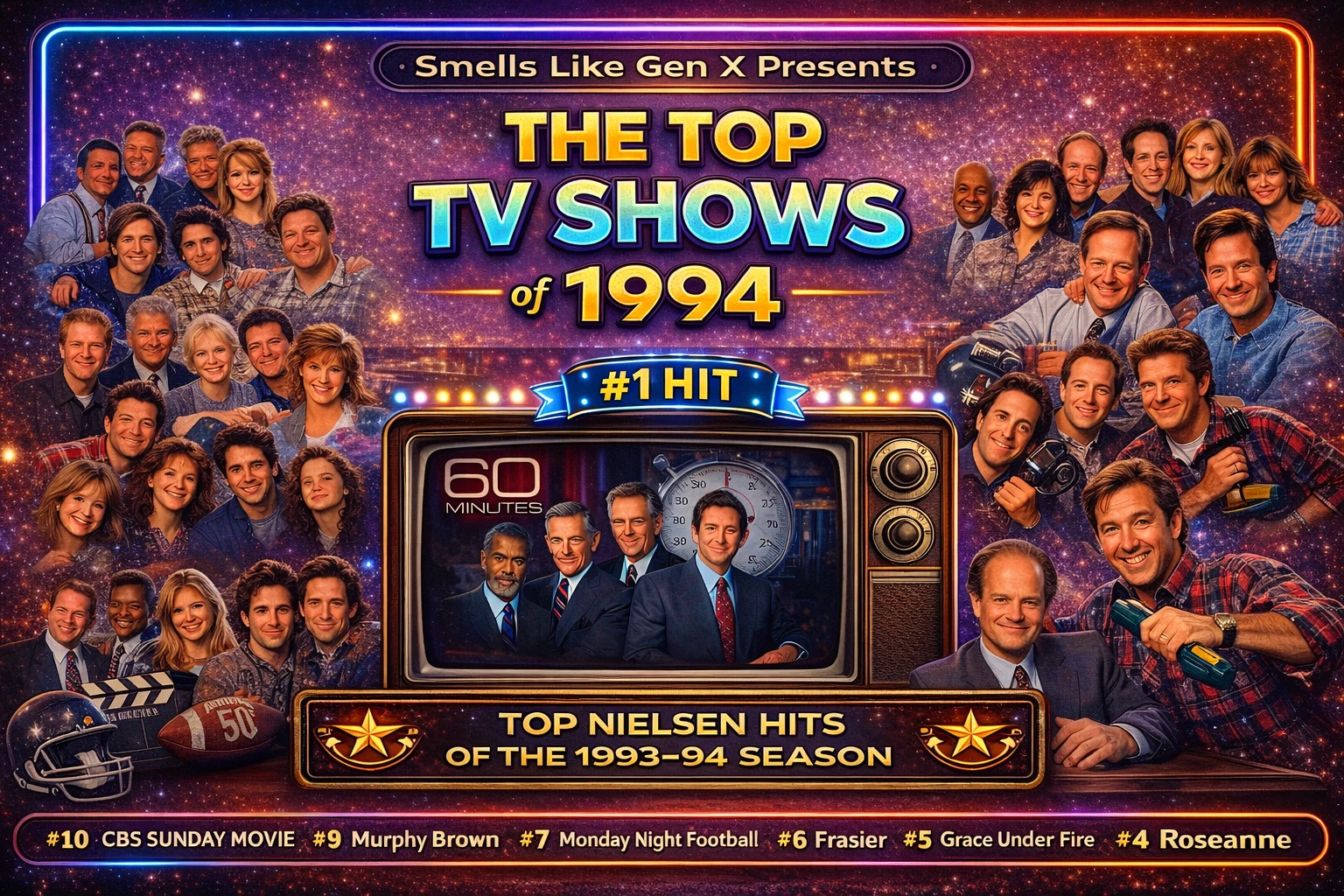
The Top TV Shows of 1994

The top TV shows of 1994 feel like the moment early-90s television stops being transitional and starts looking fully self-assured. The season still has old broadcast institutions at the top, but now they are sharing space with the shows that would define the decade’s comic personality more clearly: sharper sitcoms, bigger character voices, broader family comedy, and a much stronger sense that audiences no longer needed every hit to feel polished in the same late-80s way.

This is also the year where the comedy shift becomes impossible to miss. Home Improvement rises to #2. Seinfeld jumps all the way to #3. Grace Under Fire breaks in hard at #5. Frasier lands at #7 in its first season. That is not just a rankings story. It is a tone story. Prime time is moving toward a more specific comic identity: less glossy, less sentimental by default, more personality-driven, and more willing to let awkwardness, irritation, and adult friction drive the engine.

In Smells Like Gen X terms, 1994 is the year the TV room gets a little smarter, a little broader, and a little weirder without losing mainstream appeal. The monoculture is still alive, but it is now being shaped by multiple styles of success at once: news authority, event sports, blue-collar family noise, cynical urban comedy, elegant workplace banter, and the last wave of network movie-event gravity.

Gen X Note: 1994 is where the decade’s TV identity gets louder and more confident. The lineup still shares one room, but the voices inside it are getting way more specific.

Quick List: 1994’s Biggest TV Shows

  1. #10 CBS Sunday Movie
  2. #9 Murphy Brown
  3. #8 Monday Night Football
  4. #7 Frasier
  5. #6 Coach
  6. #5 Grace Under Fire
  7. #4 Roseanne
  8. #3 Seinfeld
  9. #2 Home Improvement
  10. #1 60 Minutes

Countdown: The Top TV Shows of 1994

#10 — CBS Sunday Movie

Official Nielsen Rank: #10
NetworkCBS
Debut YearLegacy TV Slot
TV SnapshotNetwork movie event block

The CBS Sunday Movie hanging on at #10 in 1994 is one of the clearest signs that the old network event system was not dead yet. It was weaker than it had once been, sure, but it still had enough force to put a recurring movie slot inside the national top 10. That is almost hard to imagine now, and that is exactly why it matters.

Its ranking also helps widen the story of the season. The year is often remembered for sitcom momentum, and fairly so, but the survival of the CBS Sunday Movie slot in the upper tier shows that broadcast television still had one foot planted in an older kind of mainstream habit. People still gathered for blocks, not just brands. They still showed up for the idea of “what’s on tonight” in a way that would weaken later.

Culturally, the CBS Sunday Movie is not the flashiest title here, but it may be one of the most revealing. It tells you that the broadcast era still had enough cohesion to make a movie slot feel nationally relevant.

Why It Matters It captures the lingering strength of scheduled network event viewing before that model really started to thin out.

#9 — Murphy Brown

Official Nielsen Rank: #9
NetworkCBS
Debut Year1988
TV SnapshotAdult workplace comedy

Murphy Brown staying in the top 10 at #9 proves that smart adult workplace comedy was no longer just a successful variation on the sitcom formula. By 1994, it was a core part of the mainstream. The show had already established itself as one of the most distinctive voices of the early 90s, but its continued placement here matters because it shows viewers were still making room for wit, ego, media satire, and professional friction in the middle of a lineup increasingly crowded with broader or noisier hits.

What makes Murphy Brown so important in a year like this is that it helps hold open a lane for comedy that sounds like adults talking to each other in a world with status, deadlines, politics, and consequences. It did not need a domestic setup to feel relatable. It built its world around work, competence, insecurity, and verbal sharpness.

In a larger sense, Murphy Brown also represents the kind of show that made the early 90s richer than simple nostalgia summaries allow. There was also room for series built around career identity and adult intelligence.

Why It Still Mattered It kept sharp, adult, workplace-centered comedy firmly inside the mainstream TV conversation.

#8 — Monday Night Football

Official Nielsen Rank: #8
NetworkABC
Debut Year1970
TV SnapshotLive sports ritual

Monday Night Football at #8 is another reminder that live event television still held extraordinary power in 1994. Even as comedy became the dominant story of the season, sports remained one of the few truly communal forms of appointment viewing that could still rival scripted entertainment at scale.

Its place in the top 10 also reinforces how broad the season really was. The 1993–94 rankings were not just “best sitcoms plus a news magazine.” They were a broader map of what mass audiences still wanted together: journalism, sports, family comedy, smarter adult comedy, and event movies.

There is also something very mid-90s about its presence here. The league, the broadcast package, the presentation, and the sense of television as spectacle all line up perfectly with a moment when TV still had the power to turn a regular weekly sports event into something that felt socially central.

1994 Takeaway Live sports remained one of the strongest weapons in the entire broadcast system.

#7 — Frasier

Official Nielsen Rank: #7
NetworkNBC
Debut Year1993
TV SnapshotElegant neurotic comedy

Frasier landing at #7 in its first season is one of the biggest statements in the whole 1994 lineup. This was not just a successful spinoff. It was an instant top-tier hit, and that tells you a lot about how much appetite there still was for sophisticated, adult-centered comedy when it was executed with enough confidence and precision.

What makes Frasier so significant is the way it manages to feel polished without feeling stale. It inherits some of the adult verbal intelligence associated with Cheers, but it repackages it into something more class-conscious, more neurotic, and in some ways even more explicitly built around personality clash.

Its ranking also matters in a broader historical sense because it signals NBC’s ongoing ability to turn premium-feeling comedy into mass-audience success.

Why It Mattered It proved that elegant, neurotic, adult comedy could still become immediate mainstream TV.

#6 — Coach

Official Nielsen Rank: #6
NetworkABC
Debut Year1989
TV SnapshotDependable relationship sitcom

Coach at #6 shows just how much room there still was in 1994 for a dependable, likable, well-built sitcom that was not trying to reinvent the medium. In a season now remembered for the acceleration of Seinfeld, the arrival of Frasier, and the continued dominance of Home Improvement and Roseanne, Coach can look almost modest by comparison. But that modesty is part of the point.

The show’s strength came from stability. It understood its characters, understood its emotional register, and knew how to deliver weekly familiarity without collapsing into total blandness. Not every successful show becomes a cultural flashpoint. Some become part of the structure that makes an entire network ecosystem feel comfortable to inhabit.

Its ranking also helps keep the 1994 story honest. This was not a season where every hit had to be edgy, ironic, or groundbreaking.

Why It Clicked It delivered dependable, character-driven network comfort in a season crowded with bigger personalities.

#5 — Grace Under Fire

Official Nielsen Rank: #5
NetworkABC
Debut Year1993
TV SnapshotGrounded blue-collar sitcom

Grace Under Fire breaking in at #5 is one of the clearest signs that the early 90s were still hungry for comedy built around rougher life texture and less polished domestic presentation. As a first-season hit, it matters a lot. This was not just another family sitcom entering the field. It was part of the larger post-Roseanne world, where viewers had already shown they would embrace comedy that looked more strained, more ordinary, and more recognizably worn.

What makes Grace Under Fire especially important in the 1993–94 season is that it shows how much influence the working-class comedic shift had already exerted. The show did not need to invent that tone from scratch because the audience had already been prepared for it. But it did need to execute the formula with enough confidence and presence to become a top-five hit immediately, and it did.

Its placement also helps mark 1994 as a season where new hits were not only arriving — they were arriving with force.

Why It Mattered It confirmed that rougher, more grounded, working-class comedy was not a passing fad but a durable mainstream lane.

#4 — Roseanne

Official Nielsen Rank: #4
NetworkABC
Debut Year1988
TV SnapshotWorking-class sitcom institution

By 1994, Roseanne at #4 was no longer simply a disruptive force. It had become part of the architecture of mainstream television. That is what makes its continued presence so important. The show was no longer shocking the system from the outside. It had already changed the emotional weather inside the system itself.

The reason the show still matters so much in a 1994 pillar post is that you can see its influence radiating outward. One of the season’s major new hits, Grace Under Fire, makes more sense because Roseanne had already moved the room. Broader family comedy also feels less polished overall than it once did.

At the same time, the show still earned its position as entertainment, not just as influence. It remained funny, grounded, and abrasive in a way that many viewers clearly still found more recognizable than the smoother family formats elsewhere on the dial.

Why It Still Mattered It remained one of the central forces making mainstream television feel rougher, funnier, and more lived-in.

#3 — Seinfeld

Official Nielsen Rank: #3
NetworkNBC
Debut Year1989
TV SnapshotIronic urban sitcom breakthrough

Seinfeld jumping to #3 is one of the most important shifts in the entire 1994 season. This is the point where its rise stops looking like a cultish or critically admired anomaly and starts looking like mass-audience dominance.

What Seinfeld represented was not simply another hit sitcom. It represented a different logic of comedy. The show was less interested in family cohesion, moral reassurance, or conventional workplace structure than many earlier mainstream hits. It cared about social friction, petty behavior, tiny irritations, observational absurdity, and the comedy of people who are often not especially generous or improving.

Its rise also helps explain why the mid-90s feel so distinct from the TV culture just a few years earlier. Seinfeld is one of the core reasons the decade starts to feel more ironic, more urban, and less interested in the older forms of sentimental payoff.

Why It Mattered It helped move mainstream sitcom comedy toward observational discomfort, irony, and smaller-scale social absurdity.

#2 — Home Improvement

Official Nielsen Rank: #2
NetworkABC
Debut Year1991
TV SnapshotLoud family sitcom powerhouse

Home Improvement reaching #2 in 1994 confirms that its success was not a fluke and not merely a flashy new arrival. By the 1993–94 season, it had become one of the dominant mainstream family sitcoms in America.

What makes Home Improvement especially interesting in this season is the way it blends old and new. It still offers the old broadcast promise of accessibility and family-scale appeal. But its actual comic energy feels much more aggressively 90s. The volume is higher. The gender dynamics are broader and more exaggerated. The domestic space feels less elegant and more performative.

Its placement also underlines just how much ABC was benefiting from this newer family-comedy energy. In a season where Seinfeld was rising and Frasier was breaking through, Home Improvement still managed to stand ahead of them both.

1994 Takeaway This was family sitcom power at near-peak force, built for the louder, broader emotional style of the mid-90s.

#1 — 60 Minutes

Official Nielsen Rank: #1
NetworkCBS
Debut Year1968
TV SnapshotMass-audience journalism leader

60 Minutes finishing #1 again in 1994 is one of the strongest reminders that the broadcast monoculture still had a serious civic spine. In a season where comedy was becoming sharper, family sitcoms were booming, and network identity was growing more fragmented, the biggest show in America was still a news magazine.

Its place at the top also helps explain why CBS looked so strong overall. The network was not only winning with legacy inertia. It was winning with a lineup that combined authority, adult-skewing comfort, and broad accessibility, and 60 Minutes was the crown jewel of that strategy.

In a 1994 context, 60 Minutes also functions as a kind of counterweight to the season’s comedy explosion. Yes, the year is incredibly important for sitcom evolution. But the top-rated show in America still wore a stopwatch, not a laugh track.

Why It Mattered It proved that in the middle of a comedy-heavy season, serious journalism could still be the single biggest thing on television.

Rewind Verdict

The top TV shows of 1994 reveal a broadcast system that is still powerful enough to hold the country together for a few hours each week, but flexible enough to let very different kinds of hits thrive at once. 60 Minutes wins the season. Home Improvement and Roseanne prove broad family comedy is now operating on a rougher, louder register. Seinfeld makes its leap into the elite tier. Frasier arrives immediately as a top-10 force. Murphy Brown keeps workplace comedy alive near the top.

That is what makes 1994 such a strong Gen X TV year. The room is no longer unified, but it is still shared. Viewers are rewarding multiple comic styles, multiple kinds of authority, and multiple kinds of comfort at the same time. The result is a lineup that feels fully mid-90s without yet slipping into total fragmentation.

If 1993 felt like the 90s voice settling in, 1994 feels like that voice getting louder and more confident.

FAQ: Top TV Shows of 1994

Why does this 1994 post use the 1993–94 TV season?

Because this series uses the Nielsen season ending in that year, so the 1994 post is based on the 1993–94 season rankings.

What was the #1 TV show of 1994?

For the 1993–94 Nielsen season, 60 Minutes finished at #1.

What sitcom finished highest in the 1994 rankings?

Among sitcoms, Home Improvement finished highest at #2, ahead of Seinfeld at #3 and Roseanne at #4.

Why is Frasier such a big deal in the 1994 TV story?

Because it debuted straight into the top 10, finishing #7 in its first season, which immediately established it as a major mainstream hit.

Was 1994 mostly a sitcom year?

Mostly, yes, but not entirely. The top 10 also included 60 Minutes, Monday Night Football, and CBS Sunday Movie, showing that mass-audience television was still broad.
Get the Weekly Gen X Drop

New videos, rewinds, and savage nostalgia — first.

JOIN THE NEWSLETTER WATCH VIDEOS

MORE REWINDS