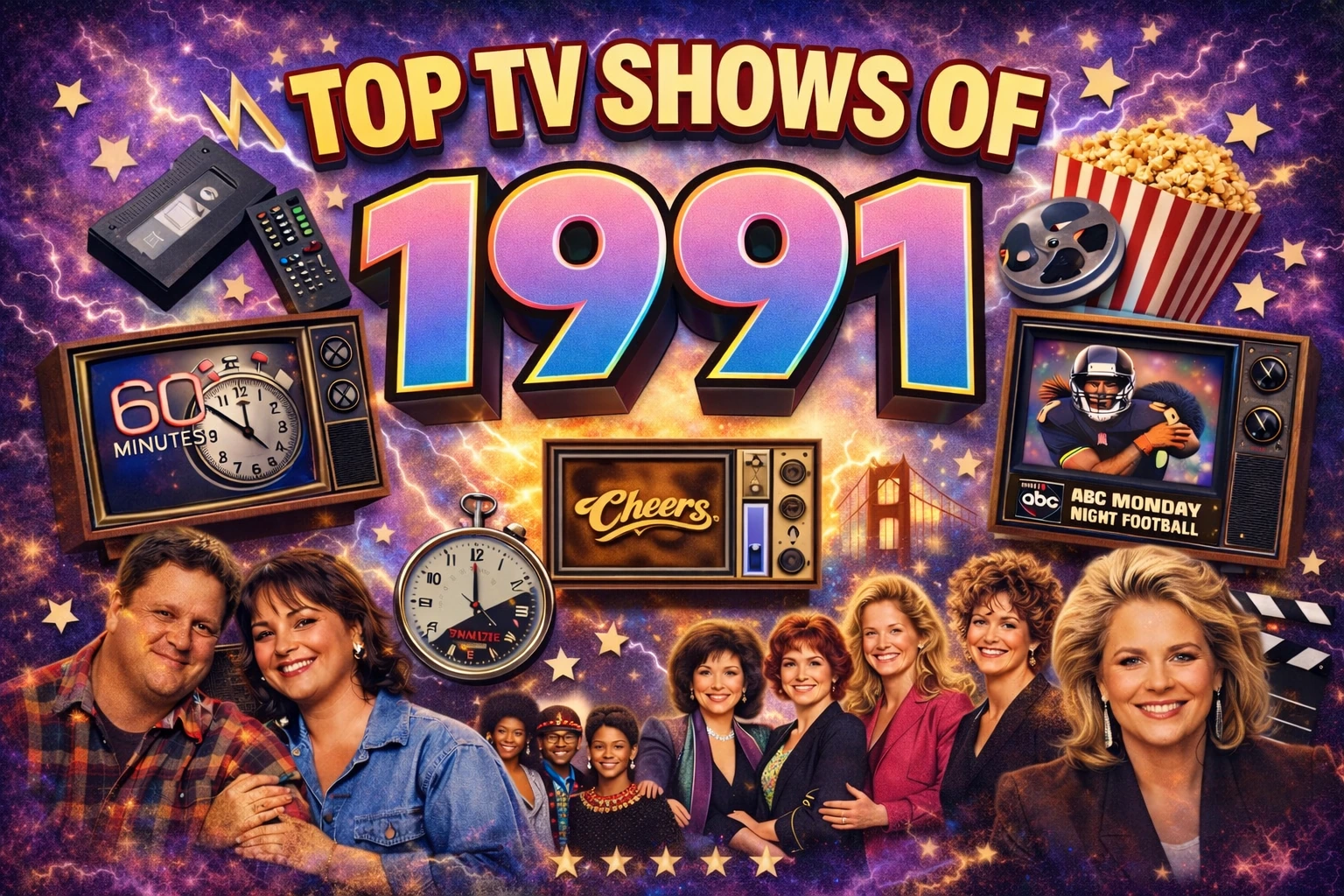
Top TV Shows of 1991: The Biggest Nielsen Hits of the 1990–91 Season

Top TV Shows of 1991: The Biggest Nielsen Hits of the 1990–91 Season
Smells Like Gen X • Top TV Shows of 1991

The Top TV Shows of 1991

The top TV shows of 1991 feel like a snapshot of broadcast television right as the old network empire started showing its age, but still had enough muscle to dominate the culture. NBC still finished on top, but the distance between the big three networks felt smaller, and the overall TV landscape was becoming less tidy than the late 80s had trained viewers to expect.

This is a year where the lineup feels less like one giant sitcom machine and more like a mixed ecosystem. Cheers finally rose to the top. 60 Minutes still had enormous institutional gravity. Roseanne remained one of the defining tonal forces in America. A Different World, Murphy Brown, and Designing Women kept sharper adult voices alive in the mainstream. America’s Funniest Home Videos and Monday Night Football reminded everyone that event TV and broad crowd-pleasers still mattered just as much as prestige sitcom writing.

In Smells Like Gen X terms, 1991 is not the year television stopped being comforting. It is the year comfort had to share shelf space with sarcasm, newsroom tension, campus energy, football spectacle, and a growing sense that viewers no longer needed every major hit to live inside the same polished emotional lane.

Gen X Note: If 1990 felt like the old network order getting shoved around a little, 1991 feels like the room widening. The laugh tracks were still warm, but the voices were getting sharper. The mood was still familiar, but it was no longer all coming from the same place.

Quick List: 1991’s Biggest TV Shows

The 1990–91 Nielsen season includes ties at #7 and #10, so this “Top 10” year actually produces 11 shows.

  1. #10 (tie) The Golden Girls
  2. #10 (tie) Designing Women
  3. #9 Monday Night Football
  4. #7 (tie) Empty Nest
  5. #7 (tie) America’s Funniest Home Videos
  6. #6 Murphy Brown
  7. #5 The Cosby Show
  8. #4 A Different World
  9. #3 Roseanne
  10. #2 60 Minutes
  11. #1 Cheers

Countdown: The Top TV Shows of 1991

#10 (tie) — The Golden Girls

Official Nielsen Rank: #10 (tie)
NetworkNBC
Debut Year1985
TV SnapshotSharp adult ensemble sitcom

The Golden Girls still landing in the top tier in 1991 says a lot about how durable truly great ensemble comedy can be. By this point, the show was not surviving on novelty or goodwill alone. It had become one of the rare sitcoms that could feel broad, warm, quick, and genuinely smart all at once. Dorothy, Rose, Blanche, and Sophia were not just archetypes plugged into a premise. They were a comic machine.

What made the machine work was the way the writing trusted character. The show did not need a gimmick-heavy setup every week because the personalities were already doing the heavy lifting. That gave the series a depth many “comfort sitcoms” never reach. It could be cozy, but it never had to be bland. It could be mainstream, but it never had to dumb itself down to get there.

In a 1991 lineup filled with sharper, more socially textured, and sometimes more abrasive programming, The Golden Girls held its ground by being exactly what it had always been: funny, humane, quick on its feet, and written with more intelligence than most network comedies thought they needed.

Why It Still Mattered It proved that adult-centered ensemble comedy could still feel warm without losing wit, speed, or bite.

#10 (tie) — Designing Women

Official Nielsen Rank: #10 (tie)
NetworkCBS
Debut Year1986
TV SnapshotOpinionated workplace sitcom

Designing Women tying at #10 is one of the best clues that 1991 audiences still had a real appetite for dialogue-forward sitcoms with actual point of view. The show was funny, yes, but it also had edge. It was rooted in strong personalities, regional flavor, and the kind of outspoken energy that made it feel more awake than a lot of smoother network comedy.

That matters because early-90s television was not only shifting toward realism in the Roseanne sense. It was also making more room for stronger voices. Designing Women did not depend on generic family mechanics to carry it. It depended on women who were distinct, argumentative, opinionated, and funny in sharply different ways. That made the series feel lively instead of interchangeable.

In a season where the TV center was widening, Designing Women represents a very specific kind of success: mainstream popularity built not on polish alone, but on personality. It did not need to flatten itself to work. It just needed the audience to enjoy spending time with people who actually sounded like they believed what they were saying.

Why It Clicked It delivered network-scale sitcom success without sanding off attitude, regional flavor, or character voice.

#9 — Monday Night Football

Official Nielsen Rank: #9
NetworkABC
Debut Year1970
TV SnapshotPrime-time sports institution

Monday Night Football at #9 is another reminder that event television still mattered enormously in 1991. This was not just sports programming. It was a weekly national ritual with all the scale and shared-attention power that broadcast television was built to maximize. It belonged in the same ratings conversation as sitcoms because it occupied the same cultural territory: huge audiences, appointment viewing, and the feeling that a big piece of the country was tuning in together.

Its placement also reinforces how broad the TV culture still was. One top-10 season could include a news magazine, a football franchise, a viewer-video comedy format, and several very different types of sitcoms without any of it feeling out of place. That range is part of what made the era feel central. Monday Night Football was one of the last great examples of TV as collective habit rather than just individual choice.

1991 Takeaway Live event television was still one of broadcast TV’s strongest weapons.

#7 (tie) — Empty Nest

Official Nielsen Rank: #7 (tie)
NetworkNBC
Debut Year1988
TV SnapshotAdult comfort sitcom

Empty Nest tying for #7 shows that mature, adult-centered comfort television still had a serious place in the 1991 landscape. The show did not arrive with the critical shine of Cheers or the disruptive force of Roseanne, but it filled a different role extremely well. It made domestic fatigue, generational friction, and ordinary loneliness feel gentle enough for sitcom form without draining them of recognition.

Part of what made the show durable was that it knew how to be low-key without becoming forgettable. It did not need to be loud to be useful. It only needed to be watchable, emotionally familiar, and well-built enough that viewers wanted to settle into it every week. In a season where television was clearly diversifying its mood, Empty Nest stayed valuable because it represented one of the strongest versions of the adult comfort lane.

Why It Worked It offered grown-up, easy-to-live-with network comfort in a year when that still mattered to a lot of viewers.

#7 (tie) — America’s Funniest Home Videos

Official Nielsen Rank: #7 (tie)
NetworkABC
Debut Year1989
TV SnapshotViewer-video comedy phenomenon

By 1991, America’s Funniest Home Videos was no longer a novelty. It was a proven mass-audience machine. That is important because it shows how quickly television can normalize a format once it finds one that plugs directly into broad family appeal. The premise was almost stupidly simple, but that simplicity was the point: instant laughs, low barrier to entry, and a sense that television was getting just a little more participatory.

The bigger significance of the show is that it pointed toward a different kind of TV future. It rewarded immediacy over polish. It made ordinary people on camera feel like viable prime-time material. It was still very much a broadcast-era product, but you can already see the bones of later viewer-driven entertainment in it. In a season where the networks were fighting harder for attention, that kind of easy, repeatable format had enormous value.

Why It Mattered It proved that mass TV did not always need a star-heavy scripted premise to become a giant hit.

#6 — Murphy Brown

Official Nielsen Rank: #6
NetworkCBS
Debut Year1988
TV SnapshotSharp newsroom workplace sitcom

Murphy Brown at #6 is one of the strongest signs that adult, sharper-edged workplace comedy had fully earned mainstream space by 1991. This was not a cozy family sitcom or a nostalgia machine. It was more pointed, more verbal, and more rooted in professional life than many of the shows surrounding it in the rankings. That gave it a different flavor, and clearly, a lot of viewers wanted exactly that.

What makes Murphy Brown important in the broader TV story is that it helped keep network comedy from collapsing into one emotional register. It had wit, pressure, ego, topical energy, and enough adult tension to feel current rather than merely comfortable. In a year already leaning more textured and less glossy than the late 80s, it fit beautifully because it sounded like grown-ups who actually had jobs, competition, and opinions.

The show also represented a version of success that mattered a lot in the early 90s: mainstream appeal built around competence and friction instead of pure domestic familiarity. That helped it stand out in a season where television’s center was no longer shaped only by home-based sitcom worlds.

Why It Clicked It proved that smart, adult workplace comedy could be just as mainstream as traditional family formats.

#5 — The Cosby Show

Official Nielsen Rank: #5
NetworkNBC
Debut Year1984
TV SnapshotLate-80s broadcast titan

The Cosby Show dropping to #5 in 1991 is one of the most revealing shifts in the whole list. It was still a giant. It was still one of television’s central institutions. But it was no longer sitting at the absolute top of the mountain. That movement matters because it captures the exact moment when the polished late-80s broadcast ideal began losing a little of its total dominance, even while remaining massively important.

The show still embodied a smoother version of mainstream network success better than almost anything else. The Huxtable household still projected warmth, competence, and welcome. But 1991 viewers were increasingly splitting their loyalties among shows that sounded rougher, more adult, more cynical, or more culturally specific. The Cosby Show did not suddenly stop mattering. The room around it simply got more crowded.

1991 Takeaway The old center was still strong, but it was no longer uncontested.

#4 — A Different World

Official Nielsen Rank: #4
NetworkNBC
Debut Year1987
TV SnapshotCampus sitcom with real momentum

A Different World at #4 confirms that the series was not just surviving on spinoff goodwill. It had become one of the actual engines of early-90s network television. The campus setting gave it movement, but the larger reason it worked was that it felt socially alive. It had romance, ensemble texture, youth energy, and the sense that its characters were actually moving through a meaningful world rather than just rotating through sitcom beats.

That kind of forward motion mattered. It made the show feel fresh without sacrificing warmth. It also widened what the center of mainstream television could look like. A series rooted in Black student life and HBCU-inspired campus culture was not tucked away on the margins. It was one of the biggest things on television. That is a major part of what made the show matter then, and it is a major part of why it still matters now.

Why It Mattered It brought specificity, youth momentum, and cultural presence into the upper tier of the ratings.

#3 — Roseanne

Official Nielsen Rank: #3
NetworkABC
Debut Year1988
TV SnapshotWorking-class sitcom disruptor

At #3, Roseanne was still one of the defining forces in American television. The fact that it slipped from the tie at #1 the previous season does not make it less important. In some ways, it makes 1991 even more interesting. The show had already proven that working-class frustration, lived-in domestic space, and sharper sarcasm could rule prime time. Now the question was not whether the audience would show up. It was what television looked like after that breakthrough had already happened.

The answer is all over this list. Roseanne helped make the room tougher, less airbrushed, and more emotionally honest. It did not need to be #1 again to remain the season’s most important tonal disruptor. The Conners still represented a version of American life that many viewers recognized more readily than the polished homes of the previous decade’s biggest sitcoms.

That grounding is exactly why the show still feels central to the story of early-90s TV. It did not just become a hit. It permanently changed the emotional grammar of mainstream sitcoms.

Why It Still Mattered It remained the show that forced mainstream TV to admit people were tired, broke, funny, and not living inside a catalog.

#2 — 60 Minutes

Official Nielsen Rank: #2
NetworkCBS
Debut Year1968
TV SnapshotMass-audience journalism institution

60 Minutes at #2 is the kind of fact that instantly widens the whole story of 1991. This was not just a season dominated by entertainment. It was still a television culture broad enough to make serious journalism one of the biggest weekly habits in America. That is extraordinary when you stop and think about it now. The stopwatch still meant something. It still signaled authority, consequence, and a connection to the national conversation.

Its placement also shows how broad the mainstream audience still was before fragmentation fully kicked the door down. A news magazine could sit just below the top-rated comedy in the country and that felt normal. It did not have to be framed as prestige, niche, or side programming. It was simply one of the biggest shows on television, which is part of what made the broadcast era feel so culturally central.

Why It Mattered It proved that serious journalism was still a mass-audience event and not a specialty side lane.

#1 — Cheers

Official Nielsen Rank: #1
NetworkNBC
Debut Year1982
TV SnapshotBroadcast ensemble comedy at full mastery

Cheers finishing at #1 in 1991 matters for two reasons. First, it tells you just how refined the show had become by this stage of its run. This was ensemble comedy operating at an almost unfair level of control: tone, timing, character interplay, and setting all working in perfect alignment. Second, the result feels deeply right for the season. If any show deserved to sit alone at the top as broadcast television entered a more complicated decade, it was this one.

What makes that especially satisfying in a 1991 context is that Cheers did not win by reinventing itself into something rougher or more obviously topical. It won by being extremely good at what network comedy could be at its best: adult, communal, funny, character-driven, and beautifully built. In a year where the television center was getting more crowded and more tonally varied, Cheers still rose above everything else.

That is not just a ratings fact. It is a testament to craftsmanship. The bar still worked because the writing still worked, the ensemble still worked, and the series still understood that television comfort hits hardest when it is built from people who actually feel alive.

1991 Takeaway This was broadcast ensemble comedy hitting full mastery and taking the top spot on craft, warmth, and precision.

Rewind Verdict

The top TV shows of 1991 reveal a broadcast system that still had enormous power, but was no longer telling one simple story about what audiences wanted. Cheers won the season. 60 Minutes was right behind it. Roseanne stayed huge. A Different World, Murphy Brown, and Designing Women kept sharper adult voices close to the top. America’s Funniest Home Videos and Monday Night Football proved that broad, event-scale programming still had major pull.

That widening is the real point of 1991. The late-80s network model had not vanished, but it no longer monopolized the emotional tone of prime time. You could still find polish, warmth, and expertly tuned ensemble comedy. You could also find more irritation, more topicality, more workplace edge, more social identity, and more raw crowd-pleasing spectacle. The old center held, but it had to share.

That is why 1991 feels like such a strong Gen X TV year. It still has the comfort-food glow of network television, but it also has more attitude, more variation, and more signs that the culture was moving. It is not the year TV became fragmented beyond recognition. It is the year you can really see the seams starting to show, and that makes it great.

FAQ: Top TV Shows of 1991

Why does this 1991 post use the 1990–91 TV season?

Because this Smells Like Gen X series uses the Nielsen season ending in that year. So the 1991 post is based on the 1990–91 network television season rankings.

Why are there 11 shows in a “top 10” year?

Because the 1990–91 season table includes ties at #7 and #10, which expands the list to 11 titles.

What was the #1 TV show of 1991?

For the 1990–91 season, Cheers finished at #1.

What were the biggest non-sitcom hits in the 1991 top 10?

60 Minutes and Monday Night Football were both in the top 10, which shows how broad mass-audience television still was.

What makes the 1991 lineup different from 1990?

1991 feels a little less like one giant sitcom machine and a little more like a mixed ecosystem: prestige comedy, working-class comedy, journalism, sports, and broad crowd-pleasing formats all sharing the same top tier.

Get the Weekly Gen X Drop

New videos, rewinds, and savage nostalgia — first.

JOIN THE NEWSLETTER WATCH VIDEOS

MORE REWINDS