Top 10 Songs of 1976: Billboard Hot 100 Year-End Countdown
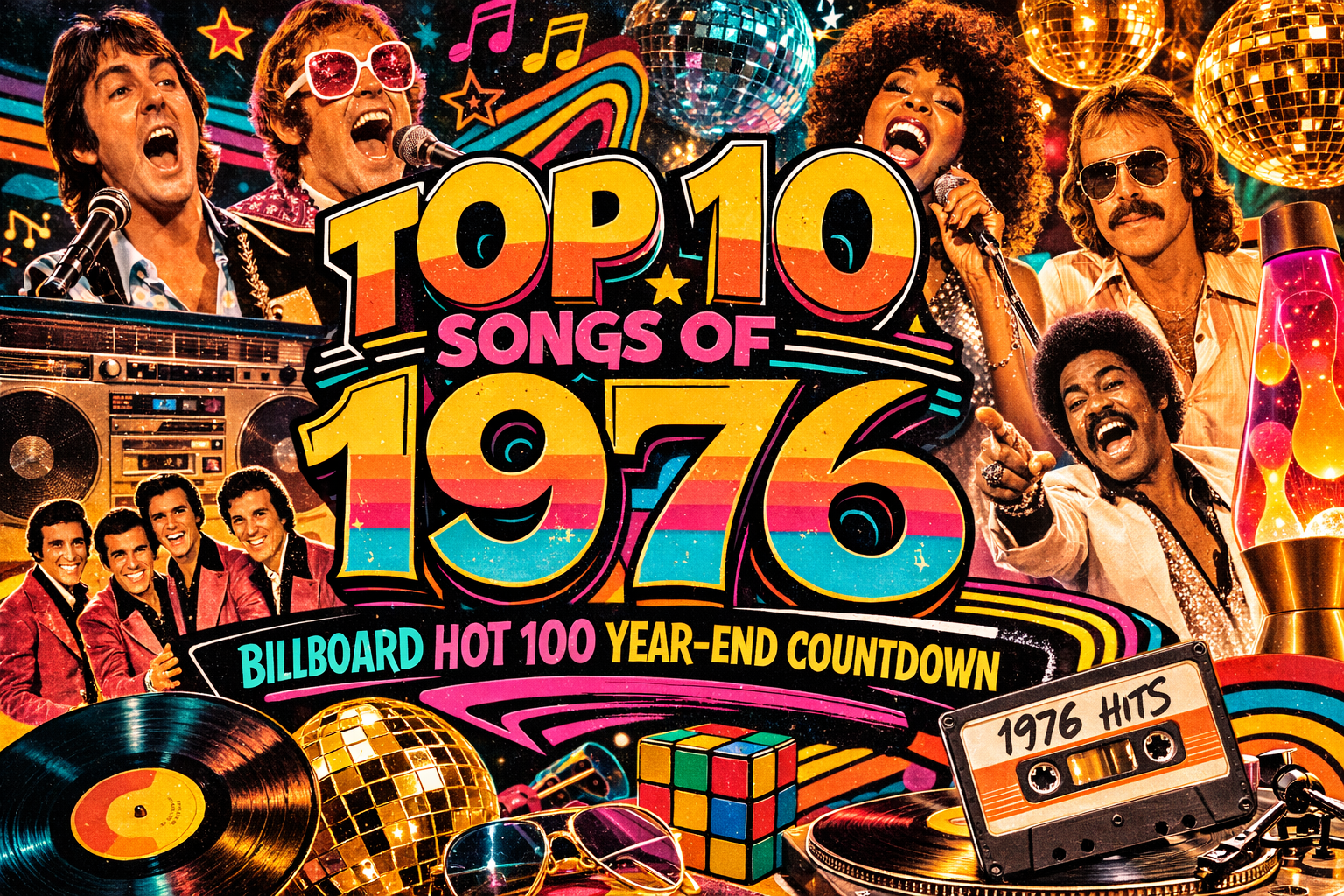
If 1976 had a glow, it was mirrored disco balls, hot dashboard plastic, roller-rink neon, cigarette smoke under colored lights, and the full realization that pop music could be slick, funky, sentimental, strange, and completely dominant all at once.
By 1976, the Hot 100 was no longer flirting with excess. It had moved in, unpacked, and started redecorating. You had disco rising harder, soft rock polishing itself into radio gold, soul staying strong, novelty still sneaking through, and mainstream pop getting more theatrical, more rhythmic, and more impossible to ignore.
This countdown ranks the Top 10 Songs of 1976 using Billboard’s Hot 100 year-end chart. These were the songs that built the biggest full-year chart performance—the records that lived in car radios, department stores, basement stereos, summer cookouts, and any room where somebody was still pretending AM radio didn’t run the country.
Top 10 Songs of 1976 (Billboard Hot 100 Year-End) — Quick List
- #10 “A Fifth of Beethoven” — Walter Murphy & The Big Apple Band
- #9 “Love Is Alive” — Gary Wright
- #8 “50 Ways to Leave Your Lover” — Paul Simon
- #7 “Love Machine” — The Miracles
- #6 “Kiss and Say Goodbye” — The Manhattans
- #5 “Play That Funky Music” — Wild Cherry
- #4 “December, 1963 (Oh, What a Night)” — The Four Seasons
- #3 “Disco Lady” — Johnnie Taylor
- #2 “Don’t Go Breaking My Heart” — Elton John & Kiki Dee
- #1 “Silly Love Songs” — Wings
#10 — “A Fifth of Beethoven” — Walter Murphy & The Big Apple Band
Why this song was such a 1976 flex
Only 1976 could take Beethoven, put a disco pulse under it, and send it to #1 without flinching. “A Fifth of Beethoven” is one of those songs that sounds like a joke right up until it absolutely steamrolls the room. The arrangement is tight, the rhythm is committed, and the record understands that style matters almost as much as concept.
What makes it more than a novelty is how well it actually works as a dance-floor record. The strings are dramatic, the groove is steady, and the whole thing sounds like tuxedo-class disco trying to prove classical music was just waiting for a mirror ball. That kind of boldness is exactly why the song still reads as pure mid-’70s chart insanity in the best possible way.
Gen X Rewind
This is the sound of the decade deciding subtlety was overrated and dramatic entrance music belonged everywhere.
Legacy
It remains one of the weirdest and most unforgettable No. 1 hits of the 1970s—proof that disco could absorb almost anything and still make it dance.
#9 — “Love Is Alive” — Gary Wright
Why this song charted like a giant anyway
“Love Is Alive” never made it to #1, but the year-end chart makes it clear the song didn’t need the crown to own the room. Gary Wright built something hypnotic here—synth-driven, slightly eerie, and much more futuristic than a lot of mainstream pop around it. It feels like a signal from the next phase of the decade.
That atmosphere did a lot of the work. The record is melodic enough to be accessible, but strange enough to keep your attention. It sounds dreamy without going soft, and mechanical without losing emotion. Songs that live that comfortably between radio friendliness and mild weirdness often age better than the neat, obvious chart-toppers, and this one absolutely does.
Gen X Rewind
This is the song that made the radio feel like it had mood lighting.
Legacy
It remains one of the essential synth-forward pop records of the mid-’70s and a major signpost toward where mainstream sound was headed next.
#8 — “50 Ways to Leave Your Lover” — Paul Simon
Why this song made heartbreak sound clever
Paul Simon took a breakup song and made it sound dry, cool, and oddly relaxed, which is not the easiest trick in the world. “50 Ways to Leave Your Lover” works because it does not wallow. It shrugs. The lyric is witty, the groove is immaculate, and the famous drum feel gives the whole record a nervous little strut that makes it unforgettable.
There is also something very commercially smart about a song that feels sophisticated without becoming distant. Listeners got a hook, a mood, and a line everyone could quote, but the arrangement still had enough finesse to make the record feel smarter than the average Top 40 smash. That’s how you end up with three weeks at #1 and a year-end Top 10 finish without sounding like you’re chasing either one.
Gen X Rewind
This is the kind of song that made adult problems sound almost stylish, which is probably why people kept playing it.
Legacy
It remains one of Paul Simon’s strongest solo hits and one of the most elegantly detached breakup songs ever to top the Hot 100.
#7 — “Love Machine” — The Miracles
Why this song still feels so alive
“Love Machine” sounds like pure movement. The groove is elastic, the vocal is teasing, and the whole record is built to feel like it’s already in motion before the first line lands. The Miracles knew exactly how to make rhythm the lead character, and that confidence is all over this track.
Even better, it doesn’t sound overworked. That’s part of why it lasted. Plenty of danceable songs get by on momentum alone. “Love Machine” adds personality, flirtation, and enough pop clarity to make the thing work beyond the club or the cookout. It got to #1 because it was fun, but it finished high for the year because it kept being fun after people already knew it by heart.
Gen X Rewind
This is “nobody in the room is sitting still, even if they pretend they are” music.
Legacy
It remains one of The Miracles’ biggest crossover hits and one of the great bridge records between classic soul polish and the dance floor to come.
#6 — “Kiss and Say Goodbye” — The Manhattans
Why this song hit so hard
There is no wasted emotion in “Kiss and Say Goodbye.” The spoken intro alone tells you exactly what kind of record this is: grown, serious, intimate, and not remotely interested in pretending heartbreak is cute. Then the melody shows up and makes the whole thing even more devastating.
What makes the song such a strong chart performer is that it balances drama and restraint beautifully. It’s sad, but not melodramatic. Smooth, but not slick to the point of losing feeling. Mainstream listeners could sit with it, soul audiences could claim it, and radio could keep spinning it without the record wearing out its welcome. That’s how it becomes both a No. 1 hit and a full-year giant.
Gen X Rewind
This is the song that made the room feel more adult than you were prepared for.
Legacy
It remains one of the defining slow-burn soul ballads of the decade and one of the most memorable No. 1s of 1976.
#5 — “Play That Funky Music” — Wild Cherry
Why this song still goes off
Because the groove is not a suggestion. “Play That Funky Music” arrives with one job and performs it with militant efficiency. The riff is instantly recognizable, the beat is undeniable, and the entire record is basically a demand wrapped in a party invitation. There is zero ambiguity about what it wants from you.
And that clarity matters. Great dance records are often incredibly specific about their purpose. This one is practically instructional. It crossed over because funk had already become impossible for mainstream radio to ignore, and Wild Cherry delivered a version that was loose enough to feel fun and sharp enough to feel undeniable. Three weeks at #1 is not nostalgia talking. That’s the sound of a record doing exactly what it was built to do.
Gen X Rewind
This is the song that turned a regular room into a temporary event space.
Legacy
It remains one of the most iconic funk-pop crossover hits ever recorded and one of the most durable party records of the era.
#4 — “December, 1963 (Oh, What a Night)” — The Four Seasons
Why this comeback hit worked so perfectly
“December, 1963 (Oh, What a Night)” is nostalgia with a pulse. The Four Seasons took memory, rhythm, and melody and turned them into one of the easiest songs in the world to love. It feels old-fashioned and modern at the same time, which is a huge part of why it landed so broadly in 1976.
The production helps a lot. It’s bright, bouncy, and clean without sounding sterile. The chorus has that instant-lift quality, and the whole song is built to feel communal. You don’t really listen to this one alone; even when you are alone, it sounds like it expects a crowd. That’s radio gold. That’s replay value. That’s year-end Top 5 behavior.
Gen X Rewind
This is the sound of everybody in the room suddenly remembering a night they may or may not have actually had.
Legacy
It remains one of the great comeback singles of the 1970s and one of the most joyful No. 1 hits of the year.
#3 — “Disco Lady” — Johnnie Taylor
Why this song mattered so much
“Disco Lady” didn’t just ride a trend. It helped prove the trend was now the center of the room. Johnnie Taylor brought swagger, groove, and enough soul grounding to make the record feel rooted instead of gimmicky. It’s dance music, yes, but it is also very much a personality record, and that distinction is important.
Four weeks at #1 tells you how strong the appetite was in 1976 for songs that could move people physically without giving up mainstream accessibility. The rhythm is hypnotic, the vocal has authority, and the song sounds like nightlife becoming commercial property in real time. It was big because it was good, but also because the culture was ready for it to be huge.
Gen X Rewind
This is the sound of the decade slipping into something shinier and not asking permission.
Legacy
It remains one of the landmark early disco chart-toppers and one of the records that helped define 1976 as a turning point year.
#2 — “Don’t Go Breaking My Heart” — Elton John & Kiki Dee
Why this duet took over
Because it is impossible to sound this cheerful by accident. “Don’t Go Breaking My Heart” is pure pop chemistry—bright, theatrical, and completely committed to being fun. Elton John and Kiki Dee play off each other perfectly, and the record knows the chorus is strong enough to do most of the heavy lifting once it lands.
That sense of play is what made it so dominant. Four weeks at #1 is a serious run, and songs last that long when they feel easy to love in public. This one is catchy enough for kids, polished enough for adults, and energetic enough for radio to keep leaning on it without exhausting people. It’s one of those songs that sounds like smiling with your whole face.
Gen X Rewind
This is the record that made even people with no intention of singing suddenly become very available for backup vocals.
Legacy
It remains one of the definitive pop duets of the decade and one of Elton John’s most universally beloved No. 1 hits.
#1 — “Silly Love Songs” — Wings
Why this was the biggest song of 1976
“Silly Love Songs” is one of pop history’s greatest passive-aggressive victories. McCartney took the criticism, turned it into a hook, layered the whole thing with elastic bass and gleaming melody, and then parked it at #1 for five weeks. That’s not just a hit. That’s a very polite act of revenge.
The reason it became the year’s biggest song is that the record is smarter than the title wants you to think. The arrangement is dense without feeling cluttered, the melody sticks instantly, and the whole thing sounds buoyant enough to mask how expertly it’s put together. It works as radio comfort, as pop craft, and as a tiny argument won in public. That kind of layered appeal is exactly how a song owns a whole year.
Gen X Rewind
This is “you can mock pop all you want, but you’re still humming it in the grocery store” music.
Legacy
It remains one of McCartney’s greatest post-Beatles singles and one of the most definitive Billboard year-end No. 1 songs of the 1970s.
1976 Rewind Verdict
1976 was the year the chart got shinier, stranger, groovier, and more self-aware. Disco pushed harder, soft rock got smoother, pop got more theatrical, and the biggest songs understood that replay value beats purity every single time. If 1975 set the table, 1976 turned on the lights and made sure everybody noticed.
FAQ: Top Songs of 1976 (Billboard Hot 100)
What was the #1 song of 1976 on the Billboard year-end chart?
The #1 year-end song of 1976 was “Silly Love Songs” by Wings.
How long was “Silly Love Songs” #1?
“Silly Love Songs” spent five weeks at #1 on the Billboard Hot 100.
Did “Love Is Alive” hit #1 in 1976?
No. Gary Wright’s “Love Is Alive” peaked at #2 on the Hot 100, but it still finished #9 on Billboard’s year-end chart because of its strong overall run.
Why is “A Fifth of Beethoven” in the Top 10?
Because it was a genuine pop phenomenon in 1976. Walter Murphy & The Big Apple Band took the disco-classical concept all the way to #1, and the song’s sustained popularity was enough to land it at #10 for the year.
What defined the 1976 Hot 100?
1976 was a transitional chart year where disco surged, soft rock refined itself, soul stayed powerful, and pop became more theatrical, danceable, and studio-driven than ever.
Get the Weekly Gen X Drop
New videos, rewinds, and savage nostalgia — first.
JOIN THE NEWSLETTER WATCH VIDEOS