Top 10 Songs of 1975: Billboard Hot 100 Year-End Countdown
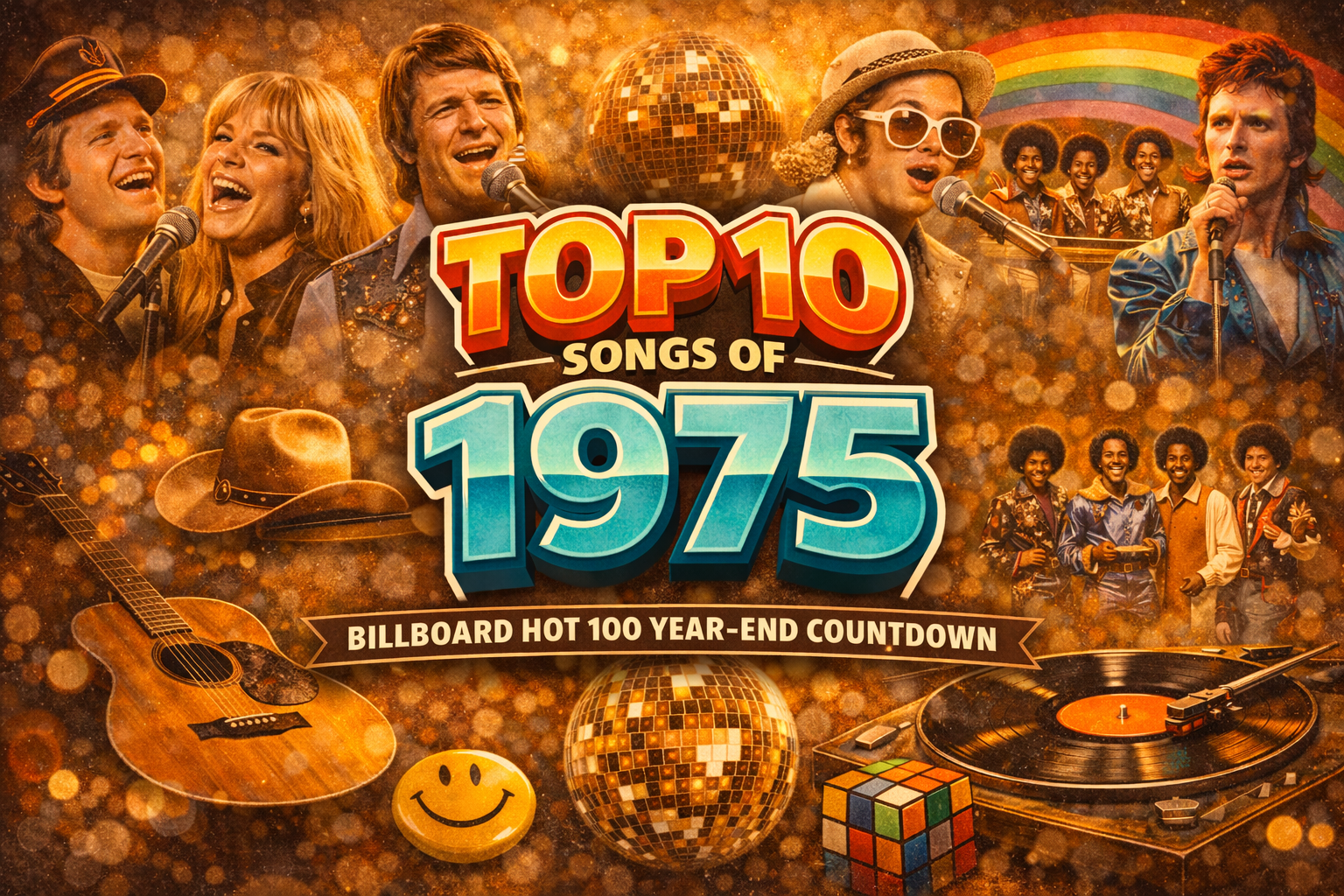
If 1975 had a texture, it was satin jackets, dashboard radios, roller-rink lights, cigarette haze over a basement bar, and the strange confidence of a decade that had fully decided pop music should be both wildly commercial and weirdly personal at the same time.
By 1975, the Hot 100 was not interested in staying in one lane. You had country crossover giants, soft-rock confessionals, sleek soul, arena-ready singalongs, TV-variety-show polish, and glam charisma drifting into the mainstream like it had always belonged there. The year feels unified less by genre than by sheer replay value. These were songs people lived with.
This countdown ranks the Top 10 Songs of 1975 using Billboard’s Hot 100 year-end chart. These were the records that piled up the biggest chart performance across the year—the hits that dominated car radios, kitchen stereos, department stores, summer drives, and whatever room in the house happened to have music on.
Top 10 Songs of 1975 (Billboard Hot 100 Year-End) — Quick List
- #10 “Thank God I’m a Country Boy” — John Denver
- #9 “One of These Nights” — Eagles
- #8 “Laughter in the Rain” — Neil Sedaka
- #7 “Fame” — David Bowie
- #6 “Shining Star” — Earth, Wind & Fire
- #5 “My Eyes Adored You” — Frankie Valli
- #4 “Before the Next Teardrop Falls” — Freddy Fender
- #3 “Philadelphia Freedom” — Elton John
- #2 “Rhinestone Cowboy” — Glen Campbell
- #1 “Love Will Keep Us Together” — Captain & Tennille
#10 — “Thank God I’m a Country Boy” — John Denver
Why this song connected
“Thank God I’m a Country Boy” is pure momentum. It doesn’t creep into the room; it bounds in like it already knows half the people listening are going to clap along whether they meant to or not. John Denver understood something a lot of pop artists never fully grasped: if a song feels open, joyful, and communal enough, it can cross far beyond its home genre.
That is exactly what happened here. The fiddles, the bounce, the grin in the performance—it all makes the record feel less like a single and more like a shared event. The reason it finished inside the 1975 year-end Top 10 is simple: it had enough hook, enough charm, and enough mass appeal to live comfortably on pop radio without losing its country identity.
Gen X Rewind
This is the record that made the room feel a little louder and the adults feel a little friendlier, at least for three minutes.
Legacy
It remains one of John Denver’s signature crossover hits and one of the most instantly recognizable feel-good records of the decade.
#9 — “One of These Nights” — Eagles
Why this song felt so huge
“One of These Nights” is where the Eagles stopped sounding merely polished and started sounding predatory in a very radio-friendly way. The groove is smooth, but it is not soft. The falsetto glides, but the tension underneath the song keeps tightening. There is a sleekness to this record that made it stand out immediately in 1975.
It also sits in that sweet spot where soft rock, R&B influence, and California cool all shake hands and agree to become a monster hit. That is year-end-chart fuel. The record could live on AM radio, FM radio, car speakers, and late-night playlists without ever feeling out of place. It sounded expensive, restless, and just mysterious enough to keep people leaning in.
Gen X Rewind
This is late-night, headlights-on, staring-through-the-window music—the kind of song that made ordinary errands feel slightly cinematic.
Legacy
It remains one of the Eagles’ defining mid-’70s hits and one of the strongest examples of soft rock learning how to sound seductive.
#8 — “Laughter in the Rain” — Neil Sedaka
Why this song lingered
Neil Sedaka had a talent for writing records that felt easy without being slight, and “Laughter in the Rain” might be one of the smoothest examples. It is warm, romantic, softly melodic, and arranged in a way that makes every part of it feel inviting. Nothing is pushing too hard, and that is exactly why it lasts.
There is also something very 1975 about the record’s emotional tone. It is intimate, but not confessional to the point of self-importance. It is sweet, but not saccharine. That balance made it ideal for mainstream radio, where songs had to be strong enough to register and gentle enough not to wear people out after the fifth spin of the day.
Gen X Rewind
This is kitchen-radio romance—the kind of song that could make a gray day feel softer without asking anyone to announce they were in a mood.
Legacy
It remains one of Sedaka’s most beloved comeback-era hits and a prime example of soft-pop craftsmanship done with real finesse.
#7 — “Fame” — David Bowie
Why this song cut through everything
“Fame” does not sound like a compromise record. It sounds like a sharp little machine built out of groove, sarcasm, and David Bowie deciding the mainstream could come to him for once. The riff is lean, the rhythm is nasty in the best way, and the vocal has that clipped, knowing tone that makes the whole thing feel like a smirk turned into a hit single.
That is what makes its success so satisfying. This was not glossy sentiment or easy-listening comfort food. It was cooler, stranger, and more cynical than a lot of the chart around it, and yet it still went to #1 for two weeks and finished #7 for the year. That tells you 1975 radio still had room for a record with actual bite.
Gen X Rewind
This is the song that made pop stardom sound less glamorous and somehow way more interesting.
Legacy
It remains Bowie’s first U.S. No. 1 and one of the great left-field chart-toppers of the decade.
#6 — “Shining Star” — Earth, Wind & Fire
Why this song felt like pure lift-off
“Shining Star” is all propulsion. Even before the chorus arrives, the groove is already doing half the emotional work. Earth, Wind & Fire knew how to make funk feel polished without draining the life out of it, and this record is one of the clearest examples. It moves, it sparkles, and it hits with total confidence.
The message helps too. A lot of encouraging songs sound like homework. “Shining Star” sounds like celebration. That difference matters. It is affirming without being corny, rhythmic without being cluttered, and catchy enough to live in the middle of mainstream radio. That combination is why it did not just hit #1—it stayed culturally useful long after the chart run ended.
Gen X Rewind
This is the kind of record that made any room feel more alive the second the drums showed up.
Legacy
It remains one of Earth, Wind & Fire’s essential hits and one of the brightest funk-pop crossovers of the era.
#5 — “My Eyes Adored You” — Frankie Valli
Why this song hit the nostalgia nerve
“My Eyes Adored You” is memory dressed up as a pop single. Frankie Valli sells it with exactly the right amount of longing, and the song’s whole structure is built around looking backward hard enough that the past starts glowing. That emotional strategy works because it is so accessible. Everybody has some version of a person, place, or feeling they can project onto this record.
It also benefited from impeccable mainstream timing. By 1975, reflective soft pop had a huge lane, and this song slid right into it. It is melodic, wistful, and polished enough to feel broad rather than niche. That is how you turn a one-week #1 into a year-end Top 5 finish: you become the song people do not mind hearing again when they are already halfway nostalgic for the day they are currently living.
Gen X Rewind
This is the sound of the adults suddenly getting a faraway look in their eyes while the radio keeps pretending everything is normal.
Legacy
It remains one of Frankie Valli’s biggest solo hits and one of the decade’s most effective nostalgia-pop ballads.
#4 — “Before the Next Teardrop Falls” — Freddy Fender
Why this song crossed over so powerfully
Freddy Fender’s performance is the whole ballgame here. “Before the Next Teardrop Falls” is gentle, patient, and emotionally plainspoken in a way that lets the feeling come through without any extra decoration. The bilingual phrasing does not feel like a gimmick; it feels like part of the song’s heart, which gave the record a character listeners could not mistake for anything else on the radio.
That individuality is a huge part of why it became such a massive crossover hit. Two weeks at #1 and a year-end Top 4 finish do not happen by accident. The song reached country audiences, pop listeners, and people who just respond to sincerity when they hear it. In a year crowded with larger and louder records, this one won by being calm and true.
Gen X Rewind
This is the kind of record that could make a room go quiet without making it feel heavy.
Legacy
It remains Freddy Fender’s defining crossover smash and one of the most elegant country-pop hits of the decade.
#3 — “Philadelphia Freedom” — Elton John
Why this song sounded so massive
“Philadelphia Freedom” feels like it was engineered to fill every available inch of air around it. The arrangement is huge, the chorus is bigger, and Elton John sounds like he is having the time of his life steering the whole thing. It is not subtle, but 1975 was not asking for subtle from its biggest pop records.
What makes the song so effective is how easily it blends grandeur and groove. It is celebratory, but not stiff. It has soul flavor, but it still feels like a giant Elton John showcase. That versatility made it ideal for heavy radio play. It worked as a pop event, a singalong, and a statement of scale, which is why it powered all the way to the year-end Top 3.
Gen X Rewind
This is the kind of song that made the radio feel like it had stage lights.
Legacy
It remains one of Elton John’s most triumphant mid-’70s hits and one of the biggest-sounding singles of the year.
#2 — “Rhinestone Cowboy” — Glen Campbell
Why this song became an anthem
“Rhinestone Cowboy” wins because it understands aspiration. Not success exactly—aspiration. The song is about hanging on, showing up, pushing through the embarrassment and the lean years long enough to maybe, finally, be seen. That theme gave it an emotional reach that went far beyond country radio, because almost everybody understands some version of that struggle.
The hook did the rest. It is immediate, singable, and big enough to carry the record into full-on anthem territory. Two weeks at #1 and a year-end runner-up finish tell you the public did not just like this song. They identified with it. It was polished enough for pop, grounded enough for country, and inspirational enough for basically everyone in between.
Gen X Rewind
This is “keep going, even if it feels a little ridiculous” music, which may be why it still works so well.
Legacy
It remains Glen Campbell’s defining crossover hit and one of the great perseverance songs in mainstream pop history.
#1 — “Love Will Keep Us Together” — Captain & Tennille
Why this was the biggest song of 1975
“Love Will Keep Us Together” sounds like momentum dressed as optimism. The beat pushes, the vocal pops, the chorus lands instantly, and the whole record feels like it has already decided it is a hit before you get through the first minute. That kind of self-confidence matters, especially on pop radio, where songs often live or die on whether they feel inevitable.
Four weeks at #1 and the year-end crown make complete sense. The record had movement, personality, and enough sheer brightness to dominate a broad audience. It worked in cars, at parties, on TV, and in the kind of domestic spaces where songs become household property instead of just chart entries. Captain & Tennille did not win 1975 with edge or mystery. They won with a chorus the country could not shake loose.
Gen X Rewind
This is the sort of song that turned the whole house into a pop set, even if nobody admitted they knew every word.
Legacy
It remains one of the defining hits of 1975 and one of the most unmistakable No. 1 year-end songs of the entire decade.
1975 Rewind Verdict
1975 was a chart year built on replay. Big choruses, crossover ambition, polished soul, country-pop dreams, theatrical glam, soft-rock longing, and records that understood mainstream radio was not about purity—it was about staying power. The songs that won did not all sound alike, but they all knew how to stick.
FAQ: Top Songs of 1975 (Billboard Hot 100)
What was the #1 song of 1975 on the Billboard year-end chart?
The #1 year-end song of 1975 was “Love Will Keep Us Together” by Captain & Tennille.
How long was “Love Will Keep Us Together” #1?
Captain & Tennille’s “Love Will Keep Us Together” spent four weeks at #1 on the Billboard Hot 100.
Did “Rhinestone Cowboy” hit #1 in 1975?
Yes. Glen Campbell’s “Rhinestone Cowboy” reached #1 on the Hot 100 and finished #2 on the 1975 year-end chart.
Why is “One Hell of a Woman” in the year-end Top 10 if it only peaked at #11?
Because Billboard’s year-end rankings reflect total chart performance across the year, not just peak position. “One Hell of a Woman” stayed on the chart long enough to outperform many songs that peaked higher.
What made the 1975 Hot 100 feel so broad?
The year mixed country crossover, soft rock, glam, funk, soul, novelty pop, and polished mainstream singalongs. It was one of those chart years where almost every corner of pop culture got a turn in heavy rotation.
Get the Weekly Gen X Drop
New videos, rewinds, and savage nostalgia — first.
JOIN THE NEWSLETTER WATCH VIDEOS