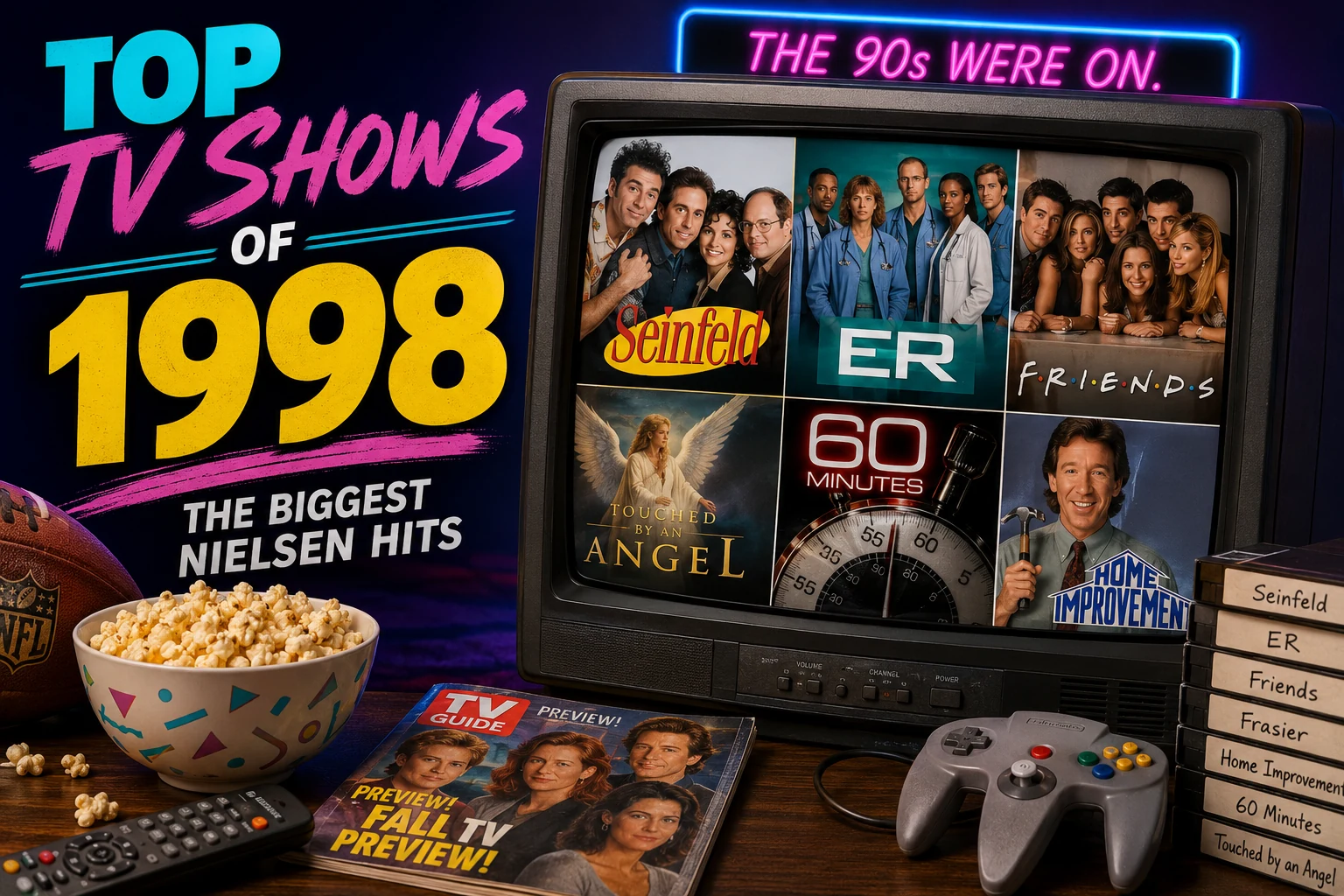
Top TV Shows of 1998: The Biggest Nielsen Hits of the 1997–98 Season

Top TV Shows of 1998: The Biggest Nielsen Hits of the 1997–98 Season
Smells Like Gen X • 90s TV Countdown

Top TV Shows of 1998

The biggest primetime hits of the 1997–98 Nielsen season, from Seinfeld closing the curtain and ER running at full speed to Friends, Touched by an Angel, and a dead-even traffic jam at #10.

If you want to understand what American television still looked like before the next wave of fragmentation really kicked the door in, 1998 is a great place to stop. This was still a world where the big broadcast networks could own entire nights, where a Thursday lineup felt like a cultural event, and where a familiar procedural, a cozy family drama, a football package, and a brutally efficient sitcom could all share the same upper tier without anyone blinking.

Using the Nielsen season ending in 1998 means following the full 1997–98 primetime race, not just a random pile of shows that happened to air new episodes during the calendar year. That distinction matters. It catches Seinfeld in its final lap, ER at peak network-drama intensity, Friends settling into permanent late-90s comfort-viewing status, and Veronica’s Closet proving just how much raw scheduling muscle NBC still had. It also leaves the #10 spot in a three-way tie, which tells you everything about how crowded the upper deck of network TV still was.

This wasn’t prestige-TV cool in the modern sense. It was broader, louder, more communal, and a lot less self-conscious. Families watched together. Offices talked about last night’s episodes. Networks still believed in building entire evenings around anchors strong enough to drag newer shows into relevance. Some of the programs on this list aged into canon. Others became time capsules. All of them were massive.

Gen X Note

1998 feels like one of the last big “everybody still watched the same stuff” seasons. Cable was growing, sure, but broadcast still had enough gravity to turn a finale, a sitcom block, or a Monday night kickoff into something that felt national instead of niche. That’s part of what makes this season so revealing: you can already see the future coming, but the old monoculture still hadn’t let go.

Top TV Shows of 1998 — Quick List

  1. #10 (tie)Frasier / Home Improvement / Just Shoot Me!
  2. #9CBS Sunday Movie
  3. #8Union Square
  4. #760 Minutes
  5. #6Touched by an Angel
  6. #5Monday Night Football
  7. #4Friends
  8. #3Veronica’s Closet
  9. #2ER
  10. #1Seinfeld

The Countdown

#10

A Three-Way Tie at #10

Frasier, Home Improvement, and Just Shoot Me! all finished with the same Nielsen rating.

The tie at #10 is more than a statistical quirk. It’s a snapshot of how deep the late-90s broadcast bench still was. You had one of television’s smartest sitcoms, one of its broadest family-friendly workhorses, and one of NBC’s sharp ensemble comedies all landing in exactly the same neighborhood. That’s a season with range.

It also says something important about 1998 as a TV year: the biggest shows weren’t all trying to do the same thing. Viewers could reward polished verbal farce, cartoonishly broad domestic chaos, and cynical workplace banter in equal measure. The networks didn’t need every hit to appeal to the same slice of America. They needed enough different kinds of hits to own as many hours of the week as possible.

Frasier TV show image
#10 Tie • NBC

Frasier

Smart-sitcom elegance with a very polished edge
NetworkNBC
Season Rank#10 (tie)
Nielsen Rating12.0

Frasier remained one of the most impressive balancing acts on network television. It played like an upscale farce, built around rhythms and references that trusted the audience to keep up, but it never floated so far into smugness that it lost its warmth. The series had a polish most sitcoms would kill for, and by 1998 it had mastered the rare trick of sounding smart without becoming chilly.

What made its placement here so impressive is that Frasier was not the loudest show in the room. It didn’t have the relentless emergency momentum of ER, the broad blockbuster energy of Home Improvement, or the mass youth-cultural chatter of Friends. It simply kept delivering one of the best-tuned comic machines on TV. In a season full of giants, that consistency still bought it a seat at the top table.

Home Improvement TV show image
#10 Tie • ABC

Home Improvement

Big laughs, bigger grunts, and late-era sitcom staying power
NetworkABC
Season Rank#10 (tie)
Nielsen Rating12.0

By 1998, Home Improvement was no longer the unstoppable force it had been at its commercial peak, but the fact that it was still tied for the final Top 10 slot tells you how much residual power the show still had. Tim Allen’s brand of oversized, family-safe, garage-grease comedy could look cartoonishly broad next to some of the slicker NBC comedies, but that was part of the point. The show delivered familiarity like a service.

There is something very revealing about seeing it here so late in its run. The series represented a strain of 90s television that believed mass appeal came from giving the audience a regular place to land: a recognizable house, a reliable dad, a handful of running bits, and just enough sentimental reset at the end to keep everybody comfortable. Home Improvement was never trying to be the coolest show on television. It was trying to be the easiest one to invite into the living room, and that still worked.

Just Shoot Me TV show image
#10 Tie • NBC

Just Shoot Me!

Acidic workplace comedy that benefited from a very strong ecosystem
NetworkNBC
Season Rank#10 (tie)
Nielsen Rating12.0

Just Shoot Me! is the kind of late-90s hit that makes perfect sense once you remember how good NBC was at building entire comedy ecosystems. On its own, the show was a nimble workplace sitcom with enough cynicism to feel modern and enough old-school timing to play broad. Put it inside NBC’s machinery and it suddenly had the runway to become much bigger than a casual retrospective might assume.

That matters because this ranking isn’t just about artistic memory. It’s about what people actually watched. Just Shoot Me! may not cast the same enormous nostalgic shadow as some of the season’s heavier hitters, but it absolutely belonged to the texture of 1998 television. It was fast, funny, urban, mildly mean, and extremely comfortable with the idea that viewers liked spending time with flawed adults trading shots at work. That formula aged surprisingly well.

#9

CBS Sunday Movie

A reminder that the made-for-TV movie block still had some real muscle left.

CBS Sunday Movie image
#9 • CBS

CBS Sunday Movie

Event viewing for an audience that still liked appointment television without weekly continuity
NetworkCBS
Season Rank#9
Nielsen Rating13.3

Now that streaming libraries have flattened everything into permanent availability, it can be easy to forget how much power the network movie block once had. The CBS Sunday Movie landing at #9 in this season’s ranking is a great reminder that a huge chunk of the audience still liked the idea of television as a scheduled event, even when that event wasn’t a series. You sat down because this was what was on tonight, not because you’d built an endless watchlist.

There’s something especially late-90s about that kind of success. The movie block represented a slightly older form of broadcast confidence: trust the brand, advertise the title, and assume families will show up. It also fit CBS’s larger identity during this era. Where NBC often felt slick and self-aware, CBS leaned into reliability and familiarity. The network understood that not every big night had to come from a hyper-buzzed sitcom or a flashy procedural. Sometimes scale came from simply offering viewers a clean, easy choice on a Sunday evening.

That doesn’t mean the block casts a bigger cultural shadow now than the scripted series around it. It doesn’t. But that’s exactly what makes its placement so interesting. Rankings like this are valuable because they preserve what the culture actually did, not just what later critics or nostalgia algorithms decided to elevate. In 1998, the CBS Sunday Movie was still a serious draw. That belongs in the record.

#8

Union Square

One of the strangest “big hit / short memory” placements in the whole 90s TV story.

Union Square TV show image
#8 • NBC

Union Square

A textbook example of how much lift the NBC machine could generate
NetworkNBC
Season Rank#8
Nielsen Rating13.6

Union Square is where this list gets fascinating. On paper, a Top 10 finish should stamp a show into long-term memory. In practice, this one now feels like a trivia grenade. That disconnect is exactly why it deserves attention. The series did not become a defining pop-culture monument, but in the moment it absolutely drew an audience. That tells you the network context was doing real work.

NBC in the late 90s could build a runway unlike anything else on broadcast television. If a show landed in the right neighborhood, it could inherit momentum from the monsters around it and post numbers that would look absurd a generation later. Union Square is evidence of that system at full strength. It also shows the limit of raw ratings as a predictor of legacy. A season can love a show without history deciding to keep it on the front shelf.

That gap between immediate success and lasting cultural footprint is part of what makes older Nielsen rankings so fun to revisit. Not every top performer becomes sacred. Some of them are reminders that television was once a more positional medium. Where you aired mattered. What came before you mattered. What the audience had already made a habit mattered. Union Square is less a forgotten classic than a perfect artifact of a powerful scheduling era.

#7

60 Minutes

Prestige, authority, and Sunday-night habit still counted for a lot in 1998.

60 Minutes image
#7 • CBS

60 Minutes

Proof that a newsmagazine could still compete with entertainment heavyweights
NetworkCBS
Season Rank#7
Nielsen Rating13.9

60 Minutes sitting at #7 is one of those placements that instantly makes the era feel different. In a contemporary environment, news content and scripted entertainment often live in totally different behavioral lanes. In 1998, a serious Sunday newsmagazine could still pull numbers that put it shoulder-to-shoulder with network sitcoms and glossy dramas. That’s not just a credit to brand recognition. That’s generational habit.

The appeal was partly authority, partly ritual. 60 Minutes carried the kind of institutional weight that made it feel important even before a segment began. It also benefited from the way households watched TV then: one set, one room, one schedule, and a willingness to watch something “for the adults” before the rest of the evening rolled forward. It wasn’t supposed to be breezy. It was supposed to matter.

Its ranking also helps explain why the late-90s schedule could feel so stable. Broadcast television still had room for programs that weren’t chasing youth buzz or maximal comedy energy. 60 Minutes represented the older, steadier side of the medium, and the fact that it still drew this kind of audience says a lot about how wide the broadcast tent remained. The monoculture was not all one flavor. It was a negotiated peace among several.

#6

Touched by an Angel

Comfort TV, moral clarity, and enormous cross-demographic appeal.

Touched by an Angel TV show image
#6 • CBS

Touched by an Angel

Earnest, emotional, and completely unashamed of its sincerity
NetworkCBS
Season Rank#6
Nielsen Rating14.4

If late-90s NBC represented polish and velocity, Touched by an Angel represented something else entirely: emotional reassurance. The show was heartfelt in a way that modern television often treats with suspicion. It did not hide its message, did not undercut its own sentiment with a wink, and did not seem remotely embarrassed to aim for uplift. In 1998, that still translated into giant numbers.

That success wasn’t accidental. Touched by an Angel offered viewers a dependable emotional experience. Week after week, it promised a moral frame, a spiritual nudge, and a sense that pain or confusion would eventually be met by grace. For audiences exhausted by cynicism or just looking for something gentler than the louder parts of prime time, that proposition was powerful. It was the TV equivalent of a soft landing.

Its placement here also broadens the shape of the season. This wasn’t just a list of cool-kid hits or urban comedies. A massive swath of America still wanted programming that felt hopeful, accessible, and explicitly humane. Touched by an Angel delivered that with remarkable consistency. Whether or not it fits modern ideas of “essential” television, it absolutely fit what the audience wanted in that moment.

#5

Monday Night Football

Live TV at national scale, before “live TV” became one of the last things left holding the center.

Monday Night Football 1998 image
#5 • ABC

Monday Night Football

A weekly American ritual that felt bigger than ordinary programming
NetworkABC
Season Rank#5
Nielsen Rating15.0

Monday Night Football landing in the Top 5 is a useful reminder that live sports were already one of the most durable forms of mass television, long before the streaming wars taught executives to say the quiet part out loud. Football didn’t just bring viewers. It brought urgency. You had to be there while it was happening, or at least be willing to arrive late to the conversation the next day.

What made the package feel so dominant in this era was the combination of scale and habit. Monday night had become a national appointment, the kind of thing that could pull in casual viewers, diehards, and people who mostly just liked the feeling of everybody watching the same thing at once. It belonged to sports, sure, but it also belonged to culture. It gave the week a shared centerpiece.

Its position on this list also helps explain the full shape of broadcast strength in 1998. The networks were not leaning on one single genre. They were winning with sitcoms, dramas, movies, newsmagazines, and football. Monday Night Football was one of the clearest examples of television at its most communal: no bingeing, no catching up later without social penalty, and no algorithm deciding what the room should care about next.

#4

Friends

No longer just a hit sitcom — by 1998 it was a lifestyle language.

Friends TV show image
#4 • NBC

Friends

Peak comfort, peak chemistry, peak late-90s apartment fantasy
NetworkNBC
Season Rank#4
Nielsen Rating16.4

By the 1997–98 season, Friends had moved beyond “popular” and into something closer to atmospheric. It was everywhere without feeling exhausting, quotable without becoming inaccessible, and polished enough to function as NBC comfort food while still giving viewers the illusion of urban cool. That balance was part of its genius. The show made adulthood look messy, funny, attractive, and just difficult enough to seem real without ever becoming depressing.

The ensemble chemistry did the heavy lifting. Plenty of sitcoms have punch lines; fewer have a cast that feels so naturally lodged in the culture that the show starts shaping the tone of the decade around it. Friends sold a fantasy of chosen family, conversational intimacy, and low-stakes romantic chaos that the late 90s absolutely inhaled. It was not trying to be edgy television. It was trying to be television people wanted to live inside.

That helps explain why it sits this high even in a brutally competitive season. Friends was consistent, repeatable, and almost frictionless to love. It belonged to NBC’s killer Thursday stack, but it was never just a scheduling beneficiary. Viewers didn’t merely leave it on. They built routines around it. And in a season dominated by giants, that distinction mattered.

#3

Veronica’s Closet

One of the best examples of how a season can crown a hit that history doesn’t keep equally close.

Veronicas Closet TV show image
#3 • NBC

Veronica’s Closet

A shiny, heavily promoted launch that converted network strength into huge numbers
NetworkNBC
Season Rank#3
Nielsen Rating16.8

Here’s where the list starts telling a richer story than simple nostalgia ever could. Veronica’s Closet finishing #3 overall is the kind of result that makes modern readers do a double take, and that reaction is precisely why it matters. The show was enormous in the moment. That does not mean it remained equally central in long-term memory, but it absolutely means late-90s NBC could still launch a glossy sitcom into rarefied air if the support system around it was strong enough.

The series fit the era’s taste for high-concept, star-driven, attractively packaged comedy. It looked expensive, felt aggressively mainstream, and arrived with the kind of confidence only a dominant network could manufacture. In another sense, it now reads as a lesson in the difference between immediate ratings heat and durable cultural afterlife. Those things overlap sometimes, but not always. Veronica’s Closet was a juggernaut of its season even if it never became a permanent shorthand for the decade.

That shouldn’t diminish the ranking. It should make it more interesting. Older TV histories can get too tidy, as if only the shows that remained iconic were the ones that mattered. Nielsen lists preserve the messier truth. A season can belong to a show without that show becoming immortal. Veronica’s Closet is a perfect case study in network-era power, promotion, and momentary cultural saturation.

#2

ER

Velocity, intensity, and pure network-drama muscle at nearly unbeatable scale.

ER TV show image
#2 • NBC

ER

High-pressure storytelling that made Thursday night feel urgent
NetworkNBC
Season Rank#2
Nielsen Rating20.7

ER at #2 feels exactly right. This was the kind of drama broadcast television could produce when it was fully committed to scope, speed, and weekly urgency. The series moved like a live wire. Its overlapping dialogue, crowded frames, emotional cliff edges, and sense of barely controlled chaos gave viewers the feeling that every episode might spill over its own container. In an era before “prestige TV” became the label everyone chased, ER already knew how to make network ambition look thrilling.

Part of the show’s appeal was simply craft. ER felt big. It felt busy. It felt expensive in motion rather than just in surface sheen. That kind of energy helped it break through the built-in limitations of episodic television. Even when the structure reset, the experience still felt eventful. You tuned in not just for story beats, but for the sensation of being thrown into a machine that was always running at slightly unsafe speed.

Its ranking also says something about NBC’s absurd level of dominance. On most networks, a show this strong would have been the clear crown jewel. Here it sits behind only one of the most consequential sitcom endings in TV history. ER was not just successful. It was operating at a level that would define another era entirely if it hadn’t happened to share a runway with Seinfeld.

#1

Seinfeld

The final season of a sitcom empire — and the biggest show of the 1997–98 season.

Seinfeld TV show image
#1 • NBC

Seinfeld

The last lap of a cultural giant that still made television feel communal
NetworkNBC
Season Rank#1
Nielsen Rating22.0

Seinfeld finishing #1 in the season ending in 1998 is the cleanest possible ending to one phase of television history. By this point, the series was more than a hit. It was a civic object. People organized around it, quoted it automatically, and treated new episodes like shared cultural homework. The final season carried all the extra electricity that comes from knowing something this dominant is about to disappear. Even people who were arguing about whether the show had peaked earlier were still watching.

What made Seinfeld so powerful was not just its joke density or its now-legendary ability to spin trivial irritations into airtight comic architecture. It was the confidence of the thing. The show understood exactly what world it occupied and how elastic that world could be. It could make selfishness funny without asking you to admire it, turn conversational nonsense into structure, and leave entire chunks of American speech permanently altered by repetition. Plenty of sitcoms were popular. Very few became default reference points.

Its #1 finish also lands as a kind of broadcast-era curtain call. This is the last big sweep of a style of dominance that relied on scarcity, habit, and shared timing. When Seinfeld ended, television didn’t stop producing hits. But the feeling of a whole country pausing around the same comedy was already becoming rarer. That’s why the top spot feels bigger than a number. It marks the end of a specific kind of TV power.

Rewind Verdict

The top TV shows of 1998 reveal a medium in transition without actually looking unstable yet. NBC still ruled by force of lineup. CBS kept winning with comfort, ritual, and broad trust. ABC had football and residual sitcom strength. The season could still elevate a glossy launch like Veronica’s Closet, preserve old-school institutions like 60 Minutes and the movie block, and let a final-season titan like Seinfeld close things out on top.

That’s what makes this list so good. It doesn’t flatten the decade into only the titles we still talk about most. It shows what 1998 viewers actually rewarded: polish, familiarity, urgency, event scheduling, and shows that made it easy to keep showing up every week. Some of these programs became permanent nostalgia landmarks. Some became fascinating time capsules. Together, they map the last stretch of late-90s broadcast dominance better than almost anything else can.

Top TV Shows of 1998 FAQ

Why does 1998 use the 1997–98 season?

Because this series follows the Nielsen TV season ending in the named year. So “Top TV Shows of 1998” uses the 1997–98 primetime season rather than only January through December of 1998.

Why are there more than ten shows discussed here?

The #10 slot was a three-way Nielsen tie between Frasier, Home Improvement, and Just Shoot Me!. Instead of pretending one of them ranked above the others, this countdown keeps the tie intact.

Are sports, newsmagazines, and movie blocks included?

Yes. This post follows the published primetime season ranking, which is why entries like Monday Night Football, 60 Minutes, and CBS Sunday Movie appear alongside scripted series.

What makes this season so memorable?

It captures the final season of Seinfeld, ER near full power, Friends as a permanent late-90s staple, and the last stretch where the broadcast networks could still make whole nights feel like national events.

Get the Weekly Gen X Drop

New videos, rewinds, and savage nostalgia — first.

JOIN THE NEWSLETTER WATCH VIDEOS

MORE REWINDS