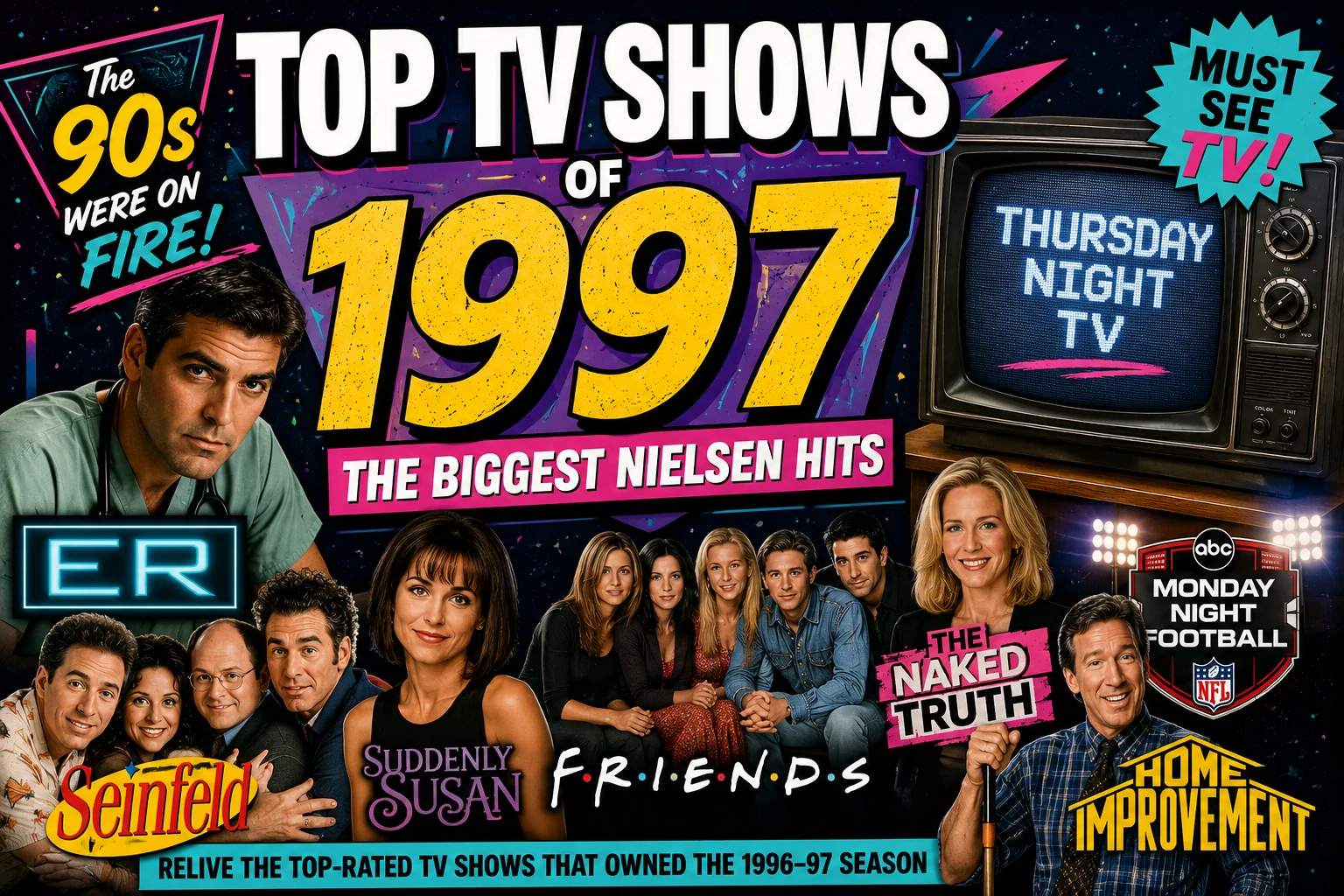
Top TV Shows of 1997: The Biggest Nielsen Hits Ranked
The top TV shows of 1997 were dominated by NBC’s Must See TV machine, but the full 1996–97 Nielsen television season tells a bigger late-90s story: ER at #1, Seinfeld still massive, Friends becoming an institution, Monday Night Football still cutting through, Home Improvement hanging on, and Touched by an Angel proving comfort TV still had a huge audience.
This was the year broadcast TV still had the monoculture by the throat. NBC stacked the upper chart with ER, Seinfeld, Suddenly Susan, Friends, The Naked Truth, Fired Up, and The Single Guy. That is not just a ratings list. That is a network machine running like it had cheat codes.
This countdown uses the Nielsen season ending in 1997, which means it reflects the 1996–97 TV season rather than a January-to-December calendar year. That is the standard way network television popularity was measured, and it explains why these shows represent the TV season that carried viewers into 1997.
This is 1997 prime time in ten shows: ER sprinting through the emergency room, Seinfeld turning petty behavior into philosophy, Friends selling coffee-shop adulthood, NBC turning Thursday night into a ratings weapon, football still owning Monday, and late-90s TV proving appointment viewing was not dead yet.
1997 Means the 1996–97 Nielsen Season
This series assigns each television season to the year in which it ended. Friends and The Naked Truth both posted a 16.8 rating, but Friends ranked higher because its share was 28 versus 27.
What Were the Top TV Shows of 1997?
The top TV shows of 1997, based on the 1996–97 Nielsen television season, were ER, Seinfeld, Suddenly Susan, Friends, The Naked Truth, Fired Up, Monday Night Football, The Single Guy, Home Improvement, and Touched by an Angel. The #1 TV show of 1997 was ER, with a 21.2 Nielsen rating.
Quick List: Top TV Shows of 1997
1997 Nielsen Top 10 at a Glance
Here is the 1996–97 Nielsen season Top 10 in quick-scan form, with network, rating, and share included for context.
| Rank | Show | Network | Nielsen Rating | Share |
|---|---|---|---|---|
| #1 | ER | NBC | 21.2 | 35 |
| #2 | Seinfeld | NBC | 20.5 | 32 |
| #3 | Suddenly Susan | NBC | 17.0 | 27 |
| #4 | Friends | NBC | 16.8 | 28 |
| #5 | The Naked Truth | NBC | 16.8 | 27 |
| #6 | Fired Up | NBC | 16.5 | 26 |
| #7 | Monday Night Football | ABC | 16.2 | 27 |
| #8 | The Single Guy | NBC | 14.1 | 23 |
| #9 | Home Improvement | ABC | 14.0 | 22 |
| #10 | Touched by an Angel | CBS | 13.6 | 21 |
How This 1997 TV Ranking Works
This list uses the Nielsen season ending in 1997, not a January–December calendar year. That means the rankings reflect the 1996–97 television season, which is the standard way network TV popularity was measured. For a page about the most popular TV shows of 1997, the season-ending Nielsen list is the cleanest fit.
Note on Friends and The Naked Truth: both shows had a 16.8 Nielsen rating, but the season-ending report listed Friends at #4 with a 28 share and The Naked Truth at #5 with a 27 share.
Why 1997 Was Such a Big TV Year
1997 matters because it captures late-90s network television at full strength. ER made medical drama feel fast, expensive, and urgent. Seinfeld kept irony in the center of American comedy. Friends turned chosen-family adulthood into a lifestyle fantasy. And NBC’s surrounding sitcoms show how powerful scheduling, branding, and Thursday-night habit had become.
For Gen X, this is the TV year where broadcast still felt enormous, but the emotional center had clearly shifted. The biggest shows were less about one family around one couch and more about workplaces, friend groups, urban adulthood, professional identity, social awkwardness, and appointment TV that everybody still seemed to know about the next morning.
Jump to a Show
Countdown: The Top TV Shows of 1997
Every show in this year’s Top 10 now connects to a deeper Smells Like Gen X feature. Look for the Keep Watching link inside each entry to move from the 1997 Nielsen snapshot into the bigger story.
#10 — Touched by an Angel
Official Nielsen Rank: #10Touched by an Angel at #10 is one of the most important reminders that late-90s television was still much broader than the NBC cool-kid version of the decade might suggest. While a lot of the season’s identity comes from urban comedy, singles energy, and network slickness, this show proves there was still a huge audience for comfort, reassurance, and overt emotional uplift.
For Gen X readers looking back, Touched by an Angel is useful because it shows that mainstream TV in 1997 still supported multiple emotional registers at once. The same culture that made Seinfeld and Friends massive also made room for a series built around compassion, redemption, and weekly reassurance.
That kind of split-screen is part of what made broadcast television feel so culturally central. Different audiences could still find very different kinds of hits inside one shared system, which is exactly why the 1997 ratings list is more interesting than just “NBC crushed everybody.”
#9 — Home Improvement
Official Nielsen Rank: #9By 1997, Home Improvement slipping to #9 does not mean it stopped mattering. It means the field around it had gotten crowded with NBC’s sitcom juggernaut and a still-dominant ER. The show remained one of the defining family comedies of the decade.
For Gen X readers, Home Improvement still represented one of the clearest examples of mid-90s family TV at mass scale: loud, broad, physical, and built around performance-heavy domestic chaos. Even in a year where NBC’s slicker comedy identity looked dominant, ABC still had one of the biggest family-sitcom brands in the country.
Its continued top-10 placement also shows how durable broad suburban family comedy could be, even as the center of pop-culture conversation shifted toward NBC’s cooler, more singles-driven sitcom lane. The show was still selling a huge version of suburban life: noisy, exaggerated, masculine, and built for mass appeal.
#8 — The Single Guy
Official Nielsen Rank: #8The Single Guy at #8 is one of the clearest clues about how NBC’s comedy ecosystem was working in 1997. This is not one of the first shows most people name when they think back on the era, but that is exactly why the ranking is useful. It shows that the late-90s network machine was not built only on its most legendary titles.
The show also matters because it reflects how central single-life comedy had become by 1997. Dating, urban adulthood, and peer-group social dynamics were no longer side lanes. They were a core part of mainstream TV business.
Placed inside the actual texture of 1997 television, The Single Guy becomes more interesting than memory usually allows. It helps explain why late-90s TV feels more socially mobile and less home-centered than earlier parts of the decade.
#7 — Monday Night Football
Official Nielsen Rank: #7Monday Night Football at #7 is another reminder that live event television still had enormous structural advantages in the broadcast era. No sitcom or drama could replicate the urgency of a game happening right now. That urgency translated directly into ratings power.
For Gen X readers, this is one of the best clues about what TV consumption still felt like in 1997. The top-rated programs were not just shows people liked. They were events people arranged around. Monday Night Football was one of the biggest examples of that ritual.
Before streaming, before clips took over everything, before everyone watched on their own schedule, football could still gather a huge audience all at once. That gave it cultural weight no scripted show could fully copy.
#6 — Fired Up
Official Nielsen Rank: #6Fired Up at #6 is one of the wildest “the system itself was powerful” rankings in the entire late-90s TV story. This is exactly the kind of title that makes the 1996–97 list so fascinating. It shows that NBC’s comedy lineup was doing more than producing classics.
That does not mean Fired Up was irrelevant. It means its historical value is tied to what it reveals about the era. NBC had built an environment where even less-remembered shows could break into the top tier simply by fitting the tone, the scheduling, and the momentum of the broader machine.
This is also a useful reminder of the difference between most remembered and most watched. In cultural memory, Fired Up does not loom nearly as large as the giants around it, but Nielsen history shows it was part of the top-tier reality of the season.
#5 — The Naked Truth
Official Nielsen Rank: #5The Naked Truth at #5 is another perfect example of how outrageous NBC’s sitcom strength had become by 1997. This is not a show that dominates memory the way Seinfeld or Friends does, but the Nielsen ranking says it was a very real part of the season’s upper tier.
For Gen X readers, The Naked Truth helps fill in the actual texture of 1997 television. The era was not built solely by the canon. It was built by the full ecosystem of network comedy, including the shows that thrived because they fit the late-90s appetite for glossy, adult, media-savvy, socially mobile sitcom energy.
There is also something very 1997 about this show sitting so high. It reflects the era’s appetite for media-aware, personality-driven sitcoms that felt more professionally tilted than older domestic comedy models.
#4 — Friends
Official Nielsen Rank: #4By 1997, Friends at #4 means the show had fully crossed from breakout success into long-haul institution status. It was no longer just the hot young ensemble. It was one of the defining pieces of the entire TV landscape.
For Gen X nostalgia, Friends is crucial because it captures the way 1997 TV sold adulthood: a mix of aspiration, anxiety, romance, work frustration, apartment culture, and chosen-family chemistry. That package became one of the defining television fantasies of the era.
By this point, Friends was helping define how late-90s television packaged adulthood itself. The apartments were unrealistically good, the chemistry was aspirational, and the whole thing turned peer life into a kind of emotional home base.
#3 — Suddenly Susan
Official Nielsen Rank: #3Suddenly Susan at #3 is one of the biggest proof points that NBC’s 1996–97 dominance was not just concentrated at the very top. This was a huge hit, and its placement shows how completely the network had aligned itself with the mainstream appetite of the moment.
Its ranking also helps explain what the top TV shows of 1997 were really about. This was a year where professional-adult identity, media-world energy, and singles comedy all had major ratings power.
For Gen X viewers, the show helps mark a cultural shift toward more workplace-and-identity-centered comedy, where adult life was increasingly framed through jobs, dating, image, and social status rather than through the old family-living-room template.
#2 — Seinfeld
Official Nielsen Rank: #2Seinfeld at #2 in 1997 means it remained one of the absolute defining forces of American television even without holding the top slot. Its importance by this point was bigger than rank. The show had already reshaped what mainstream sitcom comedy could be.
For Gen X readers, Seinfeld is still one of the key texts for understanding why 1997 television felt so different from earlier parts of the decade. It made irony feel central rather than peripheral. It made social discomfort commercially gigantic.
By 1997, Seinfeld had become part of the culture’s operating language. Its rhythms, observations, pettiness, and refusal to turn every conflict into a sentimental lesson all helped redefine what mainstream comedy could sound like.
#1 — ER
Official Nielsen Rank: #1ER finishing #1 again in 1997 confirms that its rise was not a fluke and not just a breakout moment. It was the dominant television phenomenon of the period. That matters because it tells you what kind of drama the mass audience wanted at the peak of the late-90s network era: fast, emotionally overloaded, ensemble-driven, visually kinetic, and full of professional urgency.
For Gen X viewers, ER is one of the clearest markers of how much television had accelerated by 1997. Compared with slower, more stately earlier dramas, it felt alive in a different way. The editing, overlapping energy, scale of the ensemble, and emotional tempo all signaled that network TV had entered a more modern phase.
ER staying at #1 also tells you something bigger than just “people liked this show.” Viewers wanted intensity, overlapping action, emotional escalation, and a cast structure big enough to make the whole world feel in motion.
Keep Rewinding 1997
If 1997 proved anything, it was that the culture had fully settled into its later-90s personality. Prime time was slicker, faster, and more network-engineered than ever, with NBC basically running a factory for top-tier hits. But television was only one part of the year. Radio was full of glossy pop, R&B authority, crossover hooks, and songs that felt completely locked into the decade’s second-half sound. The movies were balancing spectacle, star power, adult suspense, and blockbuster scale in a way that still made the multiplex feel broad. The toy aisle had Tamagotchi beeping from backpacks, Nintendo 64 and GoldenEye owning sleepovers, Beanie Babies turning plush into a collector economy, and Giga Pets making tiny digital guilt portable.
Here’s the rest of the 1997 cluster — the approved same-year pages that belong with this TV countdown if you want the full rewind instead of just the prime-time side of it.
You May Also Remember
the songs that made 1997 sound fully late-90s, the movies that made 1997 feel huge at the multiplex, Tamagotchi, Nintendo 64, Beanie Babies, Giga Pets, Teletubbies, Spice Girls dolls, and the toys of 1997, the previous year’s TV power shift, the next year of network-TV dominance, the 90s TV hub, and the bigger 90s nostalgia hub.
Basically: ER moving like a panic attack in scrubs, Seinfeld turning minor irritation into philosophy, Friends making coffee-shop adulthood look like a lifestyle plan, and NBC acting like Thursday night belonged to them personally.
Rewind Verdict
The top TV shows of 1997 reveal a medium that had fully settled into its late-90s personality. ER and Seinfeld still led the culture, Friends had become an institution, and NBC’s comedy machine was so strong that it packed the top ranks with shows that ranged from still-famous to half-forgotten but undeniably huge. ABC kept a foothold through Monday Night Football and Home Improvement, while CBS reminded everyone that comfort and moral uplift still had a place at scale with Touched by an Angel.
That is what makes 1997 such a strong Gen X TV year. The monoculture is still alive, but it is no longer emotionally unified. It is divided by tone, by style, and by audience mood — and yet all of it still lives inside one national system big enough to make these shows feel universal at the same time.
If 1996 felt like top gear, 1997 feels like full late-90s lock-in.
FAQ: Top TV Shows of 1997
What were the top TV shows of 1997?
The top TV shows tied to the 1996–97 Nielsen season included ER, Seinfeld, Suddenly Susan, Friends, The Naked Truth, Fired Up, Monday Night Football, The Single Guy, Home Improvement, and Touched by an Angel.
What was the #1 TV show of 1997?
For the 1996–97 Nielsen season, ER finished at #1.
What was the #1 TV show of the 1996–97 season?
The #1 TV show of the 1996–97 Nielsen season was ER, with a Nielsen rating of 21.2.
What were the top 5 TV shows of 1997?
The top five shows of the 1996–97 Nielsen season were ER, Seinfeld, Suddenly Susan, Friends, and The Naked Truth.
What were the Nielsen ratings for 1997?
The 1996–97 Nielsen season ranked ER at #1 with a 21.2 rating, followed by Seinfeld at 20.5, Suddenly Susan at 17.0, Friends at 16.8, and The Naked Truth at 16.8.
Why does this 1997 post use the 1996–97 season?
Because this series uses the Nielsen season ending in that year, so the 1997 post is based on the 1996–97 season rather than a January–December calendar year.
Did Friends and The Naked Truth tie in 1997?
They had the same 16.8 Nielsen rating, but the season-ending Nielsen list separated them because Friends had a 28 share and The Naked Truth had a 27 share.
Was Seinfeld still one of the biggest shows on TV in 1997?
Yes. Seinfeld finished #2 in the 1996–97 season and remained one of the defining sitcoms of late-90s television.
Was Friends already a major hit by 1997?
Yes. Friends finished #4 in the 1996–97 season, showing that it had moved beyond breakout status and become one of the central TV institutions of the decade.
Which network dominated the 1996–97 season?
NBC dominated the top of the chart, placing ER, Seinfeld, Suddenly Susan, Friends, The Naked Truth, Fired Up, and The Single Guy among the biggest hits of the season.
Why was NBC so dominant in 1997?
NBC had a powerful mix of prestige drama, iconic comedy, and deep-bench sitcom support. ER gave the network the #1 drama, while Seinfeld, Friends, and several surrounding sitcoms turned the network’s comedy block into a ratings machine.
Why does 1997 TV matter for Gen X nostalgia?
1997 captures the late-90s network era at full strength: appointment viewing, Must See TV, friend-group sitcoms, sharper comedy, faster dramas, and a monoculture that was still powerful enough to make weekly TV feel like a shared national habit.