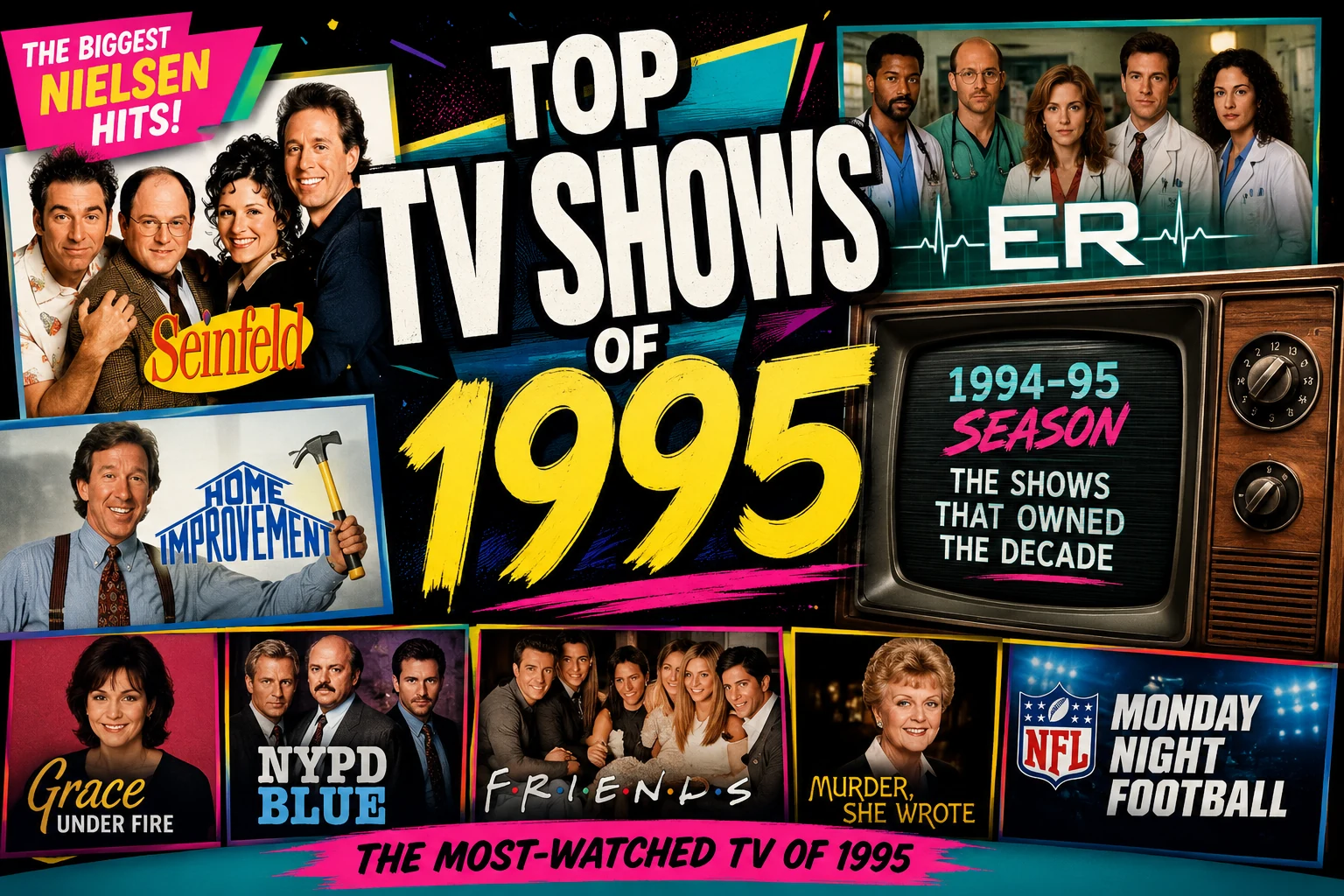
Top TV Shows of 1995: The Biggest Nielsen Hits Ranked
The top TV shows of 1995 were led by Seinfeld, ER, Home Improvement, Grace Under Fire, Monday Night Football, 60 Minutes, NYPD Blue, a tie between Friends and Murder, She Wrote, and Roseanne. Based on the 1994–95 Nielsen television season, this ranking captures mid-90s prime time locking into its most recognizable form.
This was not simply the year Seinfeld got huge, although that is the headline. It was also the year ER arrived like a lightning strike, Friends proved it was a real ratings force, Home Improvement still showed the power of broad suburban family comedy, and the larger TV ecosystem started feeling faster, sharper, and more segmented by tone.
In Smells Like Gen X terms, 1995 is the year the decade stopped warming up and started sprinting. The TV room was still shared, but it no longer sounded unified: irony, adrenaline, family sitcom power, working-class comedy, friend-group chemistry, sports ritual, journalism, and mystery comfort all lived in the same Nielsen top tier.
What Were the Top TV Shows of 1995?
The top TV shows of 1995, based on the 1994–95 Nielsen television season, were Seinfeld, ER, Home Improvement, Grace Under Fire, Monday Night Football, 60 Minutes, NYPD Blue, Friends, Murder, She Wrote, and Roseanne. The #1 TV show of 1995 was Seinfeld.
1995 Means the 1994–95 Nielsen Season
This series assigns each television season to the year in which it ended. Friends and Murder, She Wrote tied at #8, so there is no separate #9 ranking.
Quick List: Top TV Shows of 1995
The 1994–95 Nielsen season has a tie at #8, so there is no separate #9 ranking.
- #1 Seinfeld
- #2 ER
- #3 Home Improvement
- #4 Grace Under Fire
- #5 Monday Night Football
- #6 60 Minutes
- #7 NYPD Blue
- #8 tie Friends
- #8 tie Murder, She Wrote
- #10 Roseanne
1995 Nielsen Top 10 at a Glance
Here is the 1994–95 Nielsen season in quick-scan form. The ranking keeps the published #8 tie intact, which means there is no separate #9 slot.
| Rank | Show | Network | TV Lane |
|---|---|---|---|
| #1 | Seinfeld | NBC | Observational sitcom / irony machine |
| #2 | ER | NBC | Breakout medical drama |
| #3 | Home Improvement | ABC | Broad family sitcom powerhouse |
| #4 | Grace Under Fire | ABC | Working-class sitcom breakout |
| #5 | Monday Night Football | ABC | Live sports ritual |
| #6 | 60 Minutes | CBS | Institutional journalism |
| #7 | NYPD Blue | ABC | Adult urban drama |
| #8 tie | Friends | NBC | Friend-group ensemble comedy |
| #8 tie | Murder, She Wrote | CBS | Mystery comfort institution |
| #10 | Roseanne | ABC | Working-class sitcom institution |
How This 1995 TV Ranking Works
This countdown uses the Nielsen season ending in 1995, not a January–December calendar year. That means the rankings reflect the 1994–95 primetime television season, which is the standard way network TV popularity was measured.
Because Friends and Murder, She Wrote tied at #8, this list keeps the tie intact and skips a separate #9 ranking.
Why 1995 Was Such a Big TV Year
1995 matters because it shows the mid-90s TV ecosystem firing in every direction at once. Seinfeld made irony and social irritation the center of American comedy. ER made drama feel faster and more urgent. Friends pushed the friend-group ensemble into the elite tier. ABC still had major strength with Home Improvement, Grace Under Fire, NYPD Blue, and Monday Night Football. The monoculture still existed, but it had multiple engines now.
Countdown: The Top TV Shows of 1995
Several of these shows now have their own Smells Like Gen X features. When one does, you’ll find a Keep Watching link inside its entry so you can jump from the 1995 Nielsen snapshot into the deeper story.
#10 — Roseanne
Official Nielsen Rank: #10By the 1994–95 season, Roseanne was no longer the insurgent force crashing the polished sitcom party. It had already changed the party. Finishing at #10 does not make it less important. If anything, it proves how thoroughly it had already done its job. The show’s real influence by 1995 was not just in its rating. It was in the fact that network television no longer looked, sounded, or felt the way it did before the Conners made working-class frustration, domestic mess, and sarcasm fully mainstream.
What made Roseanne so significant in this season is that it remained present while the TV world around it got even more crowded. Newer comedy models were rising. Seinfeld was redefining urban irony. Friends was bringing a younger social-energy ensemble into the top tier. Home Improvement was holding the broad family lane at scale. Yet Roseanne still sat there in the official top 10, which tells you the audience had not stopped valuing its rougher honesty. That matters. It shows the show was not merely a transitional bridge. It retained mainstream power even after its tonal revolution had already been absorbed by the culture.
And the key to that power was always voice. The Conners did not feel like TV people who had been dressed down to look “real.” They felt like people whose frustration, love, humor, and financial pressure all occupied the same house at once. That gave the show a density many sitcoms never achieve. By 1995, that density had become part of the mainstream grammar of the medium.
What keeps Roseanne relevant in 1995 is that it no longer needs to be the loudest show in the room to be one of the most important. By this point, its legacy is partially structural. The reason so many mid-90s comedies are allowed to look rougher, sound harsher, and treat domestic life as something stressful rather than sitcom-perfect is because Roseanne proved the audience would come with them. Even at #10, it still reads like a foundational text for the decade’s television attitude.
#8 (tie) — Murder, She Wrote
Official Nielsen Rank: #8 (tie)Murder, She Wrote tying at #8 in 1995 is one of the best reminders that broadcast television was still broad enough to support radically different kinds of pleasure at the same time. In the same top 10 season that includes Seinfeld, ER, Friends, and NYPD Blue, there is still room for Jessica Fletcher and her elegant, ordered, mystery-solving universe. That is not a contradiction. It is the point.
The show’s continued strength tells you that network TV still had a huge appetite for institutional comfort. It did not need to sound trendy. It did not need to speed up. It did not need to reinvent itself for the 90s. It only needed to keep delivering intelligence, atmosphere, and closure with enough polish that viewers trusted the experience. That is exactly what Murder, She Wrote continued to do. In a TV environment increasingly energized by anxiety, irony, and momentum, Jessica Fletcher offered one of the last great examples of weekly reassurance as premium product.
Its survival near the top of the chart is also useful historically because it shows how misleading a single-tone narrative of the decade can be. 1995 was not all Gen X sarcasm and cool-kid ensemble energy. It was also habit, trust, and the enduring appeal of a formula beautifully executed.
There is also real reader value in remembering what Murder, She Wrote represented in a season like this: not an older show still hanging around, but one of the last huge examples of appointment mystery television as comfort ritual. If someone wants to understand why Jessica Fletcher remained such a durable TV icon, the answer is not only Angela Lansbury’s charisma. It is that the show delivered a repeatable emotional contract every week: intelligence, atmosphere, order, and resolution. In a decade increasingly full of noise, that kind of narrative certainty had serious appeal.
#8 (tie) — Friends
Official Nielsen Rank: #8 (tie)Friends tying at #8 is one of the most important signals in the whole 1995 lineup because it marks the arrival of a younger, more socially aspirational, hangout-based comedy mode at true national scale. It is easy, in hindsight, to think of Friends as inevitable, but this season is the moment where its mainstream force becomes measurable. It did not just become popular. It broke into the highest commercial tier of the medium.
What made Friends different from many of the family-centered sitcoms above and below it was the structure of intimacy it offered. The emotional center was not a marriage, a parent-child unit, or a household in the traditional sitcom sense. It was a peer group. That is a major shift, and it matters because it helped television reposition adulthood as social performance rather than purely domestic stability. Work mattered, dating mattered, friendship mattered, and the emotional drama of hanging out mattered.
Its tie at #8 also captures something important about mid-90s audience behavior: viewers were not only rewarding sophistication or roughness. They were rewarding chemistry. The cast dynamic was the commodity. The show felt bright, accessible, and romanticized in a way that gave it a very different emotional temperature from Roseanne, Seinfeld, or ER.
For readers looking back at 90s TV history, Friends matters because it helped turn friendship itself into premium network storytelling. Earlier sitcoms often treated peer groups as support systems around a family structure or workplace premise. Friends made the friend group the center of emotional life. Dating, work stress, breakups, hangouts, embarrassment, and chosen-family chemistry all became the real engine. That shift would echo across network and streaming ensemble comedy for years.
#7 — NYPD Blue
Official Nielsen Rank: #7NYPD Blue at #7 represents one of the biggest shifts in the dramatic texture of mainstream TV during the mid-90s. This was not simply a popular cop show. It was part of a broader move toward network drama that felt more volatile, more adult, and more immediate than the smoother, safer drama models that had dominated earlier eras. Its placement in the top 10 confirms that audiences were not only open to that change — they were actively rewarding it.
What made NYPD Blue important was not just the premise but the intensity of presentation. The show carried a rougher realism, a more agitated moral atmosphere, and a more visibly contemporary sense of urban stress. In the context of 1995, it belongs alongside ER as part of the season’s larger signal that drama was also speeding up, not just comedy. The network drama field was becoming less stately and more adrenalized.
Its high finish also helps explain why ABC won the season overall. The network was not simply relying on broad family sitcom weight. It had serious dramatic credibility in the mix too, and NYPD Blue was one of the clearest examples of that. The 1994–95 season was not won through one single mode of success. It was won through range.
From a broader television-history angle, NYPD Blue is important because it helped normalize a more adult and visibly contemporary style of network drama. The show’s success told broadcasters that audiences would follow messier characters, rougher city energy, and stories that felt more volatile than the smoother procedural formulas that had dominated earlier years. It helped clear the path for a faster, grittier dramatic rhythm on mainstream TV.
#6 — 60 Minutes
Official Nielsen Rank: #660 Minutes at #6 in a season this comedy-heavy is one of the strongest reminders that the broadcast era still retained a civic center of gravity. It no longer ruled the whole list the way it had in earlier years, but it remained firmly in the upper tier, which is remarkable when you consider what it was competing against: mega-hit sitcoms, a major breakout medical drama, Monday night football, and the newer rhythm of faster mid-90s entertainment.
What kept 60 Minutes so strong was institutional trust. It still meant seriousness, consequence, and national attention. Viewers were not only showing up for laughs or spectacle. They were still showing up for a program that signaled authority. That matters because it helps keep the 1995 story honest. This was absolutely a season of accelerating entertainment energy, but not at the total expense of journalism. The medium still had room for one of its most established public-facing forms to remain commercially powerful.
In a deeper sense, 60 Minutes in this position acts like a bridge between television eras. It carries the weight of an earlier network seriousness even as everything around it gets faster, more character-driven, and more segmented by style. That is part of what makes 1995 so interesting. The old center has not vanished yet. It is just sharing space with a newer cultural velocity.
For readers, this ranking is one of the best reminders that mid-90s TV was not only about entertainment becoming cooler or faster. 60 Minutes still being this high shows that the medium retained a serious public function. That is one reason the 1995 season feels so rich in hindsight: a top 10 could include sarcasm, football, hospital panic, friend-group charm, blue-collar comedy, and hard journalism without seeming incoherent. That breadth is part of what made the broadcast era feel culturally central.
#5 — Monday Night Football
Official Nielsen Rank: #5Monday Night Football at #5 is another strong reminder that live event television still had an almost unfair advantage in the broadcast ecosystem. As the scripted side of TV got more competitive, more ironic, and more crowded, football still had the power to gather mass attention in real time. That kind of simultaneous national viewership was becoming more valuable, not less.
Its ranking also underscores how broad the audience still was in 1995. This was not a season where the top 10 simply sorted itself into comedy and drama. Sports still sat squarely inside the upper tier of American entertainment. That is historically important because it shows how much broadcast television still depended on ritual and schedule, not just brand loyalty. Monday Night Football was not merely watched. It was anticipated. It was weekly national choreography.
There is also a larger interpretive point here: in a season defined by the rise of Seinfeld, ER, and Friends, football still sat near the top of the board. That tells you just how much live event power mattered. It was one of the few things on television that could still compete with the hottest scripted momentum on equal terms.
It is also worth stressing how much Monday Night Football benefited from television still being a shared-time medium. In a pre-streaming environment, big live sports had an unbeatable advantage: urgency. You watched now or you missed the experience. That made the broadcast not just a game, but a weekly cultural event. For any reader trying to understand why sports always sit slightly differently in TV rankings, this season is a perfect example.
#4 — Grace Under Fire
Official Nielsen Rank: #4Grace Under Fire finishing at #4 in its first full breakout year confirms that the rougher, more grounded, working-class comedy lane had become one of the dominant mainstream styles of the decade. This was not just a successful newcomer. It was one of the biggest shows in America. That matters because it proves the audience was not simply tolerating that tone after Roseanne. It was actively demanding more of it.
What made Grace Under Fire so important in the 1994–95 season was the way it translated strain into format. It took the pressure, fatigue, and economic wear of ordinary life and turned them into weekly, broadly accessible comedy without sanding the premise into generic softness. That balance is hard to hit. The show had to feel grounded enough to carry the lane, but open enough to operate as mass-audience entertainment. Its finish at #4 says it nailed that balance well enough to become one of the year’s defining successes.
Its position also deepens the story of 1995 as a season of multiple comic models. Seinfeld is rising through irony and social absurdity. Friends is rising through chemistry and youth-adult aspiration. Home Improvement is rising through louder family energy. Grace Under Fire belongs here because it represents yet another successful mode: tougher, more grounded, more blue-collar, and still hugely commercial.
It is also one of the most useful shows in this list because it helps explain a larger 90s sitcom trend: the rise of grounded, working-class, single-parent, or financially stressed comedy as a major commercial lane. The show did not just benefit from that movement; it helped prove the movement had legs beyond one breakout title. If someone is tracing the evolution from polished 80s sitcom homes to rougher 90s domestic realism, this is one of the key stops.
#3 — Home Improvement
Official Nielsen Rank: #3By 1995, Home Improvement at #3 means the show has moved beyond breakout status and into full institutional dominance. It is not just a hit anymore. It is one of the core pieces of the mid-90s network landscape. And the reason that matters is because it tells you what kind of family comedy the mass audience was most willing to elevate at this point in the decade: louder, broader, more physical, more overtly gendered, and much less elegant than the family-sitcom models of the previous era.
What Home Improvement sold was not merely family togetherness. It sold spectacle inside domesticity. The tool-show framework, Tim Allen’s larger-than-life performance energy, and the broad performance of masculinity gave it a kind of scale that made ordinary family sitcom material feel event-sized. That is one of the key reasons it thrived at the level it did. It made the household lane bigger.
It also matters that the show held this position in a season now remembered for NBC’s creative surge. Even with Seinfeld, ER, and Friends driving enormous buzz and ratings, Home Improvement still sat ahead of most of the field. That tells you ABC’s family-comedy engine remained incredibly powerful even as the center of TV cool was shifting.
Another reason Home Improvement is so important for readers is that it captures a very specific suburban-90s masculine comedy style at mass scale. The show turned tools, dads, home projects, and performance-based family chaos into mainstream spectacle. It was not subtle, but subtlety was not the product. The product was high-energy recognition: a sitcom that made ordinary suburban life feel big enough to compete with the decade’s sharpest and trendiest shows.
#2 — ER
Official Nielsen Rank: #2ER exploding into the #2 slot in its first season is one of the biggest stories in all of 1995 television. This was not just a new drama hitting. It was a new drama hitting at a level that instantly signaled the next phase of network television. The show’s rank confirms what later retrospectives have repeated: ER was a phenomenon right out of the gate.
What made ER so transformative was pace. The show felt urgent in a way much network drama had not before. It moved faster, carried more overlapping energy, and treated the emergency-room environment like both a moral arena and an adrenaline machine. That combination gave the drama side of the medium a very different pulse. If NYPD Blue had already roughened up the dramatic atmosphere, ER accelerated it. It helped make urgency itself into a mainstream network selling point.
Its finish at #2 also explains why NBC looked like the network with the most momentum, even though ABC won the season overall. When a freshman drama lands just below the #1 comedy in the country, that is not a normal success. That is a statement about where the medium is going. And in hindsight, that statement was exactly right.
In TV-history terms, ER is one of the load-bearing titles of the decade because it proved that a network drama could be both prestige-adjacent and wildly commercial. It had urgency, scale, youth appeal, adult stakes, and a structural pace that made older medical dramas feel positively sleepy by comparison. It did not just succeed; it reset audience expectations for how fast, emotional, and intense mainstream weekly drama could feel.
#1 — Seinfeld
Official Nielsen Rank: #1Seinfeld finishing #1 in 1995 is the moment where its rise becomes definitive. It is no longer just the smart sitcom people quote or the critical darling people insist is changing TV. It is the biggest show in America. That fact alone makes 1995 one of the most important sitcom seasons of the decade.
What Seinfeld represented at #1 was not just a popular comedy but a different theory of what mainstream comedy could be. It was not built on moral uplift, family healing, or traditional workplace structure. It was built on social irritation, petty behavior, misread cues, vanity, awkwardness, and the comedy of people who often refuse to grow in the standard sitcom sense. For a show built on that logic to become the top-rated series in the country is a genuinely major cultural shift. It means the audience had caught up with a very different comedic worldview.
Its position at #1 also helps define 1995 as a year where the medium’s comic center got sharper and more specific rather than broader and safer. Home Improvement was still huge. Grace Under Fire was huge. Friends was huge. But Seinfeld sat above all of them, which tells you that irony, urban neurosis, and tightly observed social absurdity were no longer side flavors in the TV landscape. They were the center.
For readers, Seinfeld at #1 is the clearest evidence that a more ironic, socially petty, observational style of comedy had fully taken over the mainstream by 1995. This is what makes the season such a landmark. The country’s biggest show was not built around moral lessons or sentimental closure. It was built around awkwardness, vanity, irritation, and the microscopic absurdity of everyday social behavior. That is a major shift in what mass-audience television was willing to reward.
Keep Rewinding 1995
If 1995 proved anything, it was that the culture could still share one giant room while sounding a lot less uniform inside it. Prime time had irony, adrenaline, family sitcom power, friend-group chemistry, sports ritual, and old-school institutional credibility all operating at once. But television was only one piece of the year. Radio was stacked with hooks, mid-90s polish, crossover momentum, and songs that felt like the decade had fully arrived. The toy aisle was brand-driven, transitional, and clearly showing the Gen X-to-millennial handoff. The movies were broad enough for spectacle, comedy, prestige, and blockbuster force to all matter at the same time.
Here’s the rest of the 1995 cluster — the same-year pages that belong with this TV countdown if you want the full rewind instead of just the prime-time slice.
Rewind Verdict
The top TV shows of 1995 reveal a medium operating at full mid-90s speed. Seinfeld becomes the #1 show in America and confirms that irony, petty social friction, and observational discomfort are no longer niche pleasures. ER arrives as a near-instant dramatic institution and helps accelerate the pace of network drama. Home Improvement and Grace Under Fire prove broad family and working-class comedy still have huge force. Friends announces that the friend-group ensemble is now a genuine mainstream engine. NYPD Blue keeps drama rough and urgent. 60 Minutes keeps journalism in the upper tier. Monday Night Football remains one of the biggest live rituals in American entertainment.
That combination is what makes the season so rich and reader-friendly: it is not one story, but several stories happening at once. It is the story of sitcom evolution. It is the story of network drama speeding up. It is the story of old broadcast institutions still holding power while newer styles surge past them. And it is the story of the monoculture still existing, but now powered by multiple emotional registers instead of one dominant tone.
If 1994 felt like the decade getting louder, 1995 feels like the decade locking in. This is one of the cleanest snapshots of what mid-90s American television actually looked like: fast, funny, broad, anxious, communal, and still strong enough to make a handful of shows feel like they belonged to everybody at once.
FAQ: Top TV Shows of 1995
Why does this 1995 post use the 1994–95 TV season?
Because this series uses the Nielsen season ending in that year, so the 1995 post is based on the 1994–95 season.
Why is there no #9 TV show in the 1995 ranking?
Because Friends and Murder, She Wrote are tied at #8, so the ranking skips a separate #9 slot and continues with Roseanne at #10.
What was the #1 TV show of 1995?
For the 1994–95 Nielsen season, Seinfeld finished at #1.
What was the biggest new show of the season?
Among new arrivals, ER was the biggest breakout, finishing #2 in its first season.
Did ABC or NBC win the 1994–95 season?
ABC won the season overall, but NBC had the top two shows, Seinfeld and ER.
Why is 1995 such an important year for 90s TV?
Because it brings together several defining mid-90s forces at once: Seinfeld reaches #1, ER explodes immediately, Friends breaks into the elite tier, and broad family and working-class sitcoms still remain massive. It is one of the clearest snapshots of peak network-era variety.
Was ER really that big right away?
Yes. For the 1994–95 Nielsen season, ER finished at #2 in its first season.
Did Friends already become a major hit in 1995?
Yes. In the 1994–95 season, Friends tied for #8, proving it was already a major mainstream success, not just a buzzy new comedy.
What were the most popular TV shows of 1995?
The most popular TV shows of 1995 included Seinfeld, ER, Home Improvement, Grace Under Fire, Monday Night Football, 60 Minutes, NYPD Blue, Friends, Murder, She Wrote, and Roseanne.
What were the top 5 TV shows of 1995?
The top five TV shows of the 1994–95 Nielsen season were Seinfeld, ER, Home Improvement, Grace Under Fire, and Monday Night Football.